

Riddhish Herbals
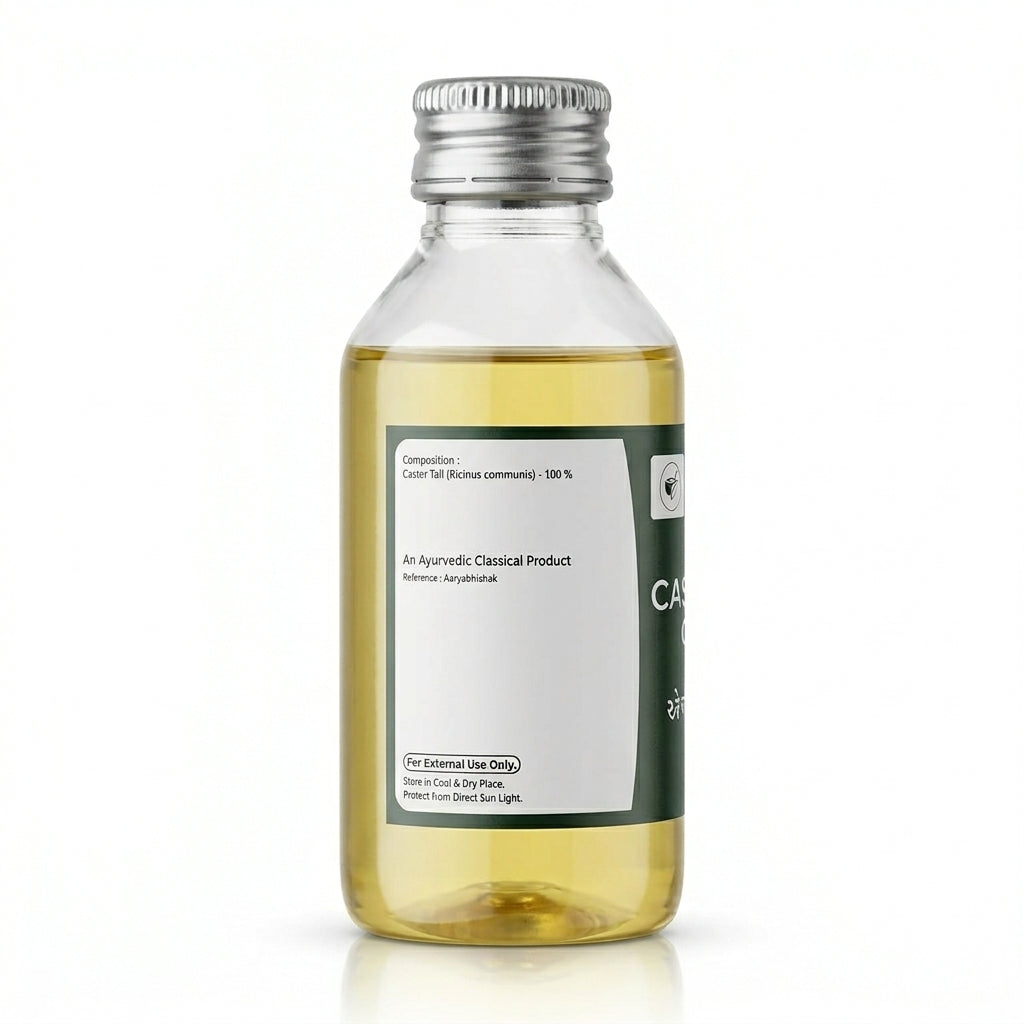
Castor Oil | Eranda Taila Divel | Riddhish Herbals | 100ml
Castor Oil | Eranda Taila Divel | Riddhish Herbals | 100ml
Couldn't load pickup availability
About Castor Oil (Eranda Taila)
Castor oil is the pale, viscous oil pressed from the seeds of Ricinus communis, known in Sanskrit as Eranda and in Gujarati as Divel. Ayurveda places it among the most valued Vata-pacifying oils — used externally for centuries as a daily oil for hair, scalp and skin, and internally, under guidance, as a classical Virechana (cleansing) and Anulomana (bowel-regularising) dravya. This 100ml bottle from Riddhish Herbals is a single-ingredient Ayurvedic classical preparation: 100% castor oil, referenced in the classical compendium Aaryabhishak.
Traditional Ayurvedic Importance
Eranda holds a settled place in the classical materia medica. Classical texts describe Eranda Taila as snigdha (unctuous), guru (heavy) and ushna (warming), and count it among the principal Vata-shamana (Vata-pacifying) and Anulomana (bowel-regularising) dravyas. Externally it has long been used in abhyanga, the Ayurvedic practice of oil massage, and for the hair and scalp. Internally, classical practice describes Eranda Taila as a gentle Virechana dravya taken under the care of a physician. This particular preparation is presented as an Ayurvedic classical product, with its reference drawn from the Aaryabhishak — a respected compendium of classical formulations.
Key Features
- Single-ingredient purity: 100% castor oil (Ricinus communis), with no added fragrance, colour or preservative.
- Classical reference: An Ayurvedic classical product, referenced in the Aaryabhishak.
- Rich in ricinoleic acid: Castor oil is naturally dominated by ricinoleic acid, the fatty acid behind its characteristic emollient feel.
- Hair and scalp care: Traditionally massaged into the scalp and along the lengths to support soft, well-conditioned hair.
- Skin nourishment: A traditional emollient for dry skin, lips, cuticles and rough patches such as heels and elbows.
- Traditional bowel wellness: Classically valued as a Virechana and Anulomana dravya for occasional bowel regularity, taken under physician guidance.
- Ricin-free oil: The toxic protein ricin stays in the seed residue and does not pass into pressed, clarified castor oil.
Ingredients
- Castor Oil — Ricinus communis (seed oil) — 100%
An Ayurvedic classical product. Classical reference: Aaryabhishak.
Research and Scientific References
Castor oil has been the subject of published phytochemical work that describes ricinoleic acid as its principal fatty-acid constituent, alongside oleic and linoleic acids (Shekade et al., 2024 — Phytochemical, Pharmacognostic and Pharmacological Aspects of Ricinus communis Seed Oil, Bentham Science). A cosmetic safety assessment reported that castor seed oil functions primarily as a skin-conditioning agent and that the oil itself does not contain ricin (Cosmetic Ingredient Review Expert Panel, 2007 — International Journal of Toxicology). Results observed under study conditions. Individual results may vary. Consult your Ayurvedic physician before use.
How to Use
External use. For hair and scalp: warm a small amount, massage into the scalp and lengths, leave for 30 minutes or overnight, then wash off. It blends well with lighter oils such as coconut or almond. For skin, lips and cuticles: apply a few drops as needed. For brows and lashes: comb a trace amount through with a clean spoolie, keeping it away from the eyes.
Internal use. As directed by your Ayurvedic physician. Classical references describe a small quantity (about 5–10 ml) taken at bedtime, traditionally with warm water or warm milk as anupan. Internal use should always be confirmed with a qualified physician, who will advise the appropriate dose and frequency.
Safety Information
For external use, do a patch test before first use, especially on sensitive skin, and keep the oil away from the eyes. For internal use, take only under the guidance of a qualified Ayurvedic physician. Do not take castor oil internally during pregnancy, as it can stimulate the uterus; pregnant and lactating women should not use it internally. Internal use is not advised for anyone with acute abdominal pain, intestinal obstruction or an inflammatory bowel condition. If you are taking any medication or managing a health condition, consult your physician before internal use. Keep out of reach of children. Results may vary from person to person.
Storage
Store in a cool, dry place and protect from direct sunlight, with the cap tightly closed. Stored well, castor oil keeps its quality across a long shelf life.
Frequently Asked Questions
Is this castor oil AYUSH or GMP certified?
Riddhish Herbals supplies genuine products with a bill provided. We do not add an AYUSH or GMP certification claim for this pack unless it is documented on the label.
Can I use castor oil without consulting a doctor?
External use on hair and skin is generally fine for adults after a patch test. For internal use as a laxative, please consult a qualified physician first.
What exactly is castor oil?
It is the seed oil of Ricinus communis, called Eranda Taila in Sanskrit and Divel in Gujarati — a single-ingredient pressed oil with no additives.
What are its other names?
Arandi ka tel (Hindi), Divel (Gujarati), Aamudam (Telugu), Aamanakku ennai (Tamil), Aavanakkenna (Malayalam), Haralenne (Kannada), Erandel tel (Marathi).
How is Riddhish Herbals castor oil different?
It is sold as a single-ingredient Ayurvedic classical product referenced in the Aaryabhishak, with correct regional naming and honest safety guidance — from a Gujarat store trusted since 2015.
Is it available at Riddhish Herbals?
Yes. This 100ml pack is in stock with pan-India delivery and a bill provided.
How should I store it?
Keep it in a cool, dry place away from sunlight with the cap closed.
What is the traditional anupan for internal use?
Classical practice pairs castor oil with warm water or warm milk, but the dose and anupan should be confirmed by your physician.
Can I use it on my eyebrows and eyelashes?
Yes — comb a trace amount through brows and lashes with a clean spoolie, taking care to keep it out of the eyes.
Does castor oil contain the toxin ricin?
No. Ricin remains in the seed residue and does not pass into the pressed, clarified oil, as noted in a published cosmetic safety assessment.
Has castor oil been studied scientifically?
Yes — published phytochemical reviews describe ricinoleic acid as its main fatty acid, and a cosmetic safety assessment notes it acts as a skin-conditioning agent. Results vary; consult your physician before use.
Regional Names
- Sanskrit: एरण्ड तैल (Eranda Taila)
- Hindi: अरंडी का तेल (Arandi ka tel)
- Gujarati: દિવ්ેલ (Divel) / એરંડિયું તેલ
- Marathi: एरंडेल तेल (Erandel tel)
- Bengali: রেড়ির তেল (Rerir tel)
- Tamil: ஆமຣக்கு எண்ຣெய் (Aamanakku ennai)
- Telugu: ఆముదం (Aamudam)
- Malayalam: ആവണക്കെണ്ണ (Aavanakkenna)
- Kannada: ಹರಳೆಣಣೆ (Haralenne)
- English: Castor Oil
- Botanical: Ricinus communis
Related from Riddhish Herbals
This is the same Erand (castor) that anoints our Erand Bhrust Harde Tablet (Gandharva Haritaki) — Haritaki roasted in castor oil for a dependable overnight laxative. Learn more in our guide, Erand Bhrust Harde (Gandharva Haritaki): Benefits, Uses & Dosage.