
Skip to product information
1 of 1

Riddhish Herbals

Gorakhmundi Akha (Mundi) – Sphaeranthus indicus Whole Herb – Riddhish Herbals – 100g

Gorakhmundi Akha (Mundi) – Sphaeranthus indicus Whole Herb – Riddhish Herbals – 100g

Regular price Rs. 70.00
Regular price Rs. 70.00 Sale price Rs. 70.00
Sale Sold out

Gorakhmundi Akha from Riddhish Herbals is whole, unmilled GorakhmundiSphaeranthus indicus L., family Asteraceae, Sanskrit Mundi or Munditika, the East Indian globe thistle — supplied in a 100 g pack. An earlier version of this page gave the botanical name as Tribulus terrestris and described the product as Gokhru whole fruit. That was wrong: Gorakhmundi and Gokhru are unrelated plants in different families, used for different things, and the error traces to a typo in the product name. The classical part is the panchanga, the whole plant, with the round flower heads as the premium graded article. Bhavaprakasha and Dhanvantari Nighantu place Mundi in the Guduchyadi varga; Charaka lists it as Shravani in the Madhuraskandha and Sushruta as Kulahala in the Surasadi gana. A five-second check settles which plant you have: Gorakhmundi is soft, round, purple-grey flower heads. Gokhru is small hard spiny burrs that hurt to squeeze.

A correction: this page named the wrong plant, and here is how to check

We would rather publish the correction than make it silently, and on this one we also want to hand you the means to check us.

This listing carried three different identities at once. Its web address says gorakhmundi. Its title said “Gokakhmudi Akha” — and Gokakhmudi is not a word in any Indian language; searched as an exact phrase it returns nothing. It is a typo of Gorakhmundi with one letter transposed and one dropped. And the title then gave the botanical name as Tribulus terrestris and called the product Gokhru whole fruit.

Those are two unrelated plants. Gorakhmundi is Sphaeranthus indicus, family Asteraceae, and the part used is the whole plant or its round flower heads. Gokhru is Tribulus terrestris, family Zygophyllaceae, and the part used is the spiny fruit. There is no tradition of confusing them and no adulteration literature linking them — they are simply different drugs. What appears to have happened is that someone met the garbled string “Gokakhmudi”, did not recognise it, pattern-matched “Go…u” to Gokhru, and confidently attached the botanical name and a whole cluster of gokshura tags. The web address and the product name both say Gorakhmundi; only the guessed botanical said otherwise.

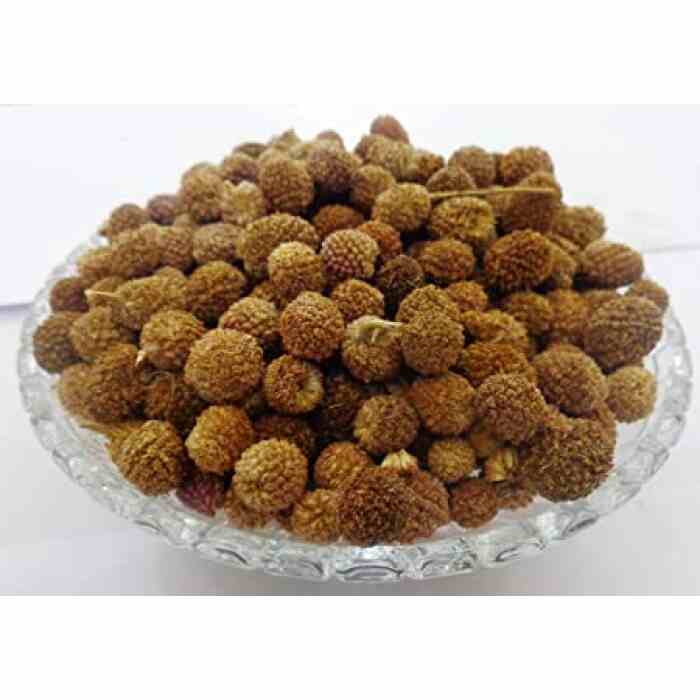
So here is the five-second test, and please do it. Open the pack and look. Gorakhmundi is small, soft, round purple-grey flower heads, six to twelve millimetres, on thin stalks, often with bits of leafy stem mixed in, and aromatic when crushed. Gokhru is small, hard, woody burrs that split into wedge-shaped nutlets, each armed with a pair of stiff sharp spines — it hurts to squeeze a handful. If yours stabs you, it is Gokhru and not what this page describes. Tell us and we will correct the listing and sort out your order.

About Gorakhmundi (Mundi)

Gorakhmundi is the East Indian globe thistle, a low herb of damp ground and rice-field margins whose flower heads are round, purple-grey and about the size of a pea. Sanskrit calls it Mundi or Munditika, and the classical nirukti given for the name is “Mundati khandayati gandadi rogan iti” — it cuts down glandular swellings.

Several of its Sanskrit synonyms are quietly poetic and all describe the same thing: Tapodhana, Bhikshu and Pravrajita all mean ascetic or mendicant, a reference to the shaven-head shape of the round flower head. Kadambapushpi and Bhukadambika compare it to the kadamba flower.

Its classical placement is well documented: Charaka has it in the Madhuraskandha as Shravani; Sushruta in the Surasadi gana as Kulahala; Ashtanga Hridaya in the Madhuraskandha; and the nighantus place it in the Guduchyadi varga (Dhanvantari and Bhavaprakasha), the Haritakyadi varga (Madanapala), the Parpatadi varga (Raja Nighantu) and the Aushadhi varga (Kaiyadeva). Its rasa panchaka is recorded as tikta and katu, laghu and ruksha, ushna in virya, katu in vipaka, tridoshashamaka and rasayana.

Classical formulations carrying Mundi include Mahamanjishthadi Kwatha, Mahavishagarbha Taila and Vatagajankusha Rasa.

Key Features

  • The botanical name on this page has been corrected: it previously read Tribulus terrestris and described the product as Gokhru whole fruit. This is Sphaeranthus indicus — Gorakhmundi, Mundi — and the five-second check to confirm it is set out above.
  • “Gokakhmudi” is not a word: searched as an exact phrase in any Indian language it returns nothing. It is a typo of Gorakhmundi, and it is the reason the wrong botanical name got attached.
  • Akha means whole: this is unmilled material, which is exactly why the identity check above is possible — a churna could not be checked by eye.
  • Well documented classically: Charaka's Madhuraskandha as Shravani, Sushruta's Surasadi gana as Kulahala, and the Guduchyadi varga of both the Dhanvantari and Bhavaprakasha Nighantus.
  • The name means what it does: the classical nirukti is “Mundati khandayati gandadi rogan iti” — it cuts down glandular swellings.
  • Ten languages, native script verified: the regional names below are published in script where two independent sources agreed, and romanised only where they did not.
  • Genuine, doctor-guided sourcing: bill provided with every pack; a store trusted since 2015, with pan-India delivery.

Research on the Constituents

No PMID is asserted on this page. NCBI returns a bot-check to us, so no PubMed record was opened while this page was built and nothing is attributed to any authors by identifier. There is a published classical-review literature on Mundi — including reviews in Indian Ayurvedic journals compiling its nighantu placement and classical uses — and that is where the text-and-chapter references on this page come from. Google Scholar — Sphaeranthus indicus / Mundi.

A gap we will not paper over: we found no dedicated pregnancy-safety study for Sphaeranthus indicus, and the sources that say no adverse effects are reported are reporting an absence, which is not the same as evidence of safety. The pregnancy note on this page is precaution, and we are labelling it as such. Individual results may vary. Consult your Ayurvedic physician before use.

Results were observed under study conditions. Individual results may vary. This is shared for general educational interest and is not a medical claim. Consult your Ayurvedic physician before use.

Composition (label-verified)

Ingredient Botanical Part Quantity
Gorakhmundi / Mundi — whole (akha) Sphaeranthus indicus L., family Asteraceae Panchanga — the whole plant; the round flower heads are the premium graded article. Not Tribulus terrestris fruit Single material, 100 g net; whole, unmilled

One material: whole Gorakhmundi, unmilled. Nothing is blended into it.

Label not verified, and the identity is checkable by you. No physical pack label was read when this page was built, and this listing previously carried a different botanical name. Because the material is akha — whole — you can settle it yourself in seconds: soft round purple-grey flower heads means Gorakhmundi; hard spiny burrs that hurt to squeeze means Gokhru. If your pack is the second one, please tell us.

A note on the image. The photograph on this listing carries a filename originating from a marketplace CDN rather than from our own photography, so we do not know what it actually shows and we have deliberately left its alt text blank rather than describe it as ours. It is queued for replacement with our own photograph of the actual stock.

How to Use

As directed by your Ayurvedic physician.

The recorded classical amounts are 1–2 g of the flower-head powder, 10–20 ml of the fresh juice (swarasa), or 50–100 ml of a decoction (kwatha). This pack is whole material, so a decoction or a freshly ground powder are the usual routes.

Anupana: as your physician directs; warm water is usual for the decoction.

Who Can Use It

Adults, on the direction of a qualified Ayurvedic physician.

Pregnancy and breastfeeding: ask your physician first — and here is why we say it. We found no dedicated pregnancy-safety study for Sphaeranthus indicus. The sources that report no adverse effects are reporting an absence, and an absence of recorded harm is not evidence of safety. This note is precaution and we would rather label it honestly than dress it up as a finding.

Children: only on a physician's direction, at a quantity they set.

Safety Information

Label not verified. No physical pack label was read when this page was built, and this listing previously carried the wrong botanical name. The printed label is the final authority — and because this material is whole rather than milled, the five-second check described above will also tell you.

No dedicated pregnancy-safety data exists for Sphaeranthus indicus that we could find. Ask your physician before use if you are pregnant or breastfeeding. We are labelling that as precaution rather than as a finding, because that is what it is.

If your pack contains spiny burrs rather than soft round flower heads, it is not the material this page describes. Do not use it on the strength of this page — tell us instead and we will correct both the listing and your order.

General. Consult your physician before use if you are pregnant, lactating, taking any medication, or managing any health condition. Keep out of reach of children. Results may vary from person to person.

Storage

Store in a cool, dry place away from direct sunlight, in a tightly closed airtight container. Whole material keeps its character considerably longer than powder, which is one of the advantages of buying it akha. Keep out of reach of children.

Frequently Asked Questions

What is Gorakhmundi?

Sphaeranthus indicus L., family Asteraceae — the East Indian globe thistle, Sanskrit Mundi or Munditika. A low herb of damp ground whose round purple-grey flower heads are the premium graded trade article; the classical part is the panchanga, the whole plant.

Why did the botanical name on this page change?

Because the old one named a different plant. The page previously said Tribulus terrestris and called the product Gokhru whole fruit. Gorakhmundi and Gokhru are unrelated — different families, different parts, different uses — and there is no adulteration literature linking them. The error traces to the title's “Gokakhmudi”, which is not a word in any Indian language; someone pattern-matched it to Gokhru and attached the wrong binomial.

How do I tell Gorakhmundi from Gokhru myself?

In about five seconds, because this material is whole. Gorakhmundi is small, soft, round purple-grey flower heads, six to twelve millimetres, on thin stalks, aromatic when crushed. Gokhru is small, hard, woody burrs with pairs of stiff sharp spines — it hurts to squeeze a handful. If yours stabs you, it is Gokhru. Tell us and we will put it right.

Is "Gokakhmudi" a real word?

No. Searched as an exact phrase it returns nothing in any Indian language. It is Gorakhmundi with one letter transposed and one dropped. It is not a corruption of “Gokharu” either — that would need a different set of changes and would not leave the -mundi ending intact.

What does the classical literature say about Mundi?

The nirukti given for the name is “Mundati khandayati gandadi rogan iti” — it cuts down glandular swellings. Charaka has it in the Madhuraskandha as Shravani, Sushruta in the Surasadi gana as Kulahala, and the nighantus place it in the Guduchyadi varga. We give that as a record of the classical literature, with the texts named, and not as a promise of any outcome for you.

Why are its Sanskrit names about monks?

Because of the shape. Tapodhana, Bhikshu and Pravrajita all mean ascetic or mendicant, and they refer to the shaven-head look of the round flower head. Kadambapushpi and Bhukadambika compare it instead to the kadamba flower. Classical naming was often this observant.

How much should I use?

As your Ayurvedic physician directs. The recorded classical amounts are 1–2 g of the flower-head powder, 10–20 ml of fresh juice, or 50–100 ml of a decoction. This pack is whole material, so a decoction or a freshly ground powder are the usual routes.

Is it safe in pregnancy?

Ask your physician first. We found no dedicated pregnancy-safety study for Sphaeranthus indicus, and the sources that say no adverse effects are reported are reporting an absence rather than a finding. We would rather tell you that than offer a reassurance we have not earned.

What are the regional names?

Gujarati ગોરખમુંડી; Hindi मुण्डी and गोरखमुंडी; Marathi मुंडी, गोरखमुंडी, खडकशेपू; Bengali মুরমুরিযা; Tamil கொட்டைக்கரந்தை; Telugu బోడతరము; Kannada ಮುಂಡಿ; Malayalam മിരംഗനീ. Those are published in native script because two independent sources agreed on each. Oriya, Urdu and Punjabi are romanised only, because the sources disagreed on their scripts and we do not publish script we have not checked.

Why does the photograph look like a marketplace image?

Because its filename came from a marketplace CDN rather than from our own photography. We do not know what it actually shows, so we have deliberately left its alt text blank instead of describing it as ours, and it is queued for replacement with our own photograph of the actual stock. We would rather admit that than caption someone else's picture.

Is this AYUSH or GMP certified?

This pack is supplied under Riddhish Herbals' own label. Any AYUSH Standard Mark or GMP mark appears on the physical pack, and we state such marks only where they are verified on the pack itself.

Is it available at Riddhish Herbals?

Yes — Gorakhmundi Akha 100 g is in stock at riddhishherbals.com and at our Gujarat retail stores, with pan-India delivery, a proper bill and doctor-guided selection since 2015.

Regional Names & Spelling Variants

Language Name
Local / common name (Gujarat) ગોરખમુંડી (Gorakhmundi) — native script verified. Gujarati has no separate indigenous word here; it uses the pan-North-Indian name.
Sanskrit Mundi · Munditika · Mahamundi · Shravani · Alambusha · Kadambapushpi · Bhukadambika · Tapodhana · Bhikshu · Pravrajita · Shravanashirshika · Kuhalaka · Palankasha · Tapasvini. Romanised only. Note the poetry: Tapodhana, Bhikshu and Pravrajita all mean ascetic or mendicant — a reference to the shaven-head shape of the round flower head.
Hindi मुण्डी · गोरखमुंडी (Mundi, Gorakhmundi) — native script verified
Marathi मुंडी · गोरखमुंडी · खडकशेपू (Mundi, Gorakhmundi, Khadakshepu) — verified
Bengali মুরমুরিযা (Murmuriya) · Chagul-nadi — verified
Tamil கொட்டைக்கரந்தை · விஷ்ணுகரந்தை (Kottai-k-karantai, Vishnu-karantai) — verified
Telugu బోడతరము · శ్రావణి (Boddatarapu, Shravani) — verified
Kannada ಮುಂಡಿ · ಬೋಳತರ · ನೆಲಗಡವ (Mundi, Bolatara, Nelagadava) — verified
Malayalam മിരംഗനീ · അടയ്ക്കമണിയന്‍ (Mirangani, Adaykkamaniyan) — verified
Konkani गोरखमुण्डी (Gorakhmundi) — verified, single source
Oriya · Urdu · Punjabi Buikadam · Gul-mundi, Kamdaryus · Gorakhmundi. Romanised only — sources disagreed on the scripts, so none is published.
English + Botanical + part East Indian globe thistle · Indian sphaeranthus — Sphaeranthus indicus L., family Asteraceae. Part: panchanga, the whole plant, classically; the flower heads are the premium graded trade article and are sold separately.
Romanised search variants gorakhmundi · gorakh mundi · mundi · munditika · mundi buti · gorakhmundi akha · sphaeranthus indicus · east indian globe thistle
Common misspellings gokakhmudi (the form previously on this page — not a word) · gorakmundi · gorak mundi · gorkhmundi

Related at Riddhish Herbals

Since 2015Genuine ProductsBill ProvidedDoctor-Guided Selection4000+ Ayurvedic Products130+ Trusted BrandsPan-India Delivery
રીધ્ધીશ હર્બલ્સ — ગુજરાતનો વિશ્વાસપાત્ર આયુર્વેદિક સ્ટોર, જ્યાં સાચી સલાહ અને genuine Ayurvedic products એક જ જગ્યાએ મળે છે.
View full details
%}