

Riddhish Herbals
Shalmali Kantak Churna (Thorn & Bark) | Bombax ceiba | Riddhish Herbals
Shalmali Kantak Churna (Thorn & Bark) | Bombax ceiba | Riddhish Herbals
Couldn't load pickup availability
Shalmali Kantak Churna — Genuine Thorn & Bark Mukhalepa Powder
Shalmali Kantak Churna from Riddhish Herbals is a single-source Ayurvedic face-pack (mukhalepa) powder milled from the thorns (Kantak) of the Shalmali tree together with the stem bark (Twak) they grow from — botanically Bombax ceiba, the Red Silk Cotton Tree (Semal). On the living tree the firm conical thorns erupt directly from the bark and stay anchored in it, so a genuine churna naturally carries both. It is meant for external application as a traditional lepa, classically described for Mukhadushika — the condition Acharya Sushruta likened to eruptions resembling Shalmali thorns, and which modern texts correlate with acne vulgaris.
About Shalmali Kantak Churna
The Shalmali tree is one of India's most recognisable trees — tall, robust, and studded along its trunk and branches with the firm conical thorns that give this churna its name. In Ayurveda, both the thorn (Kantak) and the stem bark (Twak) of Bombax ceiba hold a long-documented place in Lepa Kalpana, the classical science of medicated external pastes. This powder is milled from the thorns along with the bark they emerge from, and sieved to a smooth, blendable texture made for face-pack preparation.
Riddhish Herbals offers it as a single-source raw material — no fillers, no fragrance, no chemical additives and no substitute species. It is sold by weight in 100 g, 200 g, 500 g and 1 kg packs and dispatched with a proper bill from our Gujarat stores, where we have selected genuine Ayurvedic raw materials for customers across India since 2015.
Why Shalmali Is Valued in Classical Skincare
Shalmali appears across the classical canon. Bhavaprakasha Nighantu places it in the Guduchyadi Varga, records its Sanskrit synonyms — Kantakadhya (the thorn-bearing one), Mocha, Raktapushpa, Picchila, Sthirayu and Tulaphala — and credits the herb with kandughna (anti-itch) and vrana-ropana (wound-supporting) qualities. In the Sushruta Samhita, the very definition of Mukhadushika (also called Yuvanpidika or Tarunyapidika) is built on this tree: the eruptions are described as Shalmali-kantaka-sadrusha pidika — pustules shaped like the thorns of Shalmali.
By Ayurvedic guna-karma, Shalmali bark and thorn are regarded as Sheeta (cooling in potency) and Kashaya (astringent), traditionally associated with pacifying aggravated Pitta and Rakta — the factors classical texts connect with Mukhadushika (Charaka Samhita, Sutrasthana 27). The thorn is the part carried into the classical acne lepa of Chakradatta's Kshudrarogadhikara, while the stem bark is the part formally recorded in The Ayurvedic Pharmacopoeia of India for the same traditional context.
Thorn & Bark Together: The Genuine Article, Not Adulteration
On the Shalmali tree, the conical thorns (Kantak) are not separate growths — they erupt directly from the stem bark (Twak) and stay fused to it. Cleanly separating a thorn tip from its bark base is impractical, so the authentic Shalmali Kantak churna found in the market is, by its very nature, a thorn-and-bark (Kantak + Twak) powder. We state this openly, because it is the honest botanical picture rather than a marketing simplification.
Far from diluting the churna, the bark is a recognised medicinal part in its own right. The Ayurvedic Pharmacopoeia of India (Part I) records Shalmali stem bark with traditional use described for Yuvanapidika (the classical correlate of acne), alongside Raktapitta, Vrana and Daha. Modern pharmacognosy agrees: a published review by the Faculty of Ayurveda, IMS-BHU, notes that the extract of both the bark and the thorns showed anti-acne activity against the bacteria associated with acne under laboratory conditions.
The genuine concern in this trade is the opposite of bark inclusion. Classical dravyaguna literature flags the true adulteration as substitution with unrelated species — such as Sterculia and Ceiba — in powdered bark or gum. Our material is whole Bombax ceiba thorn-with-bark from a single tree: the real source, simply milled and sieved for face-pack use.
Key Features
Genuine Bombax ceiba thorn with its own stem bark — no fillers, fragrance, or substitute species.
Kantak (thorn) and Twak (bark) are both classically and pharmacopoeially recognised parts of Shalmali.
Milled and sieved specifically for smooth face-pack (lepa) preparation.
Documented in Sushruta Samhita, Bhavaprakasha Nighantu, Chakradatta and the API.
Sheeta-virya and Kashaya-rasa, as described in classical Nighantu literature.
100 g, 200 g, 500 g and 1 kg — from first trial to clinic and salon use.
Selected raw material, dispatched with a proper invoice from our Gujarat store since 2015.
Ingredient & Composition
| Ingredient (Sanskrit / label name) | Botanical | Plant part used | Quantity |
|---|---|---|---|
| Shalmali Kantak with Shalmali Twak | Bombax ceiba Linn. | Kantak (thorn) with Twak (stem bark) | Single source (sole part) |
Other ingredients: None. No fillers, excipients, preservatives, fragrance, or any substitute plant species. Both the thorn and the bark come from the same Bombax ceiba tree.
How to Use — Traditional Mukhalepa Method
As directed by your Ayurvedic physician. For traditional external application, take about one teaspoon of Shalmali Kantak Churna and mix it with a suitable anupan into a smooth, lump-free paste. Apply a thin, even layer over cleansed skin, avoiding the eyes and lips. Leave for 15–20 minutes, then rinse with lukewarm water. Used 2–3 times a week, or as advised.
| Anupan (mixing vehicle) | Traditionally chosen for |
|---|---|
| Rose water (Gulab Jal) | Sensitive or warm/Pitta-prone skin |
| Plain water | Everyday general use |
| Raw milk | Dry skin, added nourishment |
| A few drops of honey | Extra skin comfort and binding |
For external use only. Do not consume. Always patch-test on the inner forearm before first full-face use.
Who Can Use It
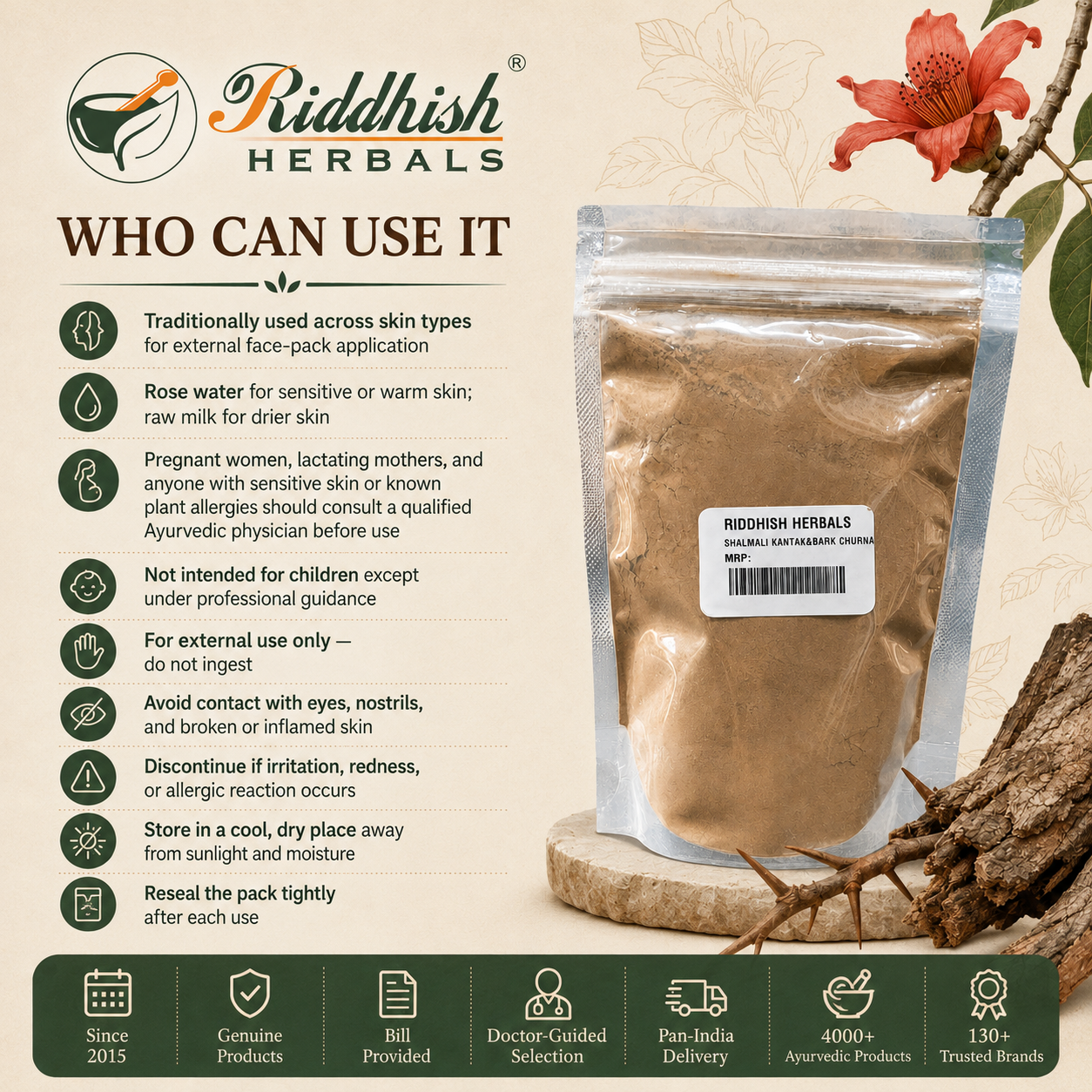
As a classical mukhalepa, Shalmali Kantak Churna has traditionally been used across skin types for external face-pack application, with the anupan adjusted to suit — rose water for sensitive or warm skin, raw milk for drier skin. Pregnant women, lactating mothers, and anyone with sensitive skin or known plant allergies should consult a qualified Ayurvedic physician before use and always patch-test first. It is not intended for children except under professional guidance.
Research & Classical References
The classical correlate of acne, Yauvanapidika / Mukhadushika, has been the subject of published clinical study. In a hospital study at Gujarat Ayurved University, Jamnagar, a Shalmali-thorn-based external lepa (Shalmalyadi Lepa, drawn from Chakradatta) was applied over the affected facial area in participants with Yauvanapidika and assessed under study conditions. — (Pampaniya PV & Pandya DH, 2013 — Ayu, 34(2):174–179; PMID 24250126)
A published review of Shalmali's therapeutics records that the alcoholic extract of both the bark and the thorns of Bombax ceiba showed anti-acne activity against the bacterium associated with acne under laboratory conditions, and notes that the stem bark is listed in The Ayurvedic Pharmacopoeia of India for this traditional use. — (Meena V & Chaudhary PH, 2017 — International Journal of Green Pharmacy, Faculty of Ayurveda, IMS-BHU, Varanasi)
Classically, Acharya Charaka noted the styptic and astringent qualities of Shalmali, and the use of its thorn and bark in skin-directed external preparations is recorded across the Kshudraroga literature and the Nighantus.
Findings noted in study conditions. Individual results may vary. Consult your Ayurvedic physician before use. This is a single-source raw material for external use only.
Safety Information
For external use only — do not ingest. Patch-test on a small area of skin before regular use and discontinue if irritation, redness, or any allergic reaction occurs. Avoid contact with the eyes, nostrils, and broken or inflamed skin. Pregnant women, lactating mothers, and anyone with known plant allergies should consult a qualified Ayurvedic physician before use. This information is educational and is not a substitute for professional medical advice. Keep out of reach of children. Results may vary from person to person.
Storage
Store in a cool, dry place away from direct sunlight and moisture. Reseal the pack tightly after each use. Use within the period specified on the pack label.
Frequently Asked Questions
What is Shalmali Kantak Churna?
It is a finely milled single-source Ayurvedic powder made from the thorns (Kantak) of the Shalmali tree together with the stem bark (Twak) they grow from, botanically Bombax ceiba (Red Silk Cotton Tree, Semal). It is prepared as a traditional mukhalepa — a face-pack powder for external application — and is classically referenced for Mukhadushika, the Ayurvedic correlate of acne.
Does this churna contain only the thorn, or also the bark?
Both — and that is by design. On the Shalmali tree the thorns grow straight out of the stem bark and stay attached to it, so a genuine churna is naturally a thorn-and-bark (Kantak + Twak) powder. Both parts are recognised in classical Ayurveda and in the Ayurvedic Pharmacopoeia of India, so nothing is lost by including the bark — it is part of the authentic material.
Is the presence of bark a sign of adulteration?
No. The bark is a genuine, recognised part of the same Shalmali tree, not a foreign filler. In this trade the real adulteration is substitution with unrelated species such as Sterculia or Ceiba in powdered bark or gum. Our churna is whole Bombax ceiba thorn-with-bark from a single source, which is the authentic, honest form of the material.
How do I use it as a face pack?
Mix about one teaspoon with rose water, plain water, milk or a little honey into a smooth paste. Apply a thin layer to clean skin, leave 15–20 minutes, and rinse with lukewarm water, 2–3 times a week. Patch-test before the first full-face use.
Is this AYUSH or GMP certified?
This is a single-source raw herb selected and packed by Riddhish Herbals, which has run retail Ayurvedic stores in Gujarat since 2015 and ships every order with a proper bill. For specific certification queries on a given batch, please contact us directly.
What are the alternate names of Shalmali?
Also known as Semal / Semar (Hindi), Shimul (Bengali), Ilavu (Tamil/Malayalam), Buruga (Telugu), Savar (Marathi), Shemalo (Gujarati) and Silk Cotton Tree in English. Sanskrit synonyms include Kantakadhya, Mocha, Raktapushpa, Picchila, Sthirayu and Tulaphala. Spelling variants: Salmali, Shalmali Kantaka, Shalmali Kanta, Shalmali Kantak Churn.
How is the Riddhish Herbals version different?
We stock it as a pure single-source raw herb — not a branded multi-ingredient cream or formulation, and not blended with substitute species. It is freshly weighed into 100 g, 200 g, 500 g and 1 kg packs, dispatched with a proper bill from our Gujarat store, and curated through our doctor-guided selection process.
Can I take this internally?
No. This product is prepared and packed as an external-use churna for skin lepa application. Do not ingest. For internal Shalmali preparations, please consult a qualified Ayurvedic physician.
Which skin types is it suitable for?
As a classical mukhalepa it has traditionally been used across skin types, with the anupan adjusted to suit — rose water for sensitive or warm skin, milk for drier skin. A patch test before first use is always recommended.
What is the recommended anupan?
For external application, rose water is the most popular choice. Plain water, raw milk, or a few drops of honey may also be used depending on individual skin tendency.
Has Shalmali been studied scientifically?
Yes. Bombax ceiba thorn and bark have featured in peer-reviewed work, including a clinical study at Gujarat Ayurved University, Jamnagar (Pampaniya & Pandya, 2013, Ayu; PMID 24250126) and a review noting anti-acne activity of bark-and-thorn extract from IMS-BHU (Meena & Chaudhary, 2017). Results were observed in study conditions and individual outcomes may vary.
Regional Names & Spelling Variants
- Local / common name: Semal (Semar) — the vernacular most buyers search across North and Central India
- Sanskrit: शाल्मली (Shalmali), कण्टक (Kantaka) — synonyms: Kantakadhya, Mocha, Raktapushpa, Picchila, Sthirayu, Tulaphala
- Hindi: सेमल (Semal), Semar, Semal Kanta
- Gujarati: શેમળો (Shemalo), Shemalo Kanto
- Marathi: Savar (Savar Kata)
- Bengali: Shimul (Shimul Kanta)
- Tamil: Ilavu (Ilava Mul)
- Telugu: Buruga (Buruga Mullu)
- Malayalam: Ilavu (Ilavu Mullu)
- English + Botanical: Red Silk Cotton Tree Thorn & Bark — Bombax ceiba Linn. (syn. Salmalia malabarica, Bombax malabaricum) — Family: Malvaceae (Bombacaceae) — part: Kantak (thorn) with Twak (stem bark)
- Romanised search variants: Shalmali Kantak Churna, Semal Kantak Powder, Bombax ceiba thorn bark powder, Silk Cotton Tree churna
- Common misspellings: Shalmali Kantka, Shalmali Kanta, Salmali Kantak, Shalmali Kantaka Churn, Shalmali Kantik Churna
Native-script names shown (Sanskrit/Devanagari, Hindi, Gujarati) are verified; other languages are given in romanised form only.
Complete Your Ayurvedic Skincare Ritual
Shalmali Kantak Churna blends beautifully into a classical face-pack routine. Customers often pair it with:
Riddhish Herbals — Gujarat's trusted Ayurvedic store since 2015. Genuine products, bill provided, doctor-guided selection, 4000+ Ayurvedic products, 130+ trusted brands, pan-India delivery. For external use only. Use under the guidance of a qualified Ayurvedic physician. Results may vary from person to person.
રીધ્ધીશ હર્બલ્સ — ગુજરાતનો વિશ્વાસપાત્ર આયુર્વેદિક સ્ટોર, જ્યાં સાચી સલાહ અને genuine Ayurvedic products એક જ જગ્યાએ મળે છે.