

Riddhish Herbals
Senna Leaf Powder (Sonamukhi) 100g | Cassia angustifolia | Riddhish Herbals
Senna Leaf Powder (Sonamukhi) 100g | Cassia angustifolia | Riddhish Herbals
Couldn't load pickup availability
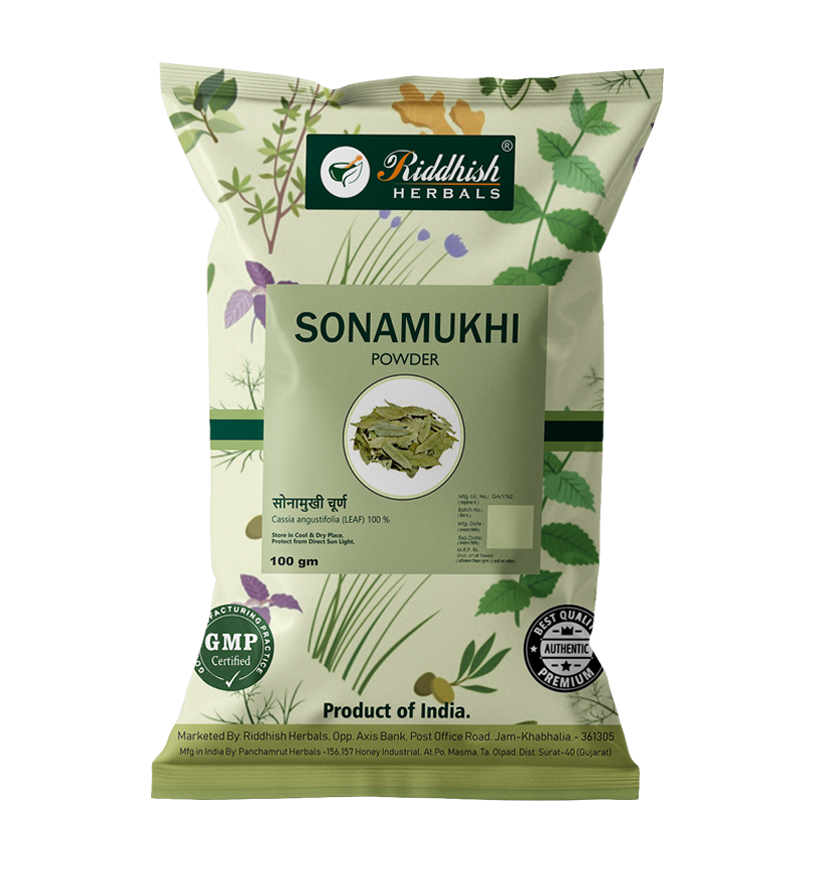
Sonamukhi Powder (सोनामुखी चूर्ण) by Riddhish Herbals is a single-herb powder of Senna leaf, Cassia angustifolia (Leaf) 100%, in a 100 g pack. Known as Sanay in Hindi, Sonamukhi in Gujarati and Svarnapatri in Sanskrit, Senna leaf has long been used in Ayurveda and Indian homes as a traditional laxative for occasional constipation. Dose: as directed by the Ayurvedic physician. Supplied by Riddhish Herbals, Gujarat’s Ayurvedic store since 2015, with a bill on every order.
About Sonamukhi and Its Traditional Ayurvedic Importance
Sonamukhi is the dried leaf of Indian Senna, Cassia angustifolia, a small shrub cultivated widely in South India and Gujarat, ground into a fine green powder. The name means “golden-faced”, after the golden-yellow flowers of the plant. Senna leaf has a place in Ayurvedic, Unani and household practice alike as a dependable traditional laxative, used when the bowels need occasional help rather than as a daily herb.
In Ayurvedic Dravyaguna the plant is known as Svarnapatri and Markandika, and it is grouped among the Rechana (purgative) dravyas:
- Rechana: traditionally used to encourage a bowel movement when stool is hard or irregular.
- Vatanulomana: described as supporting the natural downward movement of Vata in the digestive tract.
- Ushna virya: warming in potency, which is why it is often balanced with a carminative herb.
The leaf’s action comes from sennosides, natural plant compounds that work in the large intestine. Traditional practice has always kept Senna as a focused, occasional herb, and has paired it with dry ginger (Sunth) or fennel (Saunf) to keep its action smooth and comfortable. Several classical and household laxative churnas carry Senna leaf for the same reason.
Key Features
- Single herb, 100%: Cassia angustifolia (Leaf) 100%, nothing else added to the formula.
- Traditional laxative: Senna leaf is one of the best-known Rechana herbs, used for occasional constipation.
- Supports bowel regularity: traditionally used to support the natural downward movement (Vatanulomana) of the digestive tract.
- Flexible powder form: the quantity can be set by your physician to suit you, and it blends easily with Sunth or Saunf.
- Occasional-use herb: traditionally kept for short-term use, taken at bedtime with warm water.
- Clear Sanskrit identity: Svarnapatri or Markandika in Ayurvedic Dravyaguna, Sanay or Sonamukhi in Hindi.
- Riddhish Herbals own brand: manufactured by Panchamrut Herbals, a GMP-, ISO 9001:2015- and HACCP-certified manufacturer, Mfg. Lic. No. GA/1762.
- Genuine and billed: 100 g pack, supplied by Riddhish Herbals since 2015, with a bill on every order and pan-India delivery.
Composition (each pack contains)
Sonamukhi Powder is a single-herb powder of dried Senna leaf. Ingredients:
| Ingredient | Botanical name | Part | Quantity |
|---|---|---|---|
| Sonamukhi (Senna, Svarnapatri) | Cassia angustifolia | Leaf | 100% |
Pack: 100 g · Form: Powder (churna) · Mfg. Lic. No.: GA/1762 · Manufactured by Panchamrut Herbals. Marketed by Riddhish Herbals. Product of India.
How to Use
Dose: As directed by the Ayurvedic physician.
In traditional practice, a small quantity of Sonamukhi powder is taken with warm water at bedtime, so that its action shows by the next morning. It is commonly mixed with a pinch of dry ginger (Sunth) or fennel (Saunf) powder to keep the action smooth and avoid griping. Senna is kept for occasional, short-term use; your physician will set the quantity, timing, number of days and vehicle that suit you.
Safety, Storage & Pack Information
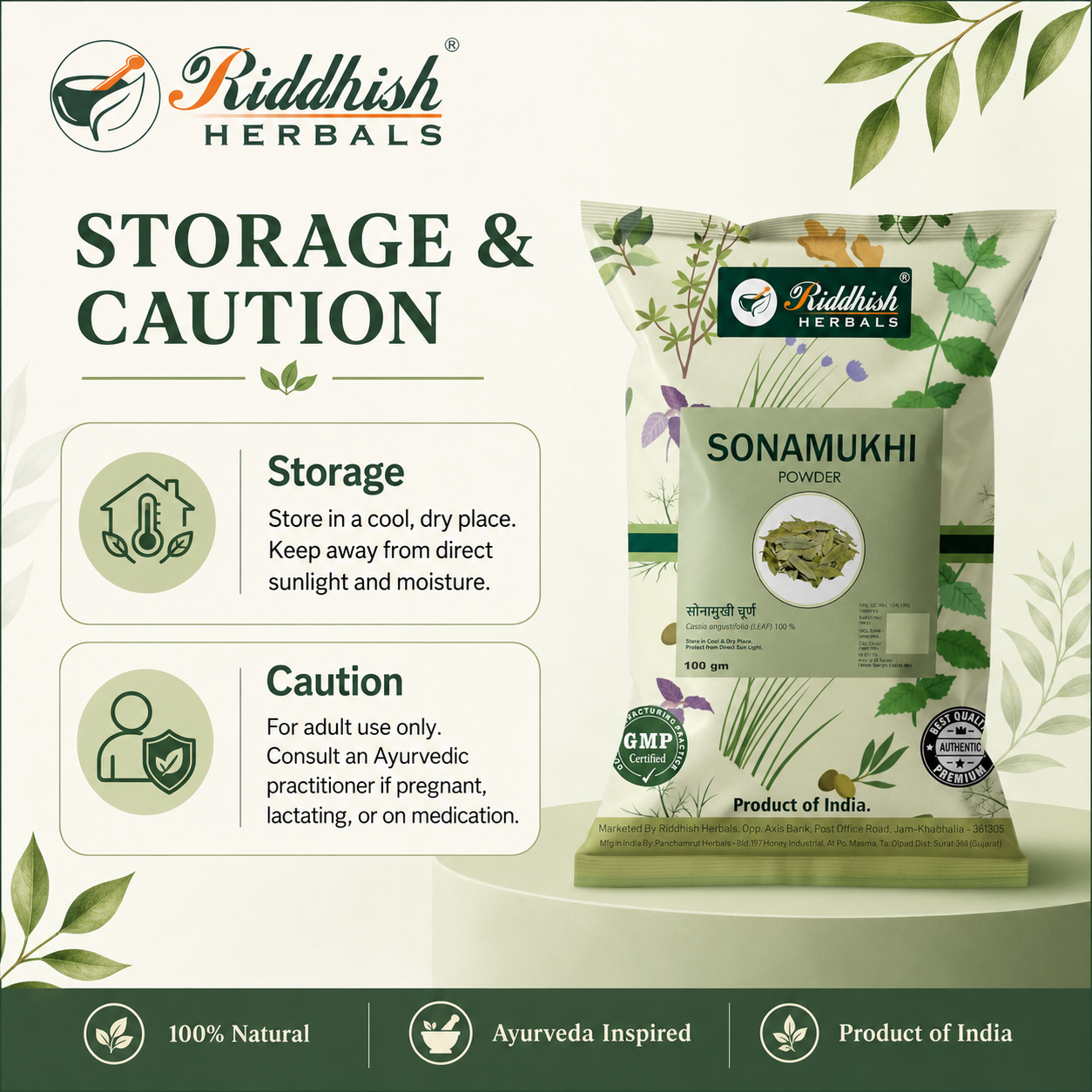
Use under the guidance of a qualified Ayurvedic physician. Senna leaf is a stimulant laxative: use it occasionally and for a short period, and do not continue it regularly without your physician’s advice. Consult your physician before use, especially if you are pregnant, lactating, taking any medication, or managing any medical condition, and do not use it if you have abdominal pain of unknown cause. Cramping or loose stools mean the quantity is too high; stop use and consult your physician. Drink enough water while using it. For children, use only as directed by a physician. Keep out of reach of children. Results may vary from person to person.
Storage: Store in a cool and dry place. Protect from direct sunlight. Close the pack well after each use to keep the powder dry.
Pack: 100 g. Check the batch number, manufacturing date and expiry date on your pack before use.
Ingredient Names in Hindi, Gujarati and Sanskrit
| Ingredient | Hindi | Gujarati | Sanskrit | English — Botanical |
|---|---|---|---|---|
| Sonamukhi | सोनामुखी, सनाय (Sonamukhi, Sanay) | સોનામુખી, મીંઢીઆવળ (Sonamukhi, Mindhiaval) | स्वर्णपत्री (Svarnapatri), Markandika | Indian Senna — Cassia angustifolia |
Also searched as: Sonamukhi Powder, Sonamukhi Churna, Sunamukhi Powder, Sonamakhi Powder, Senna Leaf Powder, Senna Powder, Indian Senna, Tinnevelly Senna, Sanay Patti, Sana Makki, Svarnapatri, Swarnapatri, Markandika, Mindhiaval, Mindhi Aaval, Cassia angustifolia Powder, Senna alexandrina, Nilavarai, Nelatangedu.
Frequently Asked Questions
What is Sonamukhi Powder?
Sonamukhi Powder (सोनामुखी चूर्ण) by Riddhish Herbals is a single-herb powder of Senna leaf, Cassia angustifolia (Leaf) 100%, in a 100 g pack. Sonamukhi, also called Sanay in Hindi and Svarnapatri in Sanskrit, is one of the best-known traditional laxative herbs of Ayurveda and Indian household practice.
What does this pack contain?
Ingredients: Cassia angustifolia (Leaf) 100%. Net weight: 100 g.
What is the dose of Sonamukhi Powder?
Dose: As directed by the Ayurvedic physician. Senna leaf is a stimulant laxative, so the quantity, timing and number of days should be set by your physician for your own needs.
How is Sonamukhi traditionally taken?
In traditional practice, a small quantity of Sonamukhi powder is taken with warm water at bedtime, so that its action shows by the next morning. It is often combined with a carminative such as dry ginger (Sunth) or fennel (Saunf) to keep the action smooth and avoid griping. Your physician will advise the quantity and vehicle that suit you.
Can Sonamukhi be taken every day?
Sonamukhi is traditionally used as an occasional, short-term laxative, not as an everyday supplement. Regular, long-term use should only be under the advice of a physician. For day-to-day digestive comfort, your physician may suggest a gentler routine of diet, water, activity and milder formulations.
How is Sonamukhi described in classical Ayurveda?
In Ayurvedic Dravyaguna, Senna leaf is known as Svarnapatri and Markandika and is grouped among the Rechana (purgative) dravyas. It is described as warming (Ushna) in potency, with an action that supports Vatanulomana, the natural downward movement of Vata, and easy passage of stool.
Is it suitable during pregnancy, while breastfeeding, for children or with other medicines?
Sonamukhi is not taken during pregnancy or while breastfeeding unless a physician specifically advises it. For children, use only as directed by a physician. Anyone taking regular medication, or with abdominal pain of unknown cause or an ongoing digestive concern, should consult a physician before use.
Who manufactures and markets this Sonamukhi Powder?
Manufactured by Panchamrut Herbals (Mfg. Lic. No. GA/1762). Marketed by Riddhish Herbals, Khambhalia, Gujarat.
Is this product GMP certified?
Panchamrut Herbals, the manufacturer of this product, holds GMP, ISO 9001:2015 and HACCP certification. Good manufacturing practice (GMP) relates to how the product is made; these are not claims about any medical outcome.
How do I know this is the genuine pack?
A genuine pack has the Riddhish Herbals logo, the name Sonamukhi Powder with सोनामुखी चूर्ण in Hindi, Cassia angustifolia (Leaf) 100%, Mfg. Lic. No. GA/1762, a 100 gm net weight, and its own batch number, manufacturing date and expiry date. Every order from Riddhish Herbals ships with a proper bill, and our team can help you confirm the pack you received.
What are the other names of Sonamukhi?
Sonamukhi is also written Sona Mukhi, Sunamukhi or Sonamakhi. It is called Sanay or Sonamukhi (सनाय, सोनामुखी) in Hindi, Sonamukhi or Mindhiaval (સોનામુખી, મીંઢીઆવળ) in Gujarati, Svarnapatri or Markandika (स्वर्णपत्री) in Sanskrit, Nilavarai in Tamil, Nelatangedu in Telugu and Sana Makki in Urdu. In English it is Senna, Indian Senna or Tinnevelly Senna, and its botanical name is Cassia angustifolia (also listed as Senna alexandrina).
Related Products
- Erand Bhrust Haritaki Churna 100g — Riddhish Herbals
- Triphala Churna 100g — Riddhish Herbals
- Avipattikar Churna 100g — Riddhish Herbals
- Sunth Powder (Dry Ginger) 50g — Riddhish Herbals
About Riddhish Herbals
Manufactured by Panchamrut Herbals. Marketed by Riddhish Herbals. Riddhish Herbals has supplied genuine Ayurvedic products across India since 2015. This is a traditional Ayurvedic herbal product; information on this page is educational and is not a substitute for professional medical advice.
Since 2015 · Genuine Products · Bill Provided · Doctor-Guided Selection · 4000+ Ayurvedic Products · 130+ Trusted Brands · Pan-India Delivery