

Riddhish Herbals
Trikatu Churna | Sunthi Mari Pippali | 50g | Riddhish
Trikatu Churna | Sunthi Mari Pippali | 50g | Riddhish
Couldn't load pickup availability
About Trikatu Churna
Trikatu means "three pungents" — and that is exactly what this churna is. It combines dry ginger, black pepper and long pepper in equal measure, a formula so fundamental to Ayurveda that it appears across the classical literature. Riddhish Herbals prepares it to the traditional 1:1:1 ratio, as a single clean blend with nothing else added.
Traditional Ayurvedic Importance
The formula is documented in the Sharangdhara Samhita and referenced across the Charaka and Sushruta Samhitas. Classical texts describe Trikatu as katu (pungent) and ushna (heating), with deepana and pachana action — it kindles agni, the digestive fire. It is classically valued for agnimandya (low digestion), aruchi (poor appetite), and kapha conditions including kasa (cough) and shwasa (breathing comfort). Ayurvedic authors also describe it as kapha–medohara — balancing of kapha and fat tissue. Because all three herbs are heating, the texts advise care for those of pitta constitution or with a tendency to acidity.
Key Features
- Equal-Part Classical Ratio: Sunthi, Mari and Pippali at 1:1:1 (each 33.33%).
- Text-Documented: Recorded in the Sharangdhara Samhita and the classical compendia.
- Three Authentic Herbs: Dry ginger, black pepper, long pepper — nothing else.
- Agni Tradition: Classically a deepana–pachana (digestive-kindling) formula.
- Recognised Bioenhancer: Traditionally and in research described as supporting the absorption of co-taken substances.
- Quality Facility: Milled in a GMP-, ISO 9001:2015- and HACCP-certified facility.
- Genuine & Billed: Sold by Riddhish Herbals, trusted in Gujarat since 2015.
Ingredients (Label-Verified)
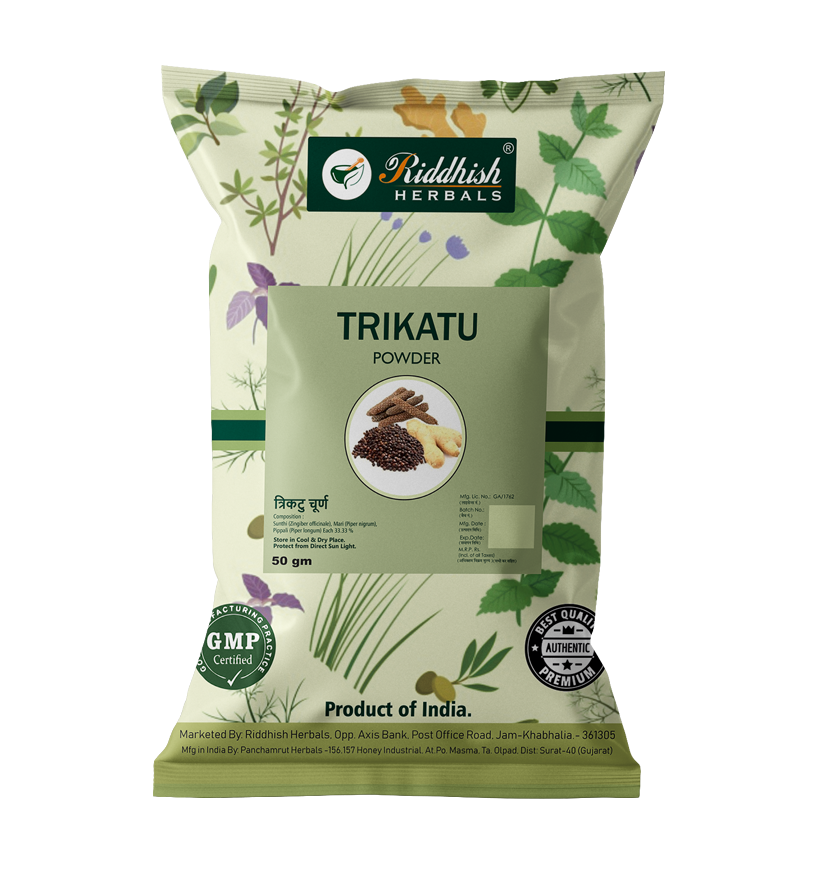
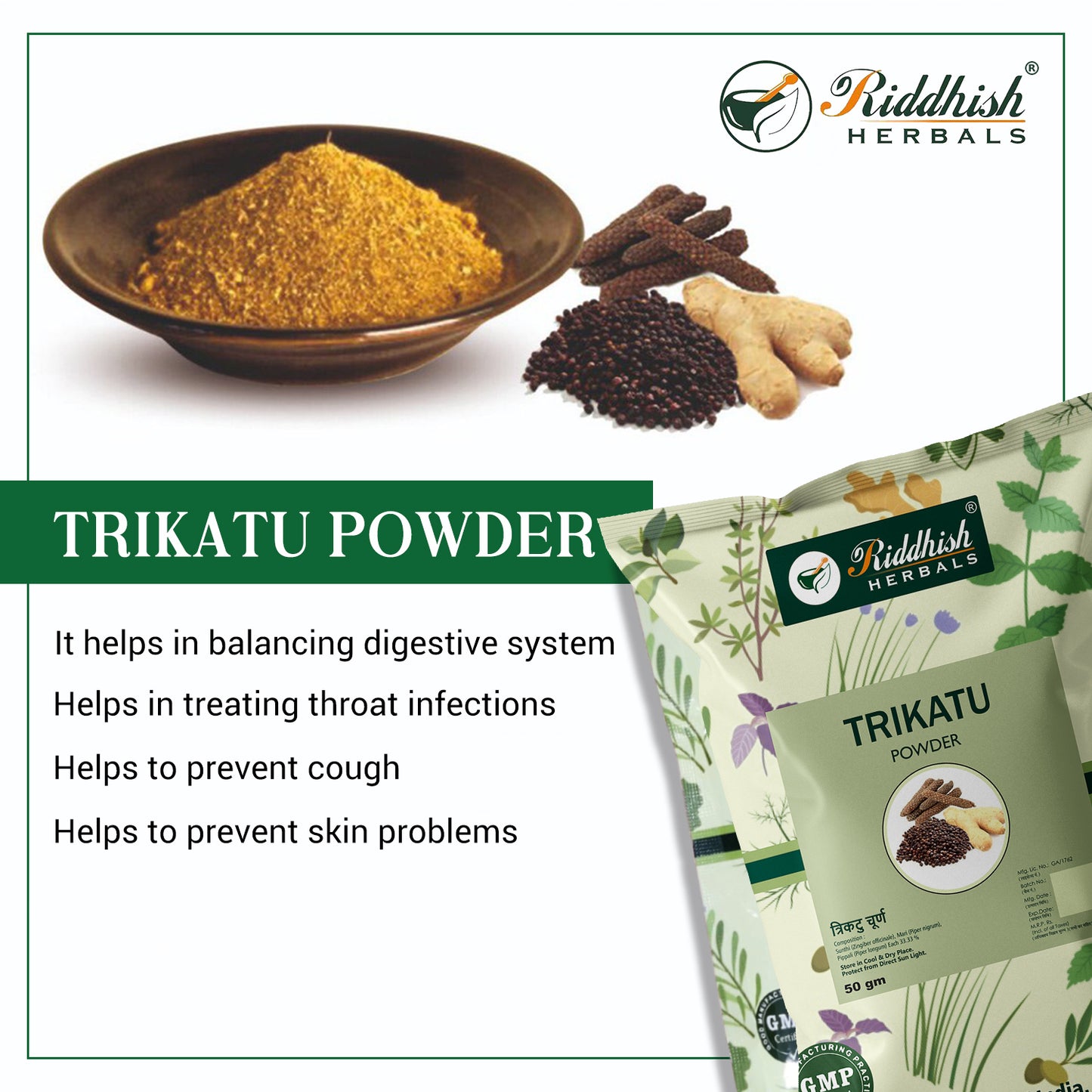
- Sunthi (Zingiber officinale) — Rhizome (dry ginger) — 33.33%
- Mari / Maricha (Piper nigrum) — Fruit (black pepper) — 33.33%
- Pippali (Piper longum) — Fruit (long pepper) — 33.33%
Research and Scientific References
Trikatu has been studied as a complete formulation. A well-cited study examined the blend and its constituents in the context of bioavailability (Johri & Zutshi, 1992 — Journal of Ethnopharmacology, PMID 1453702). Its pungent principle piperine has been reviewed for its physiological effects and bio-enhancer role (Srinivasan, 2007 — Critical Reviews in Food Science and Nutrition, PMID 17987447). Standardisation work using HPTLC has profiled the formulation's piperine content for quality control (peer-reviewed standardisation study, 2020). Results observed in study conditions. Individual results may vary. Consult your Ayurvedic physician before use.
How to Use
As directed by your Ayurvedic physician. Classical guidance: ¼ to ½ teaspoon (roughly 1–3 g) with honey or warm water, before meals. The traditional anupan is honey, or warm water; with honey it is taken for seasonal kapha balance.
Safety Information
This is a strongly warming blend of three pungent herbs. Those with a pitta constitution, acidity, gastritis, or a tendency to ulcers should use it cautiously and in small quantity, or avoid it. Not recommended during pregnancy or lactation except under qualified Ayurvedic supervision. Children should use only under guidance. Use under the guidance of a qualified Ayurvedic physician, especially if taking any medication or managing any health condition. Keep out of reach of children. Results may vary from person to person.
Storage
Store in a cool, dry place, away from direct sunlight, in an airtight container.
Pippali is one of the three pungents in this blend — see our Piper longum guide to learn more about it.