



Riddhish Herbals
Triphala Guggulu Tablet | Classical Ayurvedic Guggulu (Triphala + Shuddha Guggulu) | Riddhish Herbals | 60 Tablets
Triphala Guggulu Tablet | Classical Ayurvedic Guggulu (Triphala + Shuddha Guggulu) | Riddhish Herbals | 60 Tablets
Couldn't load pickup availability
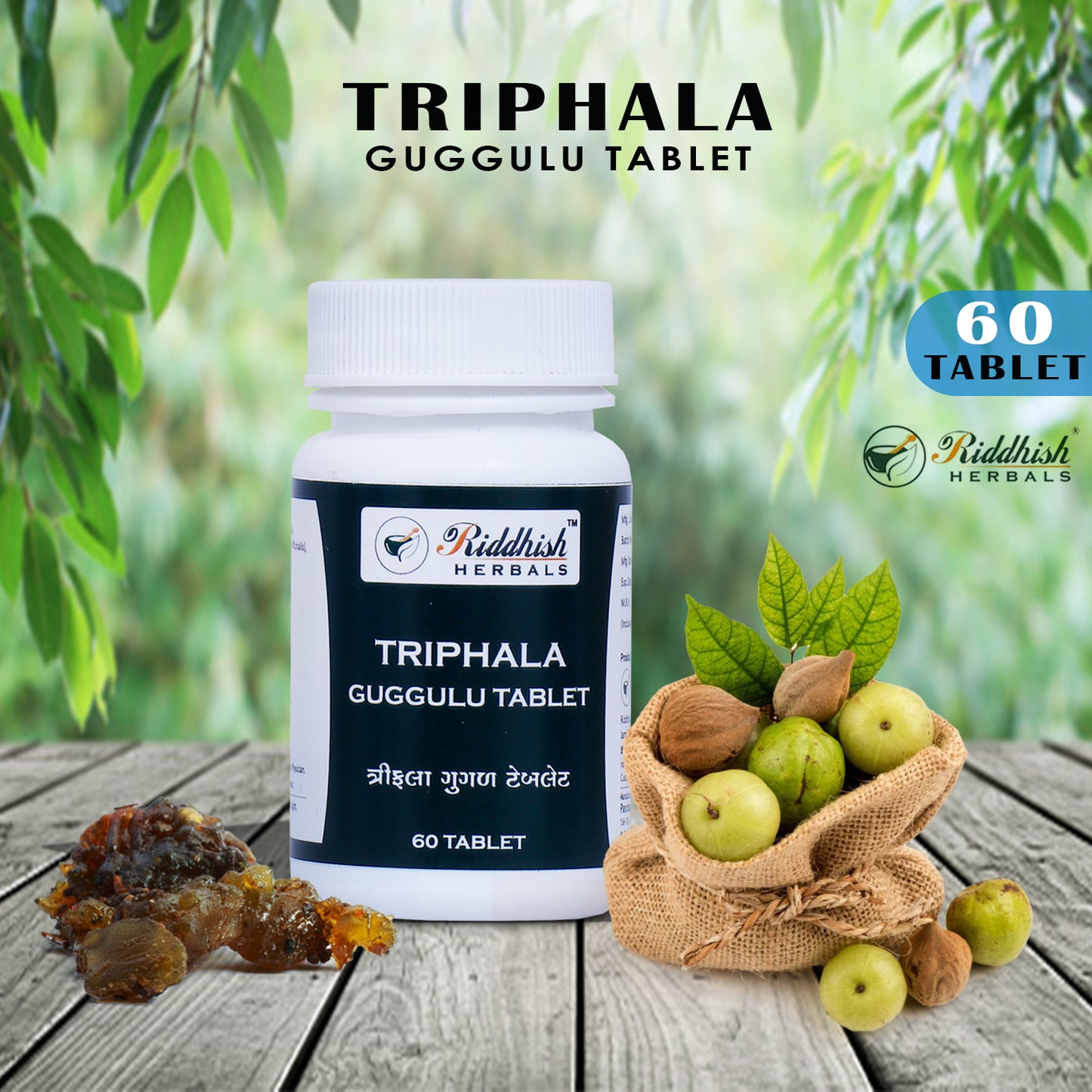
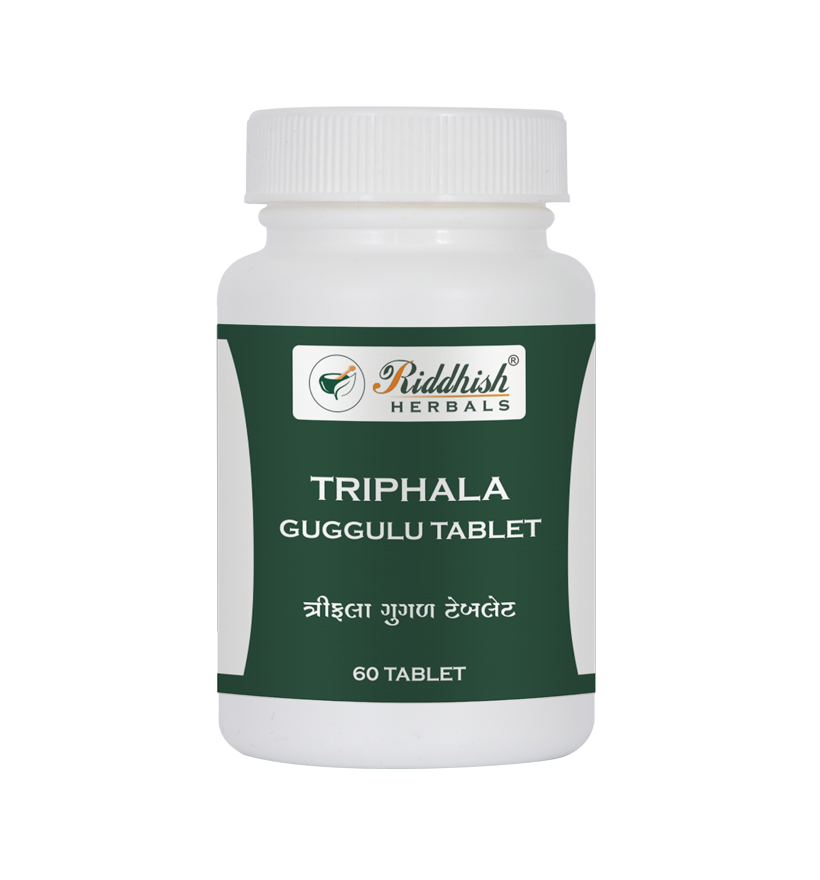
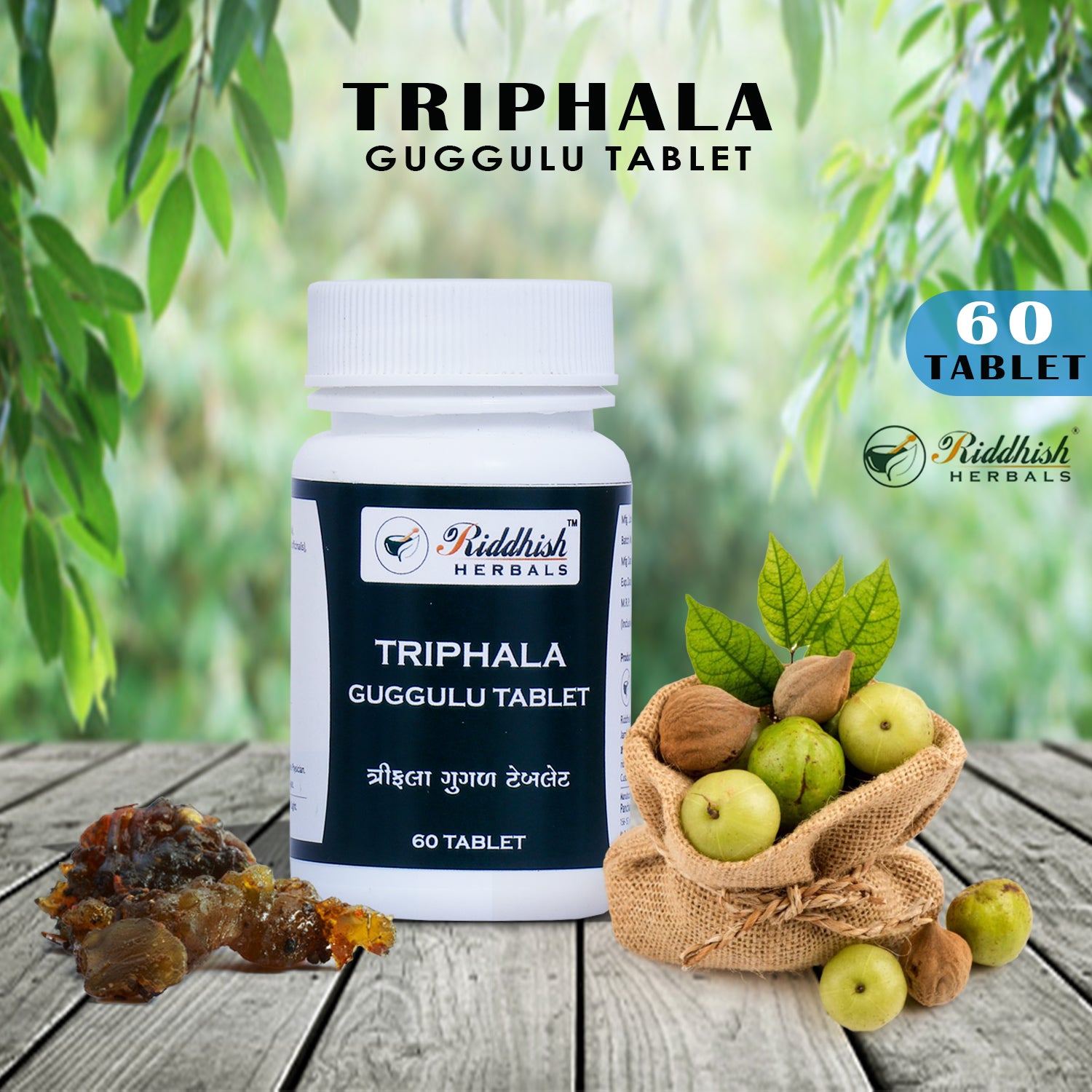
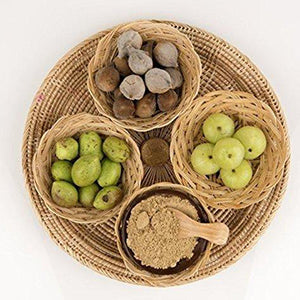
Triphala Guggulu Tablet is a classical Ayurvedic Guggulu formulation (Guggulu Kalpana) that combines the three Triphala fruits — Haritaki, Bibhitaki and Amalaki — with Pippali and purified Shuddha Guggulu resin. Described in the Sharangadhara Samhita and carried into the Ayurvedic Formulary of India, it is traditionally valued for srotoshodhana (cleansing of the body’s channels), healthy medas (fat/lipid) metabolism, kindling of agni (digestive fire) and balancing of Vata and Kapha. Each Riddhish Herbals tablet is made to the classical AFI reference in a GMP-certified facility.
About Triphala Guggulu Tablet
Few Ayurvedic formulas are as widely respected as Triphala Guggulu. The name tells its own story — Triphala, the “three fruits,” joined with Guggulu, the prized oleo-gum resin of Commiphora wightii. Classical physicians placed Guggulu among the most important scraping and channel-clearing substances, and pairing it with the gentle, balancing action of Triphala created a formulation used across centuries.
This is a Guggulu Vati — a tablet form of Guggulu Kalpana. Riddhish Herbals prepares it to the reference cited on the pack, Ayurvedic Formulary of India (AFI), Part 1, which draws the formula from the Sharangadhara Samhita. The composition is straightforward and label-verified: equal parts of the four herbs with Shuddha Guggulu in the largest proportion, exactly as a traditional Guggulu Kalpa is built.
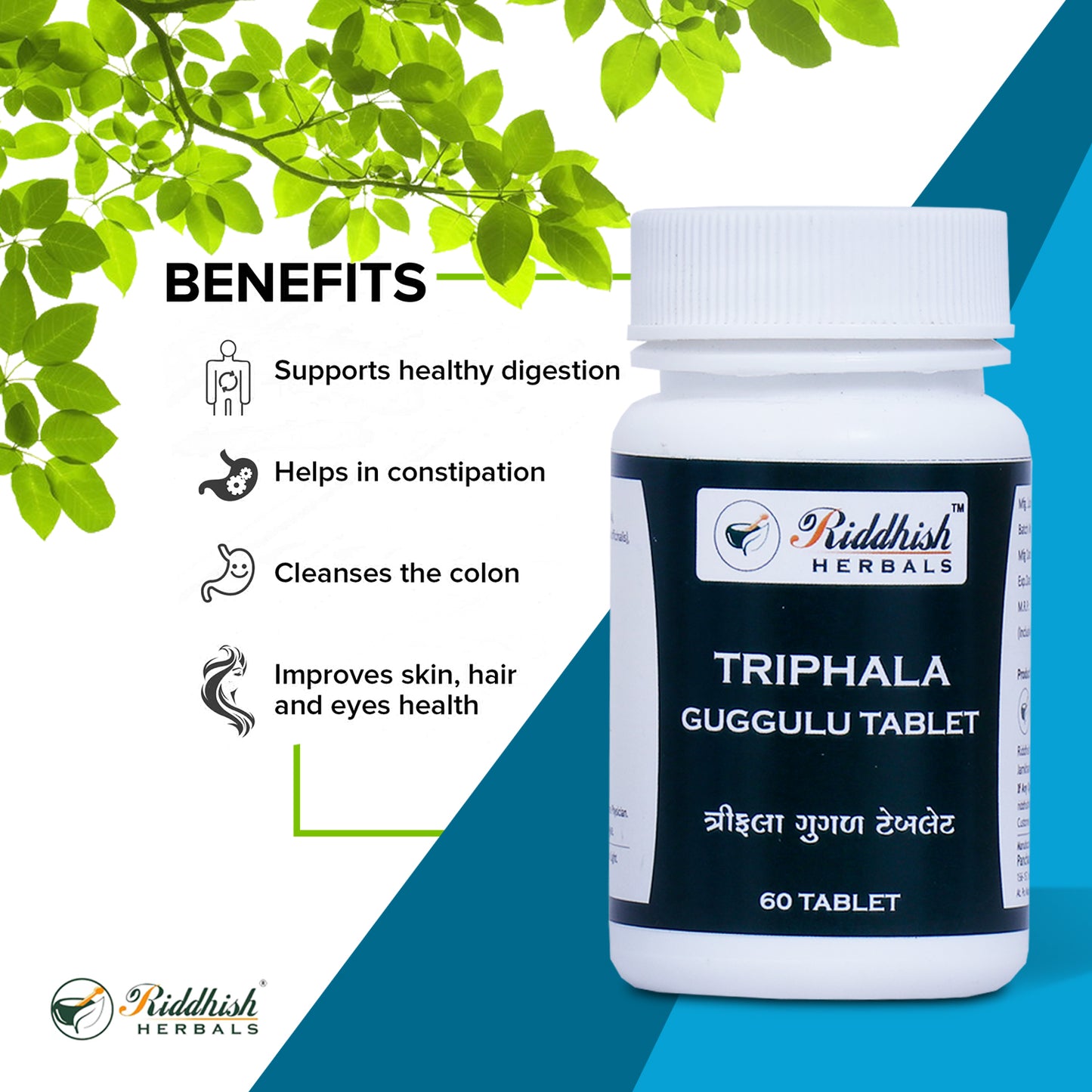
Triphala Guggulu is most often spoken of in the context of srotoshodhana (clearing the micro-channels), medas (healthy lipid and fat metabolism), deepana-pachana (supporting digestive fire and the breakdown of ama) and steady, comfortable elimination — making it a natural fit for a daily metabolic and digestive wellness routine taken under guidance.
Traditional Ayurvedic Importance
Triphala Guggulu appears in the Sharangadhara Samhita (Madhyama Khanda, Chapter 7, verses 82–83) under Vati / Guggulu Kalpana, and the same formula is recorded in Yogaratnakara and Bhavaprakasha. It is standardised in the Ayurvedic Formulary of India, the reference printed on this pack. In these texts it is classically described in the context of medoroga (disorders of fat metabolism), srotoshodhana, vrana-shodhana and vrana-ropana (wound cleansing and tissue-repair context), shotha (inflammatory swelling), and arsha and bhagandara — presented here strictly as classical textual references, not as statements about what this product does.
Guggulu (Shuddha Guggulu)
Guggulu is the heart of every Guggulu Kalpa. Classical literature attributes to it a medohara (fat-scraping) and lekhana (scraping) action, and it is counted among the foremost substances for clearing stagnation in the channels. Purification (shodhana) of the raw resin before use is essential — hence “Shuddha” Guggulu.
Triphala (Haritaki, Bibhitaki, Amalaki)
Triphala is among the oldest and most quoted formulations in Ayurveda, valued for its tridosha-balancing nature and its supportive role in digestion, gentle elimination and rasayana (rejuvenation). Haritaki is called Pathya (the one that is good for you), Amalaki is a celebrated rasayana rich in natural vitamin C, and Bibhitaki rounds out the trio.
Pippali
Pippali (long pepper) is added as a classical yogavahi and deepana herb — it supports agni and helps carry the action of the other ingredients, a role it plays in many Ayurvedic compounds.
Key Features
- Authentic classical formula — prepared to the Sharangadhara Samhita reference as standardised in AFI Part 1, the reference printed on the pack.
- Label-verified composition — Haritaki, Bibhitaki, Amalaki and Pippali at 72 mg each, with Shuddha Guggulu at 250 mg per tablet.
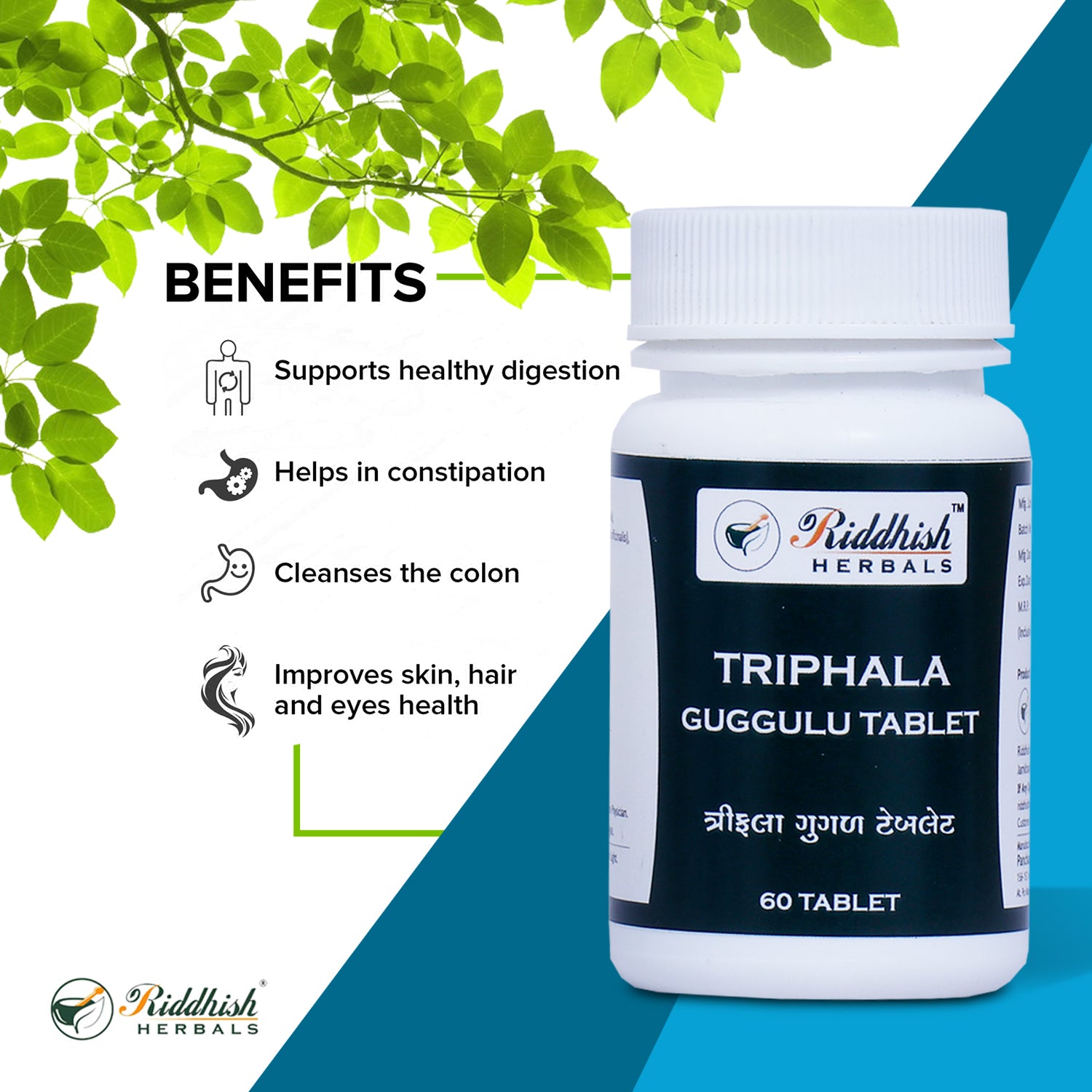
- Srotoshodhana support — traditionally valued for cleansing the body’s micro-channels as part of a routine.
- Metabolic & medas balance — Guggulu is classically a medohara (fat-metabolism) substance, valued in medoroga contexts.
- Digestive fire & gentle elimination — Triphala’s deepana-pachana qualities support agni and comfortable regularity.
- Vata-Kapha balancing — a tridosha-supportive formula with a focus on Kapha-medas stagnation.
- GMP-certified manufacturing — produced in a GMP-certified facility and sold with a genuine bill by Riddhish Herbals.
Composition (Label-Verified)
Each tablet contains:
| Ingredient (Sanskrit) | Botanical Name | Plant Part | Quantity |
|---|---|---|---|
| Haritaki | Terminalia chebula | Fruit (pericarp) | 72 mg |
| Bibhitaki | Terminalia bellirica | Fruit (pericarp) | 72 mg |
| Amalaki | Emblica officinalis | Fruit (pericarp) | 72 mg |
| Pippali | Piper longum | Fruit | 72 mg |
| Shuddha Guggulu | Commiphora wightii (syn. C. mukul) | Purified oleo-gum resin | 250 mg |
| Excipients | — | — | Q.S. |
Classical reference: AFI Part 1 / Sharangadhara Samhita. An Ayurvedic classical (proprietary tablet) preparation.
Research & Scientific References
Triphala and Guggulu are among the more widely studied Ayurvedic substances. Published work has explored their constituents in the context of lipid metabolism and weight under controlled study conditions:
- A study in Yakugaku Zasshi reported a hypolipidemic effect of Triphala in an experimentally induced hypercholesteremic animal model, under study conditions. — (Saravanan S et al., 2007, Yakugaku Zasshi 127(2):385–8; PMID 17268159)
- A pilot clinical trial examined Guggulu (Medohar) alongside diet in adults in the context of weight, observing modest changes the authors noted require larger confirmation. — (Singh RB et al., 2000, J Assoc Physicians India; PMID 10740691)
- A 2025 systematic review and meta-analysis of controlled trials evaluated Triphala and Triphala Guggul in relation to anthropometric measures in overweight adults. — (Systematic review, 2025, Journal of Medicinal & Natural Products)
How to Use & Anupan
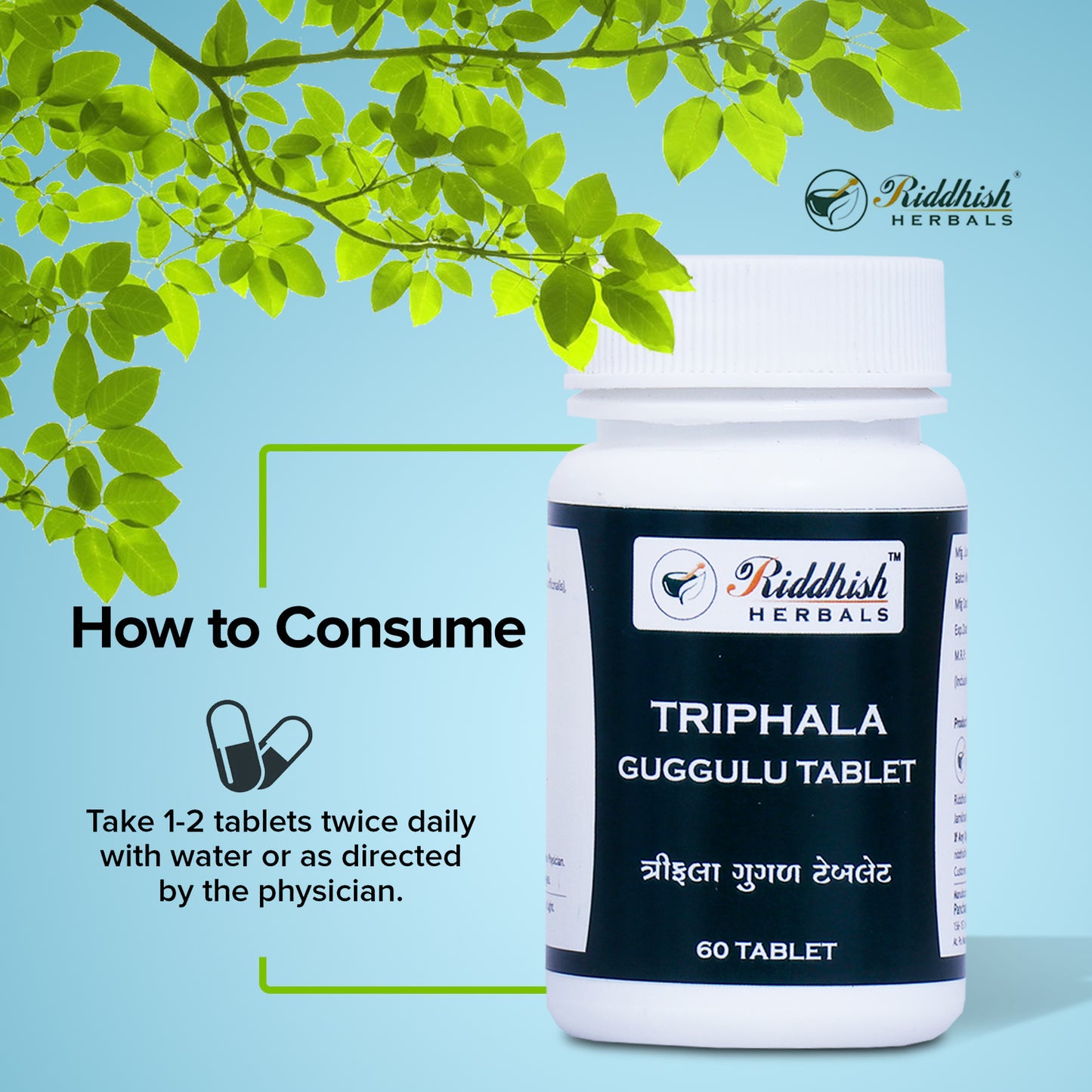
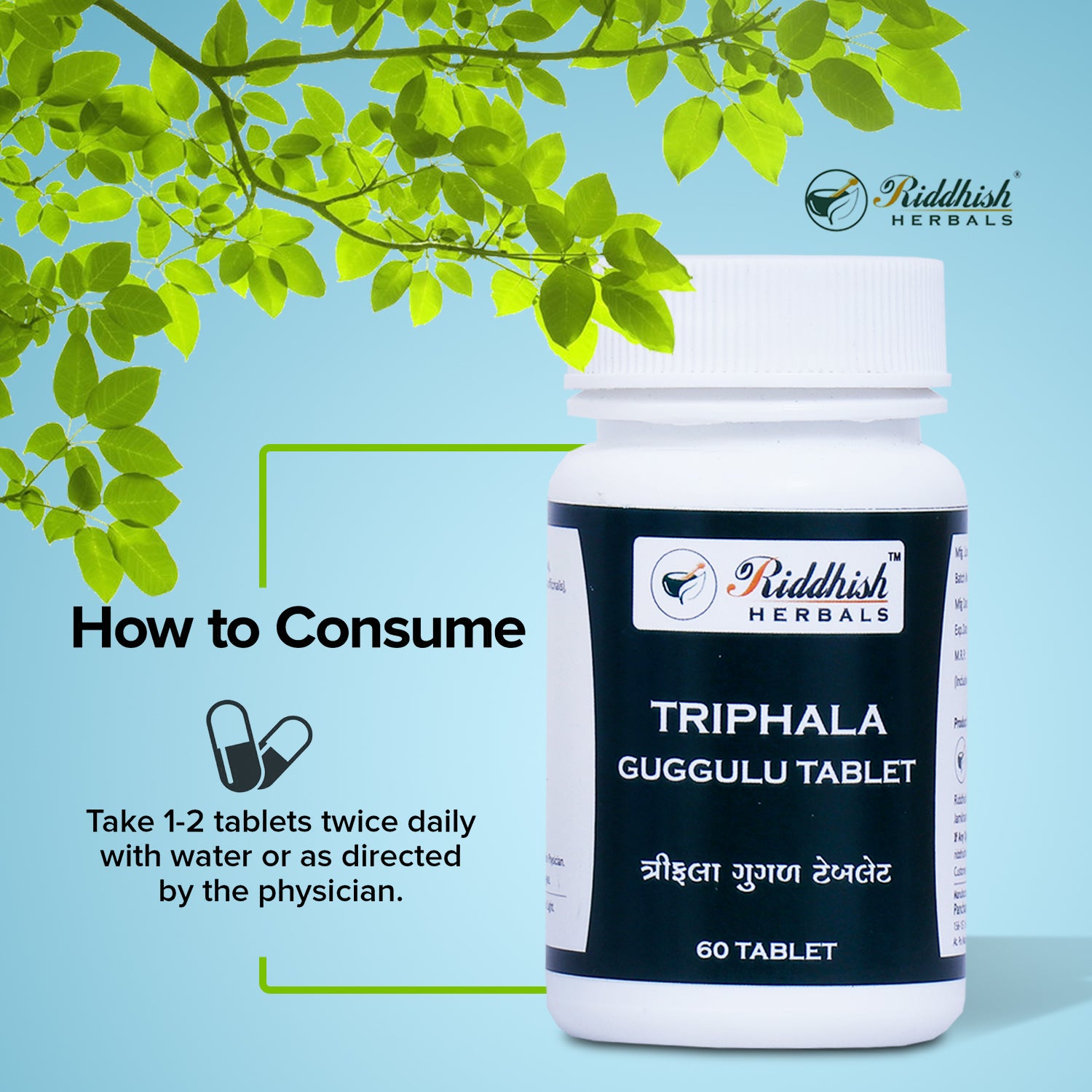
Dosage (per pack): Two tablets twice a day, or as directed by your Ayurvedic physician.
Anupan (vehicle): Traditionally taken with lukewarm water, usually after meals. Your physician may advise a specific anupan suited to your constitution.
Because this is a Guggulu formulation, it is best used as part of a guided routine alongside a suitable diet. Do not exceed the dose advised by your physician.
Who Can Use It
Triphala Guggulu is generally suited to adults looking to support metabolism, digestion and channel-cleansing as part of a daily Ayurvedic routine. It should be taken under the guidance of a qualified Ayurvedic physician. It is not recommended during pregnancy or lactation except on a physician’s advice, and anyone managing a health condition or taking medication (including blood-thinning or thyroid medication) should consult their physician first.
Safety Information
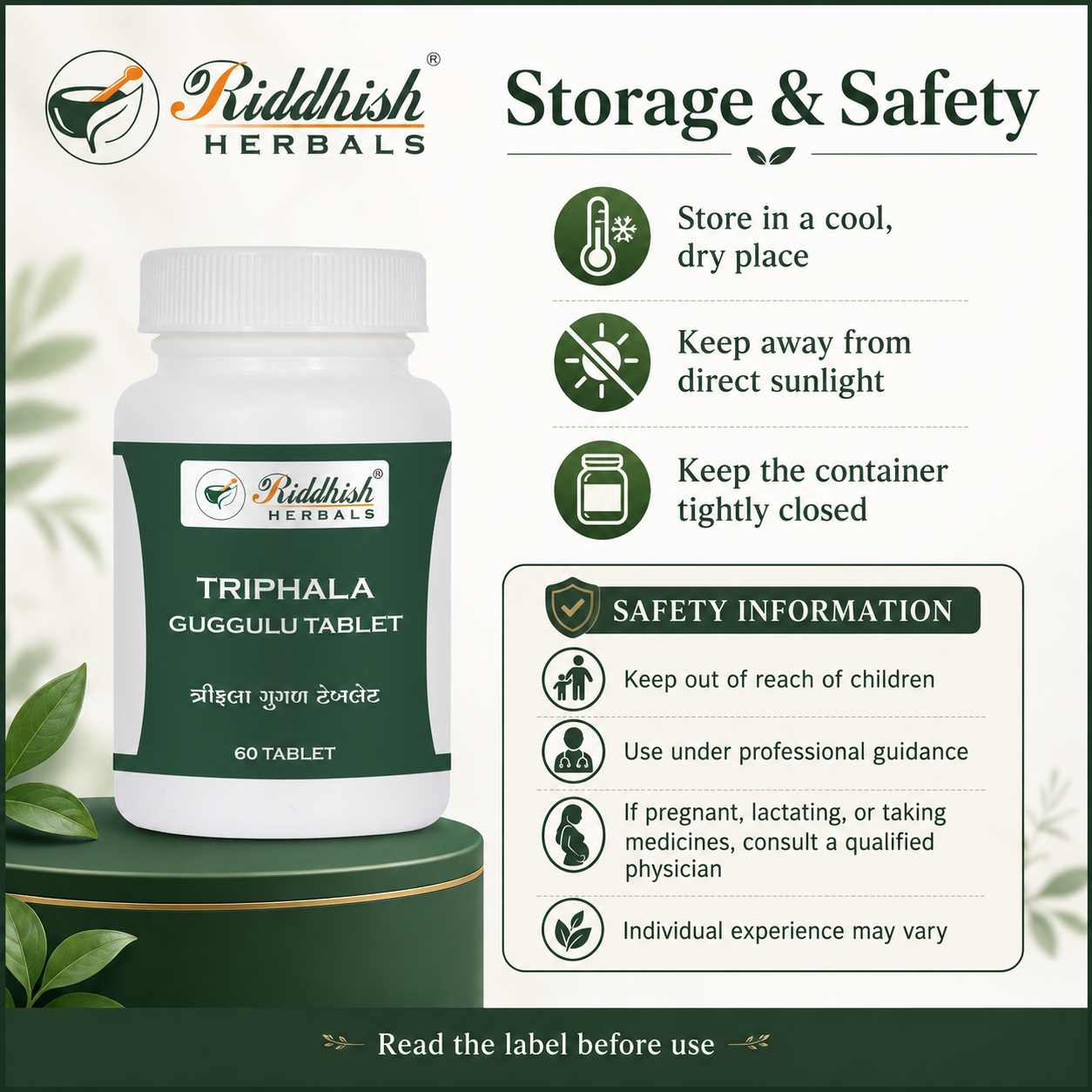
For use under medical supervision only. Consult your physician before use, especially if you are pregnant, lactating, taking any medication, or managing any medical condition. Keep out of reach of children. Results may vary from person to person. Use within the printed expiry and do not exceed the recommended dose.
Storage
Store in a cool, dry place. Protect from direct sunlight. Keep the bottle tightly closed.
Frequently Asked Questions
Is this product GMP certified?
Yes — Triphala Guggulu Tablet is manufactured in a GMP-certified facility (Mfg. Lic. No. GA/1762) and marketed by Riddhish Herbals, who provide a genuine bill with every purchase.
Can I take Triphala Guggulu without consulting a doctor?
This is a classical Guggulu formulation and is best taken under the guidance of a qualified Ayurvedic physician, who can confirm the right dose and duration for you.
What is Triphala Guggulu?
It is a classical Ayurvedic tablet (Guggulu Kalpana) combining the three Triphala fruits (Haritaki, Bibhitaki, Amalaki) with Pippali and purified Shuddha Guggulu resin, described in the Sharangadhara Samhita and the Ayurvedic Formulary of India.
What are its other names and spellings?
Also written as Triphala Guggul, Trifla Guggulu, Triphla Guggul and Triphala Guggulu Vati. “Guggulu” (the resin) is also spelled Guggul or Gugal; in Gujarati the pack reads “Trifla Gugal Tablet”.
How do I know this is the genuine pack?
Every Riddhish Herbals order ships with a bill and is sourced directly through authorised channels — never a grey-market or re-packed unit.
Which classical text is this formula from?
The formula is described in the Sharangadhara Samhita (Madhyama Khanda 7/82–83) under Guggulu Kalpana, and standardised in the Ayurvedic Formulary of India (the reference printed on the pack).
What is the recommended anupan?
Lukewarm water is the traditional vehicle, usually after meals. Your physician may suggest a different anupan based on your prakriti.
How should I store it?
Keep it in a cool, dry place away from direct sunlight, with the cap tightly closed.
Has Triphala Guggulu been studied scientifically?
Yes — its components Triphala and Guggulu have been examined in published research in the context of lipid metabolism and weight, under study conditions (see the Research section above). Such studies describe observations under controlled conditions and are not medical claims about this product; results may vary.
Is it available at Riddhish Herbals?
Yes. It is available at riddhishherbals.com and at Riddhish Herbals retail counters in Gujarat, with pan-India delivery.
Regional Names Across India
The herbs in Triphala Guggulu are known by many names across India. A few key ones:
Haritaki (Terminalia chebula)
| Language | Regional Script | Romanised |
|---|---|---|
| Sanskrit | हरीतकी | Harītakī, Abhayā, Pathyā |
| Hindi | हरड़ | Harad |
| Gujarati | હરડે | Harade |
| Marathi | हिरडा | Hirdā |
| Bengali | হরীতকী | Horītokī |
| Tamil | கடுக்காய் | Kadukkāi |
| Telugu | కరక్కాయ | Karakkāya |
| Malayalam | കടുക്ക | Kaṭukka |
| English | — | Chebulic Myrobalan |
Bibhitaki (Terminalia bellirica)
| Language | Regional Script | Romanised |
|---|---|---|
| Sanskrit | विभीतकी | Vibhītakī, Akṣa |
| Hindi | बहेड़ा | Bahedā |
| Gujarati | બહેડાં | Bahedāṁ |
| Marathi | बेहडा | Behaḍā |
| Bengali | বহেড়া | Bohera |
| Tamil | தான்றி | Thānri |
| Telugu | తానికాయ | Tānikāya |
| Malayalam | താന്നി | Thānni |
| English | — | Belleric Myrobalan |
Amalaki (Emblica officinalis)
| Language | Regional Script | Romanised |
|---|---|---|
| Sanskrit | आमलकी | Āmalakī, Dhātrī, Amṛtā |
| Hindi | आँवला | Āṁvalā |
| Gujarati | આમળાં | Āmaḷāṁ |
| Marathi | आवळा | Āvaḷā |
| Bengali | আমলকী | Āmloki |
| Tamil | நெல்லிக்காய் | Nellikkāi |
| Telugu | ఉసిరికాయ | Usirikāya |
| Malayalam | നെല്ലിക്ക | Nellikka |
| English | — | Indian Gooseberry, Amla |
Pippali (Piper longum)
| Language | Regional Script | Romanised |
|---|---|---|
| Sanskrit | पिप्पली | Pippalī, Māgadhī |
| Hindi | पीपल | Pīpal |
| Gujarati | પીપર | Pīpar, Līṇḍī Pīpar |
| Marathi | पिंपळी | Piṁpaḷī |
| Bengali | পিপুল | Pipul |
| Tamil | திப்பிலி | Thippili |
| Telugu | పిప్పలి | Pippali |
| Malayalam | തിപ്പലി | Thippali |
| English | — | Long Pepper |
Guggulu (Commiphora wightii)
| Language | Regional Script | Romanised |
|---|---|---|
| Sanskrit | गुग्गुलु | Guggulu, Devadhūpa, Pura |
| Hindi | गुग्गुल | Guggul |
| Gujarati | ગૂગળ | Gūgaḷ |
| Marathi | गुग्गुळ | Gugguḷ |
| Bengali | গুগগুল | Guggul |
| Telugu | గుగ్గిలము | Guggilamu |
| Kannada | ಗುಗ್ಗುಳ | Guggula |
| English | — | Indian Bdellium, Guggul |
Related Ayurvedic Products
- Triphala Guggulu Tablet — 120 Tablet pack (larger value size)
- Digestive Wellness collection
- Joint & Muscle Comfort collection
- Explore single-herb Triphala and Guggulu-based Ayurvedic formulations at Riddhish Herbals.
Marketed by Riddhish Herbals, Post Office Main Road, Jamkhambhalia, Dist. Devbhumi Dwarka, Gujarat. Manufactured by Panchamrut Herbals (Surat) in a GMP-certified facility, Mfg. Lic. No. GA/1762. An Ayurvedic classical preparation — to be taken under medical supervision. Reviewed for classical and compositional accuracy by Dr. Riddhish Padiya (Ph.D., Dravyaguna).