
Riddhish Herbals
Vishamjvarantak Loha (Putapakva, Suvarna Yukta) – Loha Rasaushadhi – Virgo UAP Pharma
Vishamjvarantak Loha (Putapakva, Suvarna Yukta) – Loha Rasaushadhi – Virgo UAP Pharma
Couldn't load pickup availability
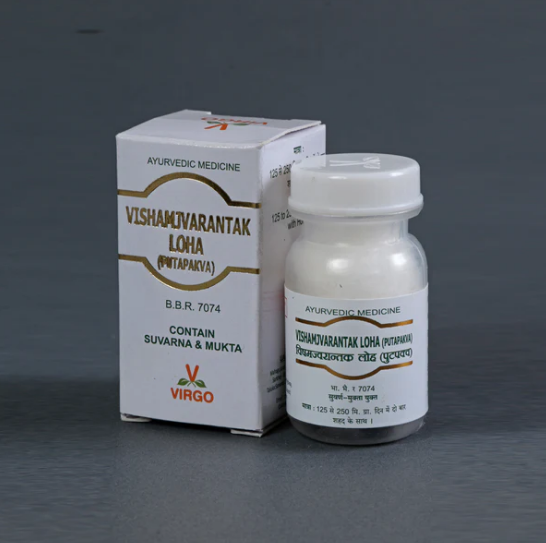
Vishamjvarantak Loha (Putapakva, B.B.R. 7074) is a classical Suvarna-bearing Loha Rasaushadhi manufactured by Virgo UAP Pharma, traditionally described in Rasashastra within the Vishama-Jwara (irregular-fever) group of classical texts and given under a qualified Ayurvedic physician's guidance. It is a Putapakva (repeatedly incinerated) powder carrying a Parada-Gandhaka Kajjali with Loha, Tamra, Abhrak, Suvarna and several other Bhasma. It is a licensed Ayurvedic medicine used under strict medical supervision only.
About Vishamjvarantak Loha
Vishamjvarantak Loha is a classical Loha-Bhasma-predominant Rasaushadhi of the Putapakva tradition, catalogued at Bharat Bhaishajya Ratnakara 7074. It is built on a Parada-Gandhaka base with a broad group of metallic and mineral Bhasma — Loha (iron), Tamra (copper) and Abhrak (mica) leading, with Suvarna (gold), Bang (tin), Shuddha Gairik, Praval, Mukta, Shankh and Shukti Bhasma.
This is the Virgo UAP Pharma preparation, supplied genuine by Riddhish Herbals with a bill and doctor-guided selection. The composition below is reproduced exactly from the approved pack.
The Rasashastra behind it
These are Rasaushadhi — medicines of Rasashastra, the classical Ayurvedic pharmacy of processed metals and minerals. Each metal passes through Shodhana (purification) and Marana (incineration into a Bhasma); mercurial preparations pass additionally through Kajjali and Kupipakwa. What the Samskara yields is a new, nanocrystalline substance, not the raw metal that entered the furnace. Peer-reviewed X-ray diffraction of Vasant Kusumakar Rasa — a different classical preparation, which we also stock — identified cinnabar, cassiterite, massicot and magnetite as the phases its Samskara produces, and one of those does not bear on this medicine at all: massicot arises from that formula's Naga (lead) Bhasma, which is not present in Vishamjvarantak Loha. The other three map directly onto this pack — cassiterite to its own Bang (Vanga) Bhasma, magnetite to its own Loha Bhasma, and cinnabar to its Parada-Gandhaka Kajjali.
Traditional Ayurvedic importance
Classical Rasashastra records Loha-based Putapakva preparations within the Vishama-Jwara Chikitsa (the classical category of irregular or periodic Jwara), traditionally described in texts such as the Bharat Bhaishajya Ratnakara and used under a physician's direction. Its Loha, Tamra and Abhrak Bhasma group is characteristic of the classical Loha Rasayana architecture.
These are traditional textual attributions shared for context, not medical claims; the precise indication and duration are set by your Vaidya.
Research on the Constituents
◆ Ota, Singh, Srikanth, Sreedhar, Ruknuddin & Dhiman (2017) — Ancient Science of Life 36(4):207–214, CCRAS. X-ray diffraction of Vasant Kusumakar Rasa — a different classical preparation, which we also stock — identified cinnabar, cassiterite, massicot and magnetite as the phases produced by the Samskara, and one of those does not bear on this medicine at all: massicot arises from that formula's Naga (lead) Bhasma, which is not present in Vishamjvarantak Loha. The other three do bear on this formula — cassiterite from its own Bang Bhasma, magnetite from its own Loha Bhasma, and cinnabar from its Parada-Gandhaka Kajjali. PubMed PMID 29269973.
Results were observed under study conditions. Individual results may vary. This is shared for general educational interest and is not a medical claim. Consult your Ayurvedic physician before use.
Composition (label-verified, per pack)
| Ingredient (label) | Identity / description | Part | Content (%) |
|---|---|---|---|
| Shuddha Parad | Purified mercury for Kajjali (A.B.) | — | 9.523 % |
| Shuddha Gandhak | Purified sulphur for Kajjali (A.B.) | — | 9.523 % |
| Suvarna Bhasma | Classical gold Bhasma (Rasamritam) | — | 2.381 % |
| Loha Bhasma | Classical iron Bhasma (R.T.S.-1) | — | 19.048 % |
| Tamra Bhasma | Classical copper Bhasma (R.T.S.-1) | — | 19.048 % |
| Abhrak Bhasma | Purified mica Bhasma (R.T.S.-1) | — | 19.048 % |
| Bang Bhasma | Classical tin Bhasma (R.T.S.-1) | — | 4.762 % |
| Shuddha Gairik | Purified red-ochre mineral (classical) | — | 4.762 % |
| Praval Bhasma | Coral Bhasma (R.T.S.-1) | — | 4.762 % |
| Mukta Bhasma | Pearl Bhasma (R.T.S.-1) | — | 2.381 % |
| Shankh Bhasma | Conch Bhasma (R.T.S.-1) | — | 2.381 % |
| Shukti Bhasma | Oyster-shell Bhasma (R.T.S.-1) | — | 2.381 % |
Reproduced from the approved Virgo UAP Pharma pack as percentage composition (this is a Putapakva powder, not a tablet). Classical reference: B.B.R. 7074 (Bharat Bhaishajya Ratnakara). R.T.S.-1 = Rasa Tantra Sara; A.B. = Arya Bhishak; Rasamritam = classical Bhasma reference; Putapakva = prepared by repeated incineration (Puta).
How to Use
As printed on the pack: 125 to 250 mg twice a day with Honey (Anupana), or as advised by the physician. Because this is a potent Loha-Bhasma Putapakva powder, your Vaidya sets the exact dose, Anupana and duration.
Who Can Use It
Intended for adults strictly under the care of a qualified Ayurvedic physician. Not for self-medication. If pregnant, lactating, elderly, on any medication or managing any health condition, use only on a physician's advice. For children, only as directed by a qualified Ayurvedic physician.
Safety Information
Bhasma and Bhasma-based Ayurvedic medicines are to be used under strict medical supervision only. That is the standard practice for this class of medicine, and the instruction the manufacturer prints on the pack. Your Vaidya matches the preparation, the dose and the duration to you — to your Prakriti, your Agni and your condition — which is something no pack and no web page can do.
Use strictly under the guidance of a qualified Ayurvedic physician. Consult your physician before use, especially if you are pregnant, lactating, taking any medication, or managing any medical condition. Keep out of reach of children. Results may vary from person to person.
CAUTION — TO BE TAKEN UNDER MEDICAL SUPERVISION. सावधानी — चिकित्सक की देखरेख में ही लें।
This preparation contains a dravya listed in Schedule E(1) of the Drugs and Cosmetics Rules, 1945. Rule 161 of those Rules requires the caution above on a medicine of this class intended for internal use. Consult a qualified Ayurvedic physician before usage. Take it only at the dose and for the duration your physician directs, never above the dose printed on the pack, and not as self-medication. Keep out of reach of children. Results may vary from person to person.
Storage
Store in a cool, dry place away from direct sunlight and moisture, tightly closed in the original pack, out of reach of children.
Frequently Asked Questions
Is Vishamjvarantak Loha an AYUSH / GMP-made medicine?
It is a licensed Ayurvedic medicine manufactured by Virgo UAP Pharma (Virgo UAP Pharma Pvt. Ltd., Ahmedabad) in a GMP-, ISO-9001- and ISO-22000-certified facility, as declared on the pack.
Can I take Vishamjvarantak Loha without a doctor?
No. Like all Bhasma-bearing Rasaushadhi, it is to be used under strict medical supervision only. A qualified Vaidya matches the preparation, dose and duration to your Prakriti and condition.
What is Vishamjvarantak Loha made of?
See the label-verified composition table on this page — every ingredient, content and, where declared, plant part is reproduced from the approved pack.
What are the alternate names?
Vishamjvarantak Loha is also written as Vishamjwarantak Loha / Visham Jvarantak Loha (Putapakva).
What is the recommended Anupana?
The Anupana (vehicle) is printed in the How to Use section above; your physician may specify the one best suited to you.
How should I store it?
In a cool, dry place away from sunlight and moisture, tightly closed in the original pack, out of reach of children.
Is this the genuine Virgo product?
Yes. Riddhish Herbals supplies genuine Virgo UAP Pharma stock with a bill, since 2015, with doctor-guided selection and pan-India delivery.
Has this class of medicine been studied scientifically?
Yes. Peer-reviewed X-ray diffraction of Vasant Kusumakar Rasa — a different classical preparation, which we also stock — identified cinnabar, cassiterite, massicot and magnetite as phases produced by the Samskara, and one of those does not bear on this medicine at all: massicot arises from that formula's Naga (lead) Bhasma, which is not present in Vishamjvarantak Loha. The other three do bear on this formula: cassiterite from its own Bang Bhasma, magnetite from its own Loha Bhasma, and cinnabar from its Parada-Gandhaka Kajjali. See the research note on this page.
Is Vishamjvarantak Loha a tablet or a powder?
It is a Putapakva powder, dosed by weight (125 to 250 mg) rather than by tablet count, taken with Honey as the classical Anupana or as your physician directs.
Does it contain gold?
Yes. The pack declares Suvarna (gold) Bhasma at 2.381%, alongside Loha, Tamra, Abhrak and several other Bhasma on a Parada-Gandhaka base.
Related at Riddhish Herbals
Vasant Kusumakar Rasa (Virgo) · Chaturmukh Rasa (Virgo) · Mahalaxmivilas Rasa (Virgo) · Rasaushadhi & Bhasma collection · Virgo UAP Pharma collection
Riddhish Herbals is an authorised online seller for Virgo UAP Pharma.