

Riddhish Herbals
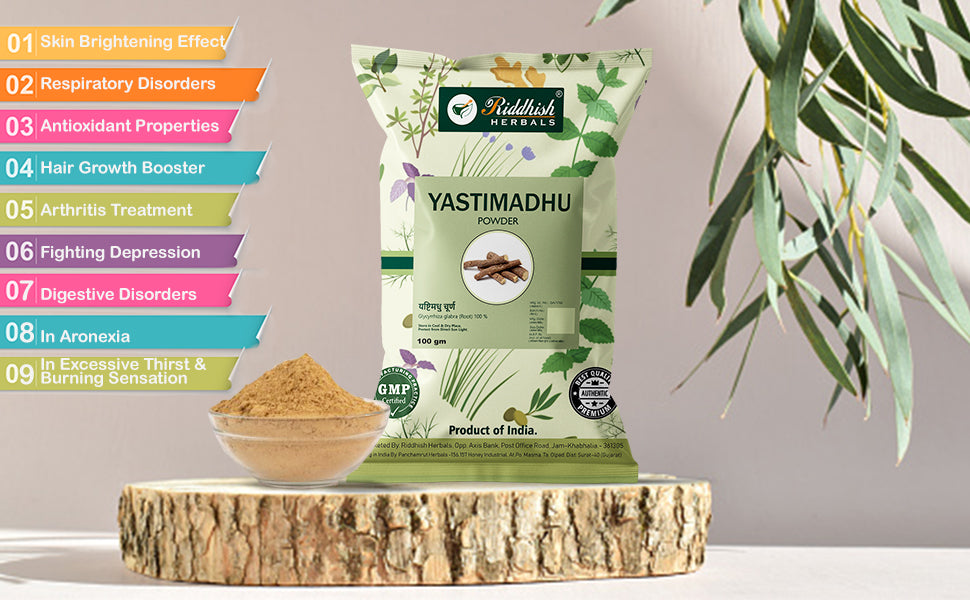
Yastimadhu Powder (Mulethi · Licorice) | Glycyrrhiza glabra Root 100% | Jethimadh | Riddhish Herbals | 100g
Yastimadhu Powder (Mulethi · Licorice) | Glycyrrhiza glabra Root 100% | Jethimadh | Riddhish Herbals | 100g
Couldn't load pickup availability
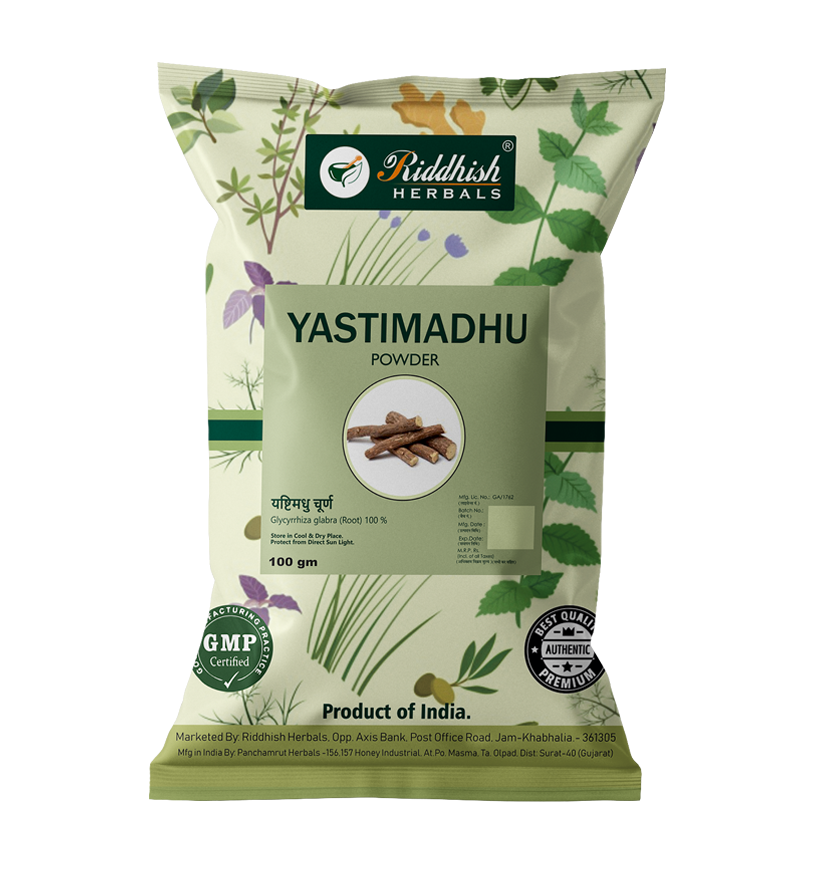
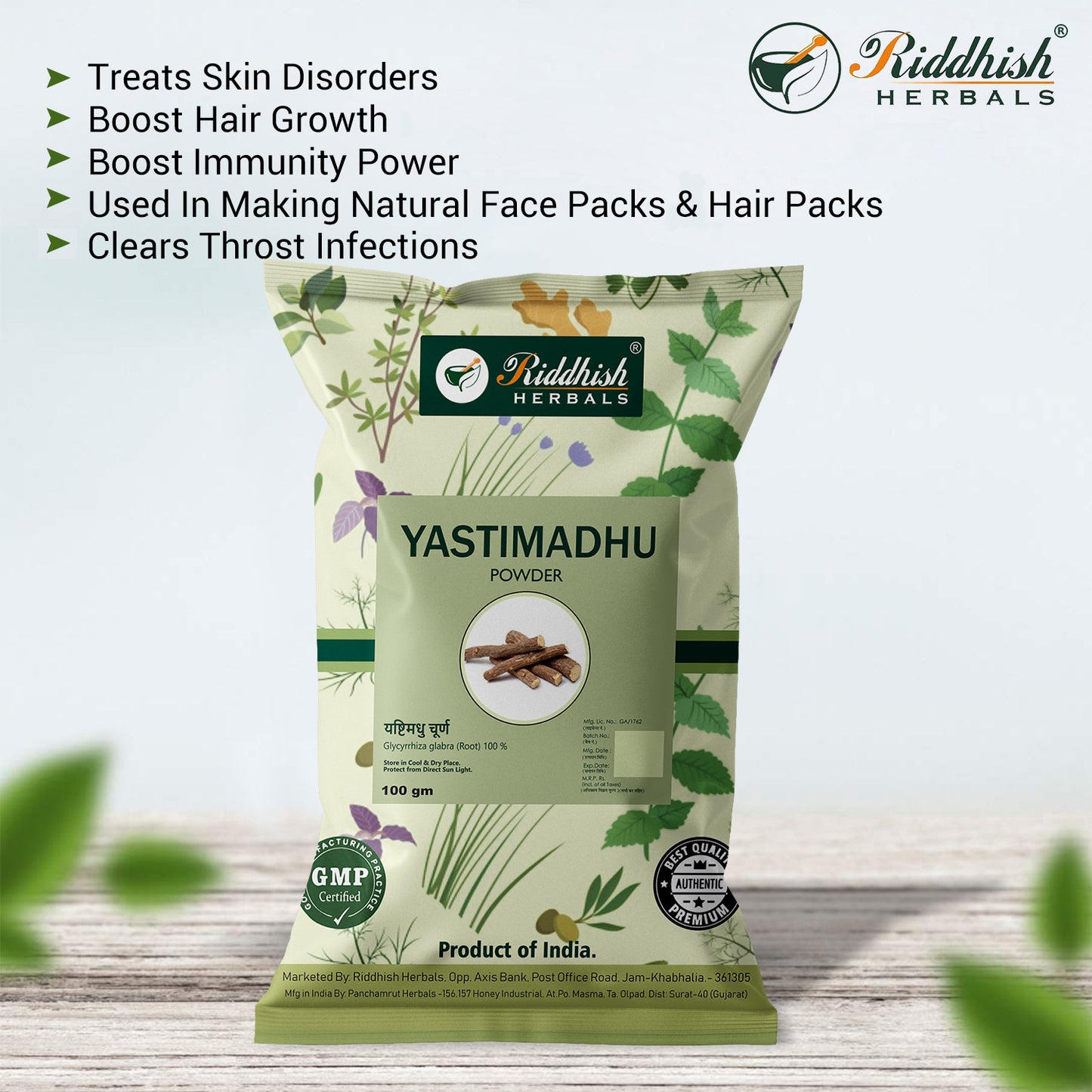
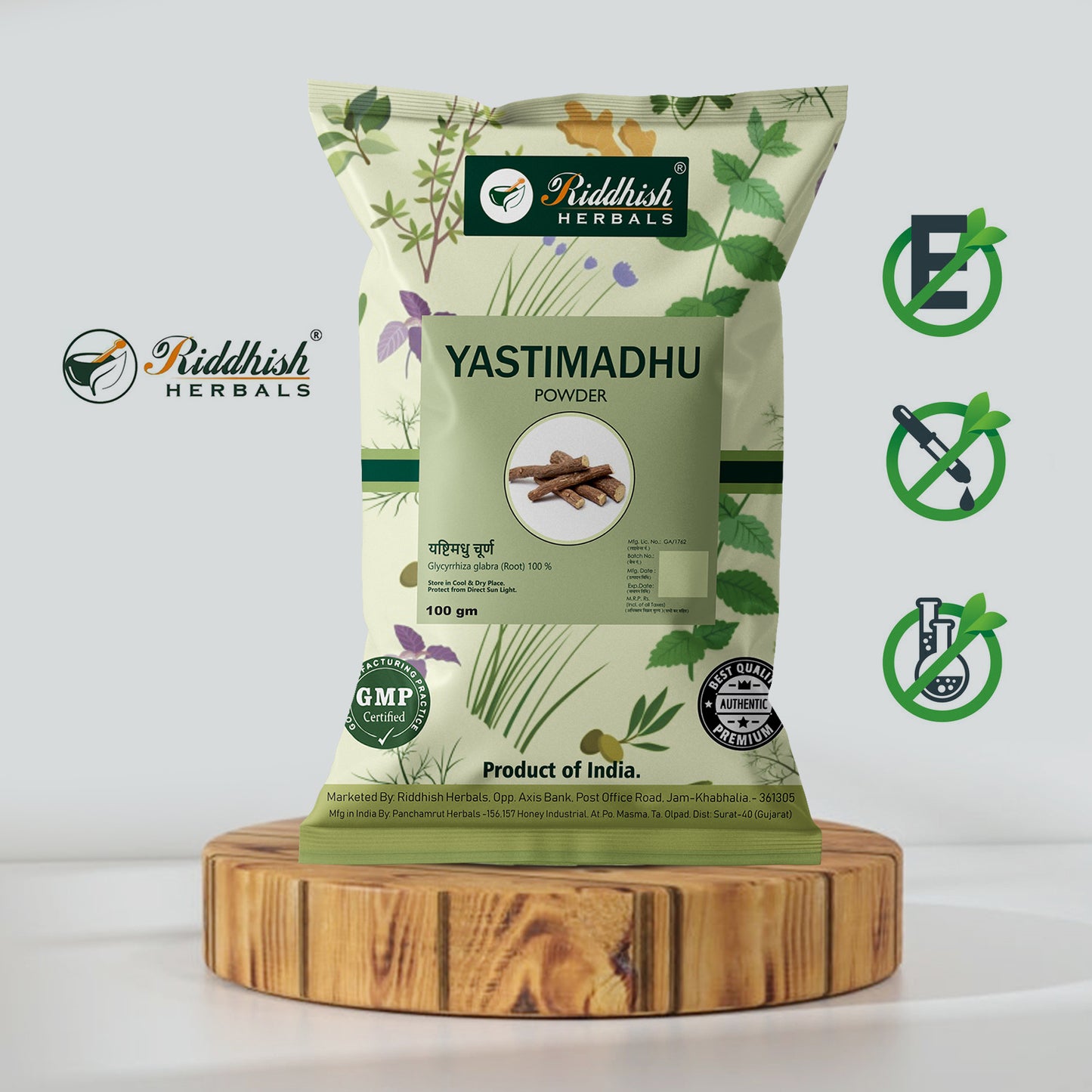
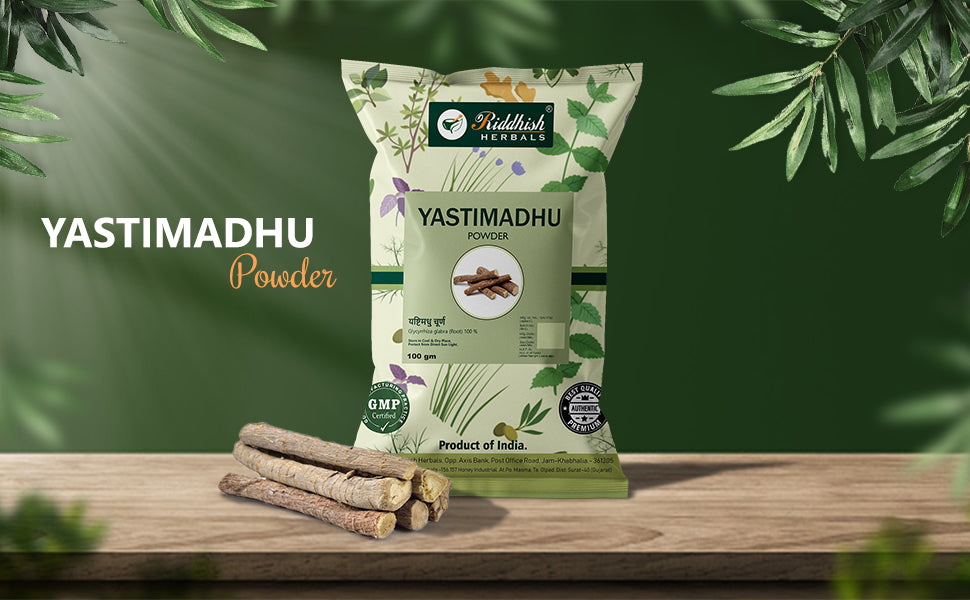
Yastimadhu Powder is a single-herb Ayurvedic churna made from 100% pure Yashtimadhu (Mulethi / Licorice), the root of Glycyrrhiza glabra. Sweet in taste (madhura rasa) and cooling in potency (sheeta virya), Yashtimadhu is one of the most quoted herbs in the classical texts — valued for kantya (throat and voice), soothing the digestive tract, and as a gentle Rasayana. Riddhish Herbals offers it as a clean, root-only powder, milled and packed in a GMP-certified facility.
About Yastimadhu Powder
Yashtimadhu means “the sweet stick” — a fitting name for a root that has flavoured remedies and kitchens across India for centuries. Known as Mulethi in Hindi and Jethimadh in Gujarati, it is the root of Glycyrrhiza glabra, and this pack contains that root and nothing else: a single-herb powder, 100% pure.
In classical Ayurveda, Yashtimadhu is celebrated for its madhura (sweet) rasa and sheeta (cooling) virya, which together make it soothing to irritated tissues and calming to aggravated Pitta and Vata. It has long been a household herb for the throat and voice, for a comfortable digestive tract, and as a nourishing Rasayana taken in small amounts.
Because it is a versatile root powder, Yashtimadhu can be taken internally with a suitable anupan or used externally in traditional lepa (face and skin packs) for varnya (complexion care). As with all classical herbs, it is best used thoughtfully and in the right dose — see the Safety section below, which matters more for licorice than for most herbs.
Traditional Ayurvedic Importance
Yashtimadhu (Madhuka) is one of the few herbs that Charaka placed in several of the fifty Mahakashayas (great herbal groups) in the Charaka Samhita, Sutrasthana, Chapter 4 — including the Jivaniya (vitalising), Sandhaniya (uniting), Varnya (complexion) and Kanthya (throat and voice) groups. It is described again in the Sushruta Samhita, the Ashtanga Hridaya, and the Bhavaprakasha Nighantu (Haritakyadi Varga).
Its classical pharmacology is consistent across these texts: Madhura rasa (sweet taste), Guru & Snigdha guna (heavy, unctuous), Sheeta virya (cooling potency) and Madhura vipaka (sweet post-digestive effect), pacifying Vata and Pitta. Among its classically attributed karmas are kanthya (good for the throat/voice), chakshushya (eye-supportive), varnya (complexion), keshya (hair), balya (strengthening), and rasayana (rejuvenation). It is classically described in the context of kasa (cough), swarabheda (hoarseness), amlapitta (hyperacidity) and trishna (thirst) — presented here as traditional textual references, not as statements about what this product does.
Key Features
- Single-herb & label-verified — 100% Yashtimadhu, the root of Glycyrrhiza glabra, with nothing else added.
- Root-only powder — made from the medicinally used root, as stated on the pack (“Glycyrrhiza glabra (Root) 100%”).
- Throat & voice tradition — classically a kanthya herb, long valued for the throat and voice.
- Soothing & cooling — madhura rasa and sheeta virya make it gentle on Pitta and irritated tissues.
- Rasayana character — traditionally taken in small amounts as a nourishing, rejuvenating herb.
- Versatile use — taken internally with a suitable anupan, or used externally in lepa for varnya (complexion care).
- GMP-certified milling — produced in a GMP-certified facility and sold with a genuine bill by Riddhish Herbals.
Composition (Label-Verified)
| Ingredient (Sanskrit) | Botanical Name | Plant Part | Proportion |
|---|---|---|---|
| Yashtimadhu (Mulethi) | Glycyrrhiza glabra | Root | 100% |
A single-herb Ayurvedic raw-material churna. Net weight 100 g.
Research & Scientific References
Licorice (Glycyrrhiza glabra) is one of the most studied medicinal roots; its principal constituents — glycyrrhizin, glycyrrhetinic acid and flavonoids such as glabridin — are well characterised in the pharmacological literature. A few peer-reviewed references relevant to its traditional throat and digestive-soothing uses:
- A randomised study found that a licorice gargle before anaesthesia reduced the incidence and severity of post-operative sore throat, under study conditions. — (Agarwal A et al., 2009, Anesthesia & Analgesia 109(1):77–81; PMID 19535697). Note: later trials report mixed results, so findings are not uniform.
- A randomised, double-blind, placebo-controlled trial reported that a standardised extract of Glycyrrhiza glabra (75 mg twice daily for 30 days) improved upper-digestive comfort scores versus placebo in adults with functional dyspepsia, under study conditions. — (Raveendra KR et al., 2012, Evidence-Based Complementary & Alternative Medicine 2012:216970; PMID 21747893)
How to Use & Anupan
Internal use: Generally 1–2 teaspoons (about 3–5 g) once or twice daily, or as directed by your Ayurvedic physician.
Anupan (vehicle): Traditionally taken with lukewarm water, milk or honey. Your physician may suggest a vehicle suited to your constitution.
External use: Can be blended into a paste (lepa) with water, milk or rose water for a traditional face or skin pack.
Because licorice is best not taken in large amounts for long unbroken periods, keep to the advised dose and duration.
Who Can Use It
Yashtimadhu suits most adults as an occasional, dose-controlled herb for throat comfort, digestive soothing and complexion care. It is not recommended for people with high blood pressure, heart conditions, kidney disease or low potassium, and not during pregnancy or lactation, except on the advice of a qualified physician. Anyone on blood-pressure, diuretic, corticosteroid or heart (digoxin) medication should consult their physician before use.
Safety Information
Licorice deserves a little more care than most kitchen herbs. Prolonged use of high doses can cause water/sodium retention, lowered potassium and raised blood pressure in sensitive individuals. Use the recommended amount, avoid continuous long-term high-dose use, and take breaks. Consult your physician before use — especially if you are pregnant, lactating, have hypertension or a heart, kidney or potassium-related condition, or are on any medication. Keep out of reach of children. Results may vary from person to person.
Storage
Store in a cool, dry place. Protect from direct sunlight. Keep the pack tightly closed to preserve freshness.
Frequently Asked Questions
Is this product GMP certified?
Yes — Yastimadhu Powder is manufactured in a GMP-certified facility (Mfg. Lic. No. GA/1762) and marketed by Riddhish Herbals, who provide a genuine bill with every purchase.
What exactly is in the pack?
Only one ingredient: 100% Yashtimadhu (Mulethi), the root of Glycyrrhiza glabra. No fillers, no additives — as stated on the label.
What is Yashtimadhu / Mulethi?
Yashtimadhu (Madhuka), known as Mulethi in Hindi, Jethimadh in Gujarati and Licorice in English, is the sweet root of Glycyrrhiza glabra — one of the most widely used herbs in classical Ayurveda.
What are its other names and spellings?
Also written Yashtimadhu, Yastimadhu, Jethimadh, Jeshtamadhu and Mulhatti. In Tamil it is Atimaduram, in Telugu Atimadhuram, in Malayalam Irattimadhuram.
How is Riddhish Herbals Yastimadhu different from other brands?
It is a label-verified, root-only single-herb powder, milled in a GMP-certified facility, with classical grounding and an honest safety section — reviewed for accuracy by Dr. Riddhish Padiya (Ph.D., Dravyaguna). We state the plant part (root) and proportion transparently.
Which classical texts mention it?
Charaka Samhita lists Madhuka among several Mahakashayas (Sutrasthana, Ch. 4); it also appears in the Sushruta Samhita, Ashtanga Hridaya and Bhavaprakasha Nighantu.
What is the recommended anupan?
Lukewarm water, milk or honey is traditional. Your physician may suggest a vehicle based on your prakriti.
Can it be used on the skin?
Yes — it is traditionally blended into a lepa (paste) for face and skin packs, in keeping with its classical varnya (complexion) reputation.
Is it safe to take every day?
In small, dose-controlled amounts it is generally well tolerated, but licorice should not be taken in high doses for long unbroken periods. Please read the Safety section and consult your physician, especially if you have high blood pressure.
Has licorice been studied scientifically?
Yes — its constituents, traditional throat use and digestive-soothing use have been examined in published research, including a randomised, placebo-controlled trial of a Glycyrrhiza glabra extract in functional dyspepsia (see the Research section). Such studies describe observations under specific conditions, sometimes with mixed results, and are not medical claims about this product.
Is it available at Riddhish Herbals?
Yes. It is available at riddhishherbals.com and at Riddhish Herbals retail counters in Gujarat, with pan-India delivery.
Regional Names Across India
Yashtimadhu is known by many names across India:
| Language | Regional Script | Romanised / Name |
|---|---|---|
| Sanskrit | यष्टिमधु | Yaṣṭimadhu, Madhuka, Klītaka, Yaṣṭī |
| Hindi | मुलेठी | Mulethī, Mulahaṭhī |
| Gujarati | જેઠીમધ | Jeṭhīmadh |
| Marathi | ज्येष्ठमध | Jyeṣṭhamadh |
| Bengali | যষ্টিমধু | Yaṣṭimadhu, Jôṣṭhimodhu |
| Punjabi | ਮੁਲੱਠੀ | Mulaṭhī |
| Tamil | அதிமதுரம் | Atimaduram |
| Telugu | అతిమధురం | Atimadhuram |
| Kannada | ಜೇಷ್ಠಮಧು | Jēṣṭhamadhu, Atimadhura |
| Malayalam | ഇരട്ടിമധുരം | Iraṭṭimadhuram |
| English | — | Licorice, Liquorice, Sweet Wood |
| Botanical | — | Glycyrrhiza glabra L. (Fabaceae) |
Related Ayurvedic Products
- Yashtimadhu Ghanvati (60 Tablets) — the same herb in a convenient tablet form
- Yashtimadhu Ghritam (100 g) — classical medicated ghee of Yashtimadhu
- Digestive Wellness collection
- Explore more single-herb churnas and classical formulations at Riddhish Herbals.
Marketed by Riddhish Herbals, Opp. Axis Bank, Post Office Road, Jam-Khambhalia – 361305, Dist. Devbhumi Dwarka, Gujarat. Manufactured by our contract-manufacturing partner Panchamrut Herbals (Surat) in a GMP-certified facility, Mfg. Lic. No. GA/1762. A single-herb Ayurvedic raw material — to be used thoughtfully and under guidance. Reviewed for classical and compositional accuracy by Dr. Riddhish Padiya (Ph.D., Dravyaguna).