

Riddhish Herbals
Triphala Churna | Amla Haritaki Baheda | Riddhish Herbals | 100gm
Triphala Churna | Amla Haritaki Baheda | Riddhish Herbals | 100gm
Couldn't load pickup availability
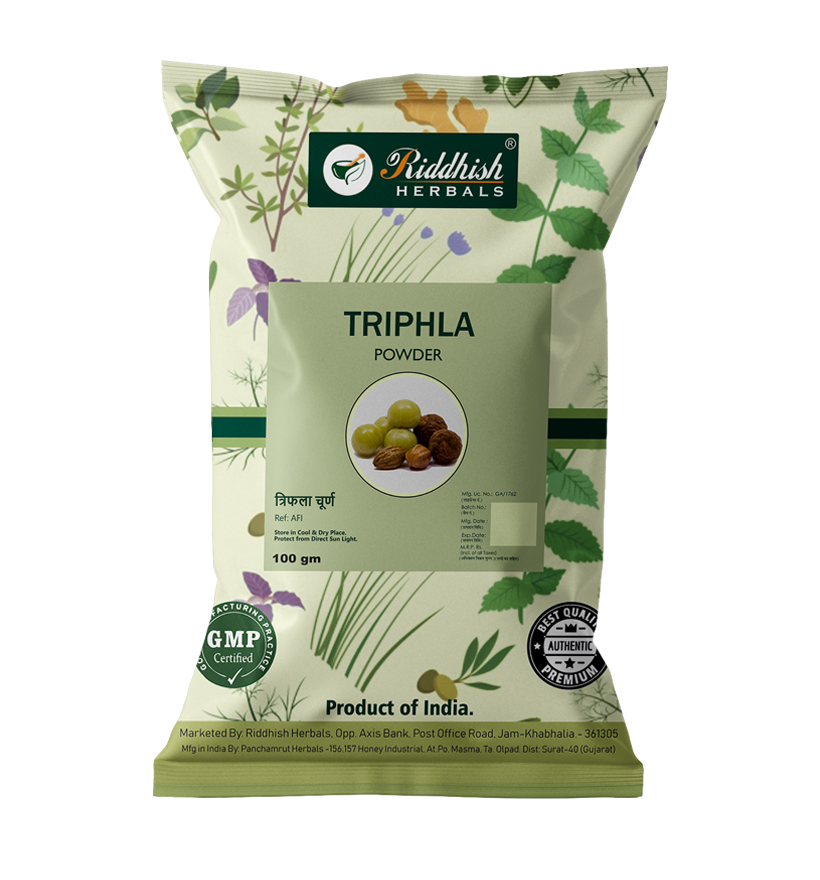
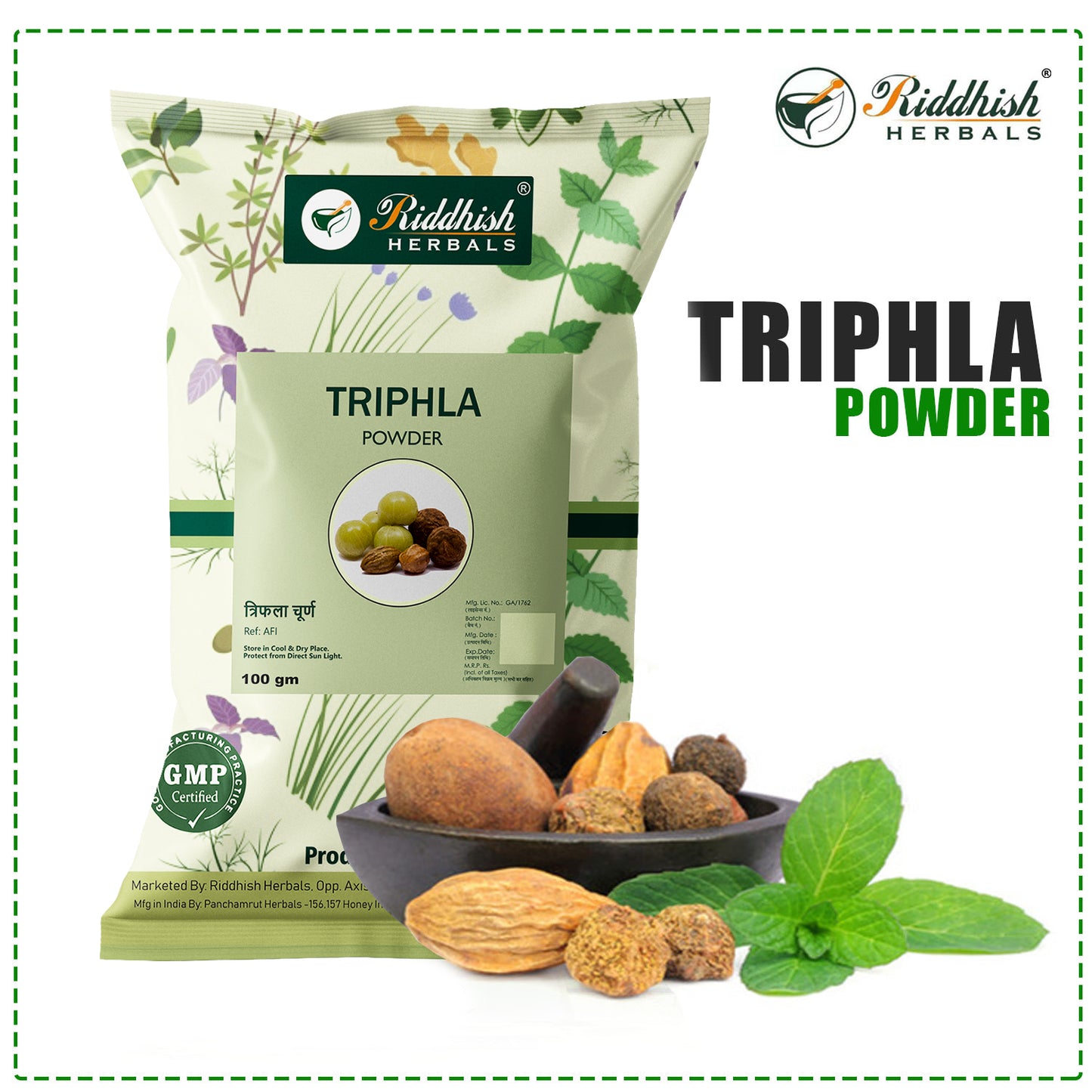
Triphala Churna is the classical Ayurvedic "three fruits" — Amalaki, Haritaki and Bibhitaki in equal measure, prepared per the Ayurvedic Formulary of India (AFI). One of the few formulas classically described as Tridoshahara (balancing for all three doshas) and a foremost Rasayana, it is traditionally valued for digestion, regularity and gentle daily cleansing. Own-brand, 100 g.
About Triphala Churna
Triphala — also spelled Triphla, Trifla or Tri Phala — means "three fruits" in Sanskrit: Tri (three) + Phala (fruits). The three are Amalaki (Emblica officinalis), Haritaki (Terminalia chebula) and Bibhitaki (Terminalia bellirica). What makes it exceptional in classical Ayurveda is not the sum of its parts but the synergy between them.
Each fruit carries a distinct classical profile: Amalaki is associated with Pitta balance and Rasayana nourishment; Haritaki with Vata balance and gentle internal cleansing; and Bibhitaki with Kapha balance. Combined in the classical 1:1:1 ratio, Triphala is classified as Tridoshahara — suitable for all three constitutional types. Riddhish Herbals Triphala Powder is prepared from all three pure fruits, with no synthetic preservatives, GMOs or added colours.
Traditional Ayurvedic Importance
The Charaka Samhita (Chikitsa Sthana, Rasayana Pada) places Triphala among the foremost Rasayana formulations, describing it as appropriate for year-round use and suitable for all body types — a classification rarely given to any single formula. The Sushruta Samhita emphasises its role in digestive and cleansing traditions as a Tridoshahara compound.
The Ashtanga Hridayam gives one of the most detailed classical descriptions of the individual fruits — attributing to Amalaki its Madhura-vipaka (sweet post-digestive effect), to Haritaki its Katu-vipaka (pungent post-digestive effect), and to Bibhitaki its Laghu–Ruksha (light, dry) qualities — together creating a compound of a complexity no single herb achieves. Classical texts also note Triphala's traditional Chakshushya (eye-supportive) association. This product carries the pack reference AFI (Ayurvedic Formulary of India), the Government of India's official formulary.
Key Features
- Classical three-fruit formula: Amalaki, Haritaki and Bibhitaki in equal 1:1:1 parts, per the Ayurvedic Formulary of India (AFI).
- Tridoshahara: one of the few formulations classically described as balancing for Vata, Pitta and Kapha together.
- Digestive wellness tradition: traditionally valued for natural bowel rhythm, regularity and digestive strength (Agni).
- Foremost Rasayana: classified in the Charaka Samhita among the foremost year-round rejuvenative formulations.
- Gentle daily cleansing: classically associated with supporting the body's own cleansing processes.
- Pure three-herb blend: vegetarian and vegan, no GMOs, no synthetic preservatives, no added colours.
- Own-brand, GMP facility: a Riddhish Herbals own-brand churna, manufactured in a GMP-certified facility (Mfg. Lic. GA/1762).
Composition (Label-Verified)
| Ingredient | Botanical | Plant Part | Proportion |
|---|---|---|---|
| Haritaki | Terminalia chebula | Fruit pericarp | 1 part |
| Bibhitaki | Terminalia bellirica | Fruit pericarp | 1 part |
| Amalaki | Emblica officinalis | Dried fruit | 1 part |
Equal parts (1:1:1) as described in the Ayurvedic Formulary of India (AFI). Classical profile — Rasa: five tastes except Lavana (predominantly Kashaya/astringent); Guna: Laghu, Ruksha; Karma: Deepana, Anulomana, Rasayana, Tridoshahara, Chakshushya.
Research & Scientific References
Triphala is among the most-studied classical Ayurvedic formulations in published phytopharmacological research. A widely cited review examined the research literature and noted parameters consistent with its traditionally described digestive and antioxidant properties. (Peterson et al., 2017 — Journal of Alternative and Complementary Medicine, University of New Mexico.)
CCRAS (Central Council for Research in Ayurvedic Sciences, Government of India) has published monographs on Triphala as part of its systematic documentation of classical Ayurvedic formulations.
Results were observed under study conditions and individual results may vary. This information is shared for general awareness and does not constitute a treatment claim. Please consult a qualified Ayurvedic physician before use.
How to Use & Anupan
As directed by your Ayurvedic physician. General classical guidance is 3–5 g (about ½ to 1 teaspoon), once or twice daily.
Traditional anupan (vehicle) options: warm water for general digestive use; with honey for Kapha; with ghee for Vata; with sugar candy (Mishri) for Pitta. It is classically taken at bedtime or early morning on an empty stomach. Consistent daily use over weeks, alongside a balanced diet and good hydration, is the traditional approach.
Who Can Use It
Suited to adults seeking a gentle classical churna for digestion, regularity and daily Rasayana support across all constitutions. If you are pregnant, lactating, managing any health condition, taking medication, or considering it for a child, consult a qualified Ayurvedic physician first.
Safety Information
Generally very well tolerated in classical recommended quantities. Pregnant and lactating women should consult a qualified Ayurvedic physician before use. If any digestive discomfort occurs, reduce the quantity and consult your Vaidya. Keep out of reach of children. Results may vary from person to person.
Storage
Store in a cool, dry place, away from direct sunlight and moisture. Keep the container tightly sealed after each use.
Regional Names Across India
Amalaki — Amla (Emblica officinalis)
| Language | Regional Script | Romanised / English |
|---|---|---|
| Sanskrit | आमलकी / धात्री | Amalaki / Dhatri |
| Hindi | आंवला | Amla |
| Gujarati | આમળાં | Amla |
| Marathi | आवळा | Avla |
| Bengali | আমলকী | Amloki |
| Tamil | நெல்லிக்காய் | Nellikkai |
| Telugu | ఉసిరికాయ | Usirikaya |
| Kannada | ನೆಲ್ಲಿಕಾಯಿ | Nellikayi |
| Malayalam | നെല്ലിക്ക | Nellikka |
| English | Indian Gooseberry | — |
Haritaki — Harde (Terminalia chebula)
| Language | Regional Script | Romanised / English |
|---|---|---|
| Sanskrit | हरीतकी / अभया | Haritaki / Abhaya |
| Hindi | हरड़ / हरड़े | Harad / Harde |
| Gujarati | હરડે | Harde |
| Marathi | हिरडा | Hirda |
| Bengali | হরীতকী | Horitoki |
| Tamil | கடுக்காய் | Kadukkai |
| Telugu | కరక్కాయ | Karakkaya |
| Kannada | ಅಣಿಲೆಕಾಯಿ | Anilekayi |
| Malayalam | കടുക്ക | Kadukka |
| English | Chebulic Myrobalan | — |
Bibhitaki — Baheda (Terminalia bellirica)
| Language | Regional Script | Romanised / English |
|---|---|---|
| Sanskrit | बिभीतकी / अक्ष | Bibhitaki / Aksha |
| Hindi | बहेड़ा | Baheda |
| Gujarati | બહેડાં | Baheda |
| Marathi | बेहडा | Behada |
| Bengali | বহেড়া | Bohera |
| Tamil | தான்றிக்காய் | Thanrikkai |
| Telugu | తానికాయ | Tanikaya |
| Kannada | ತಾರೆಕಾಯಿ | Tarekayi |
| Malayalam | താന്നിക്ക | Thannikka |
| English | Belleric Myrobalan | — |
Formula also known as: Triphala Churna, Triphla / Trifla Churna, Three-Fruit Powder. Hindi/Sanskrit: त्रिफला चूर्ण · Gujarati: ત્રિફળા ચૂર્ણ.
Frequently Asked Questions
What is Triphala Churna?
Triphala Churna is a classical Ayurvedic formulation of three fruits — Amalaki (Emblica officinalis), Haritaki (Terminalia chebula) and Bibhitaki (Terminalia bellirica) — in equal proportion, prepared per the Ayurvedic Formulary of India (AFI). Classical texts including the Charaka Samhita classify it as Tridoshahara and a foremost Rasayana.
What are the three fruits in Triphala?
Amalaki (Amla, Emblica officinalis), Haritaki (Harde, Terminalia chebula) and Bibhitaki (Baheda, Terminalia bellirica), each in equal 1:1:1 part.
Is this Triphala GMP certified?
Yes — it is a Riddhish Herbals own-brand churna manufactured in a GMP-certified facility (Mfg. Lic. GA/1762) and prepared to the AFI reference. GMP refers to the quality standard of the manufacturing facility, not a therapeutic claim.
What is the correct anupan for Triphala?
Classical texts describe seasonal anupan options: warm water (general), honey (Kapha), ghee (Vata) and sugar candy / Mishri (Pitta). The most widely used is warm water. Consult your Vaidya for guidance suited to your constitution.
Can Triphala be taken at night?
Yes — taking Triphala at bedtime with warm water for digestive wellness and overnight regularity is one of the most traditional methods of use. Consult your Vaidya for dose and timing appropriate to your constitution.
Who can take Triphala?
It is classically described as suitable across all three constitutions (Tridoshahara). Pregnant or lactating women, children, and anyone managing a condition or on medication should use it under the guidance of a qualified Ayurvedic physician.
What are the alternate names and spellings?
Also spelled Triphla, Trifla and Tri Phala. In scripts: त्रिफला चूर्ण (Hindi/Sanskrit), ત્રિફળા ચૂર્ણ (Gujarati), திரிபலா (Tamil), త్రిఫల (Telugu).
How is Riddhish Herbals Triphala different?
It is an honest, label-verified equal-part (1:1:1) classical blend of all three authentic fruits, prepared to the AFI reference and manufactured in a GMP-certified facility — an own-brand product sold by Riddhish Herbals with a bill provided.
Is it available at Riddhish Herbals?
Yes — at our Khambhalia, Gujarat retail store and at riddhishherbals.com with pan-India delivery, a bill provided and doctor-guided selection, since 2015.
Has Triphala been studied scientifically?
Yes — a widely cited 2017 review (Peterson et al., Journal of Alternative and Complementary Medicine) examined published research consistent with its traditional digestive and antioxidant properties, and CCRAS has published monographs on it. Findings were observed under study conditions and individual results may vary.
Triphala is built from three fruits — each also available on its own, and the formula sits within our wider digestive range:
- Amla Powder (Amalaki Churna) — the Amalaki of this blend, as a single-herb churna.
- Haritaki Churna (Harde Powder) — the Haritaki of this blend, on its own.
- Baheda Powder (Bibhitaki Churna) — the Bibhitaki of this blend, on its own.
- Avipattikar Churna and Pet Nirogi Churna — companion digestive churnas.
- Triphala — the complete three-fruit guide, with the Amla and Haritaki ingredient guides.
Riddhish Herbals — Gujarat's trusted Ayurvedic store since 2015. Genuine products · Bill provided · Doctor-guided selection · Pan-India delivery. A Riddhish Herbals own-brand product, manufactured by our contract-manufacturing partner Panchamrut Herbals (Mfg. Lic. GA/1762) in a GMP-certified facility. Classical reference: Ayurvedic Formulary of India (AFI). This is a traditional Ayurvedic product; statements reflect classical Ayurvedic use and are not intended to diagnose, treat, cure or prevent any disease.