

Riddhish Herbals
Abhayarishta (Abhayarishtam) – Haritaki Digestive Arishta – Virgo UAP Pharma – 450 ml
Abhayarishta (Abhayarishtam) – Haritaki Digestive Arishta – Virgo UAP Pharma – 450 ml
Couldn't load pickup availability
Abhayarishta is a classical fermented Ayurvedic liquid (arishta) made by Virgo UAP Pharma in which Abhaya (Haritaki, Terminalia chebula) is the lead dravya, combined with a large share of Amalaki, sweet Draksha, Kaith and gentle spices, and matured with its own naturally generated alcohol (not more than 12% v/v). In classical Ayurveda it is an Anulomana preparation, traditionally valued for comfortable, regular bowel movement and easy digestion. Amalaki (Emblica officinalis), a major constituent, has itself been reviewed in the modern research literature (peer-reviewed review, 2016 — Pharmacological Research).
About Abhayarishta
Abhayarishta is a classical fermented Ayurvedic tonic (arishta) built around Abhaya — Haritaki, Terminalia chebula, ‘the fearless one’ of Ayurveda. Manufactured by Virgo UAP Pharma and supplied by Riddhish Herbals, it follows the Siddha Yoga Sangraha (s.y.s.) reference printed on the pack.
Around Haritaki the formula carries a generous dose of Amalaki, sweet Draksha, Kaith (Feronia), Vidanga and warm aromatic spices, with Dhataki flowers driving the fermentation. Abhayarishta is one of Ayurveda's best-loved liquids for gentle, comfortable digestion.
Traditional Ayurvedic Importance
In classical Ayurveda, Haritaki (Abhaya) is a foremost Anulomana and Deepana-Pachana dravya, and Abhayarishta is described in the Siddha Yoga Sangraha as a preparation that supports comfortable, regular bowel movement (it is a classical, lawful laxative and carminative formulation).
Amalaki and Draksha are nourishing and cooling; Vidanga is a traditional Krimighna dravya; the aromatic spices are carminative. Dhataki (Woodfordia fruticosa) is the Sandhana dravya that gives the arishta its self-generated alcohol and long shelf stability.
Key Features
- Abhaya (Haritaki)-led digestive arishta — with a large dose of Amalaki and sweet Draksha.
- Classical Anulomana focus — traditionally valued for comfortable, regular bowel movement.
- Made to the Siddha Yoga Sangraha (s.y.s.) formula by Virgo UAP Pharma (Virgo UAP Pharma Pvt. Ltd., Ahmedabad).
- Naturally fermented — carries its own self-generated alcohol, not more than 12% v/v.
- Label-verified composition — quantities reproduced exactly from the physical pack; genuine stock with bill from Riddhish Herbals.
Research on the Constituents
◆ Amalaki (Emblica officinalis) — a major constituent of Abhayarishta — has been reviewed in the research literature for its phytochemistry and traditional uses — (peer-reviewed review, 2016 — Pharmacological Research). PMID 27320046. View on PubMed
Results were observed under study conditions. Individual results may vary. This is shared for general educational interest and is not a medical claim. Consult your Ayurvedic physician before use.
Composition (label-verified, per 10 ml)
| Ingredient | Botanical | Part | Quantity |
|---|---|---|---|
| Abhaya (Badi Haritaki) | Terminalia chebula | Fruit | 288.38 mg |
| Amalaki | Emblica officinalis | Fruit | 576.76 mg |
| Kaith Guda | Limonia acidissima (Feronia) | Fruit | 360.29 mg |
| Indrayana Phala | Citrullus colocynthis | Fruit | 180.13 mg |
| Vidanga | Embelia ribes | Fruit | 71.89 mg |
| Pippali | Piper longum | Fruit | 71.89 mg |
| Lodhra | Symplocos racemosa | Stem Bark | 71.89 mg |
| Maricha | Piper nigrum | Fruit | 71.89 mg |
| Shatapushpa (Saunf) | Foeniculum vulgare | Fruit | 71.89 mg |
| Draksha | Vitis vinifera | Dried Fruit | 306.16 mg |
| Dhataki Pushpa | Woodfordia fruticosa | Flower | 143.80 mg |
| Dalchini (Twak) | Cinnamomum zeylanicum | Stem Bark | 35.55 mg |
| Tamalapatra | Cinnamomum tamala | Leaf | 35.55 mg |
| Chhoti Elaichi | Elettaria cardamomum | Fruit | 35.55 mg |
| Nagakeshara | Mesua ferrea | Stamen | 35.55 mg |
| Arishta Base | — | — | Q.S. |
Values are per 10 ml, reproduced exactly from the physical label. Book reference: Siddha Yoga Sangraha (s.y.s.). Contains self-generated alcohol, not more than 12% v/v.
How to Use
As directed by your Ayurvedic physician. Traditionally, 10 to 20 ml is taken after meals twice daily, diluted with an equal quantity of water (the anupana). Shake gently before use.
Who Can Use It
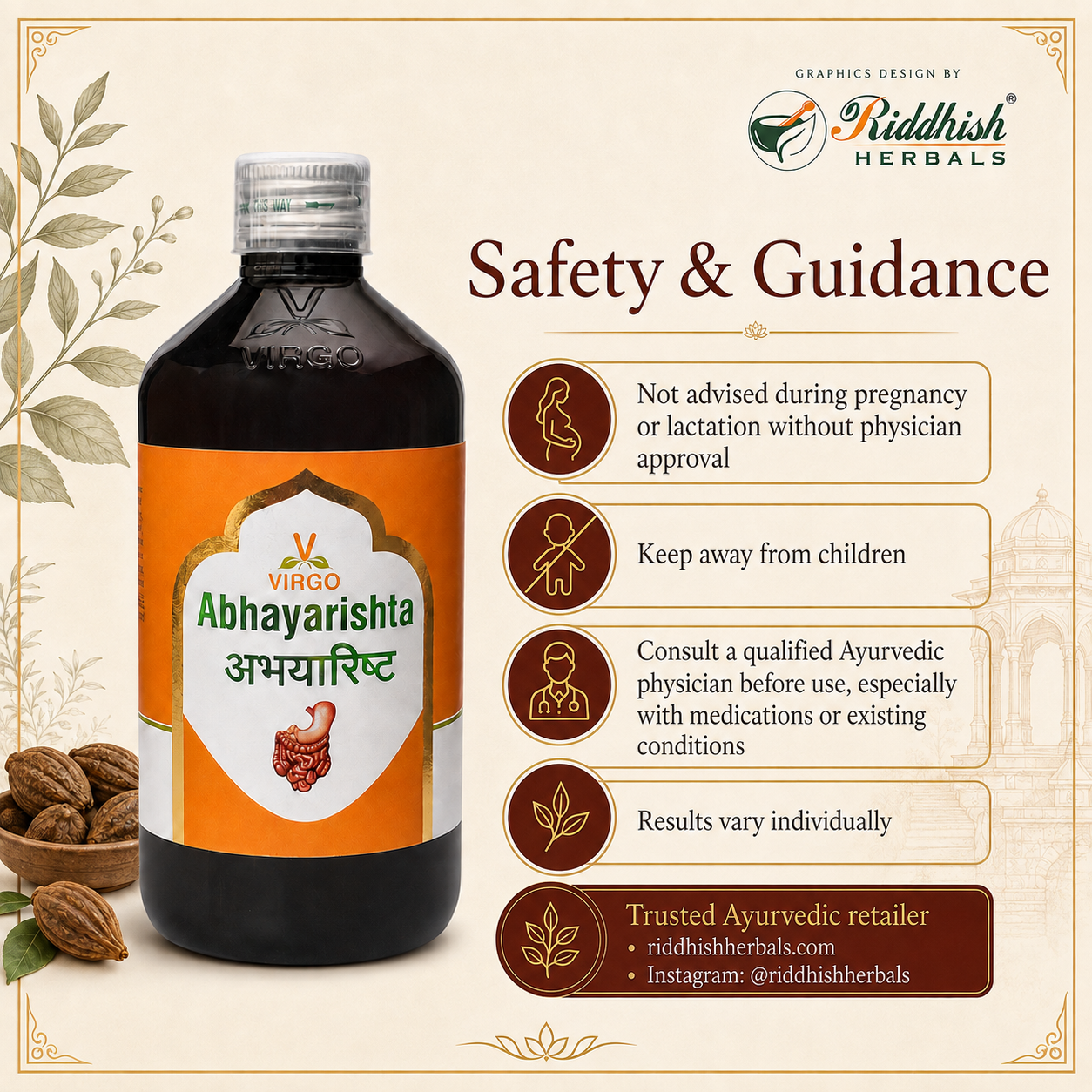
Adults seeking a classical Ayurvedic digestive tonic as part of a daily routine. Because the preparation is best matched to your constitution by a physician, and because it carries naturally generated alcohol, it is taken on the advice of a physician. Not recommended during pregnancy or lactation except on the advice of a qualified Ayurvedic physician; keep out of reach of children.
Safety Information
Abhayarishta is a classical Ayurvedic Anulomana preparation, best used under the guidance of a qualified Ayurvedic physician who can match the preparation, dose and duration to you. It contains self-generated alcohol (not more than 12% v/v). Consult your physician before use if you are pregnant, lactating, taking any medication, or managing any health condition. Results may vary from person to person.
Storage
Store in a cool, dry place away from direct sunlight and keep the bottle tightly closed. A natural sediment may settle at the bottom of an arishta — this is normal; shake gently before use.
Frequently Asked Questions
What is Abhayarishta?
Abhayarishta is a classical fermented Ayurvedic liquid (arishta) built around Abhaya (Haritaki, Terminalia chebula), traditionally valued in Ayurveda as an Anulomana tonic for comfortable, regular bowel movement.
Is Abhayarishta made to a classical formula?
Yes. This Virgo UAP Pharma Abhayarishta follows the Siddha Yoga Sangraha (s.y.s.) reference, as printed on the pack.
What is the main ingredient in Abhayarishta?
Abhaya (Haritaki) is the lead dravya, with a large share of Amalaki (576.76 mg) and sweet Draksha (306.16 mg) per 10 ml.
What is Abhayarishta also known as?
It is also written as Abhayarishtam and Abhaya Arishta; Abhaya is a classical name for Haritaki.
Does Abhayarishta contain alcohol?
It contains only self-generated alcohol from natural fermentation, not more than 12% v/v. No alcohol is added from outside; it develops during the classical Sandhana process.
How should Abhayarishta be taken?
As advised by your Ayurvedic physician. Traditionally 10 to 20 ml is taken after meals twice daily with an equal quantity of water.
Can I take Abhayarishta without consulting a doctor?
It is best taken on the advice of a qualified Ayurvedic physician, who can decide whether it suits you and for how long.
Has a constituent of Abhayarishta been studied scientifically?
Amalaki (Emblica officinalis), a major constituent, has been reviewed in the published research literature (2016, Pharmacological Research). Results were observed under study conditions and individual results may vary.
How should I store Abhayarishta?
Keep it in a cool, dry place away from sunlight, tightly closed. Shake gently before use as a natural sediment may settle.
Is Abhayarishta available at Riddhish Herbals?
Yes. Riddhish Herbals stocks genuine Virgo UAP Pharma Abhayarishta 450 ml with a bill and pan-India delivery.
Related at Riddhish Herbals
Virgozest 500 g — Virgo UAP Pharma (a dry-fruit avaleha, not a Chyawanprash — it contains no Amla) · Kutajarishta – Virgo UAP Pharma · Kumaryasava – Virgo UAP Pharma · Drakshasava – Virgo UAP Pharma · Dhavdi / Dhataki Phool Churna · Ayurvedic Asava & Arishta