

Riddhish Herbals
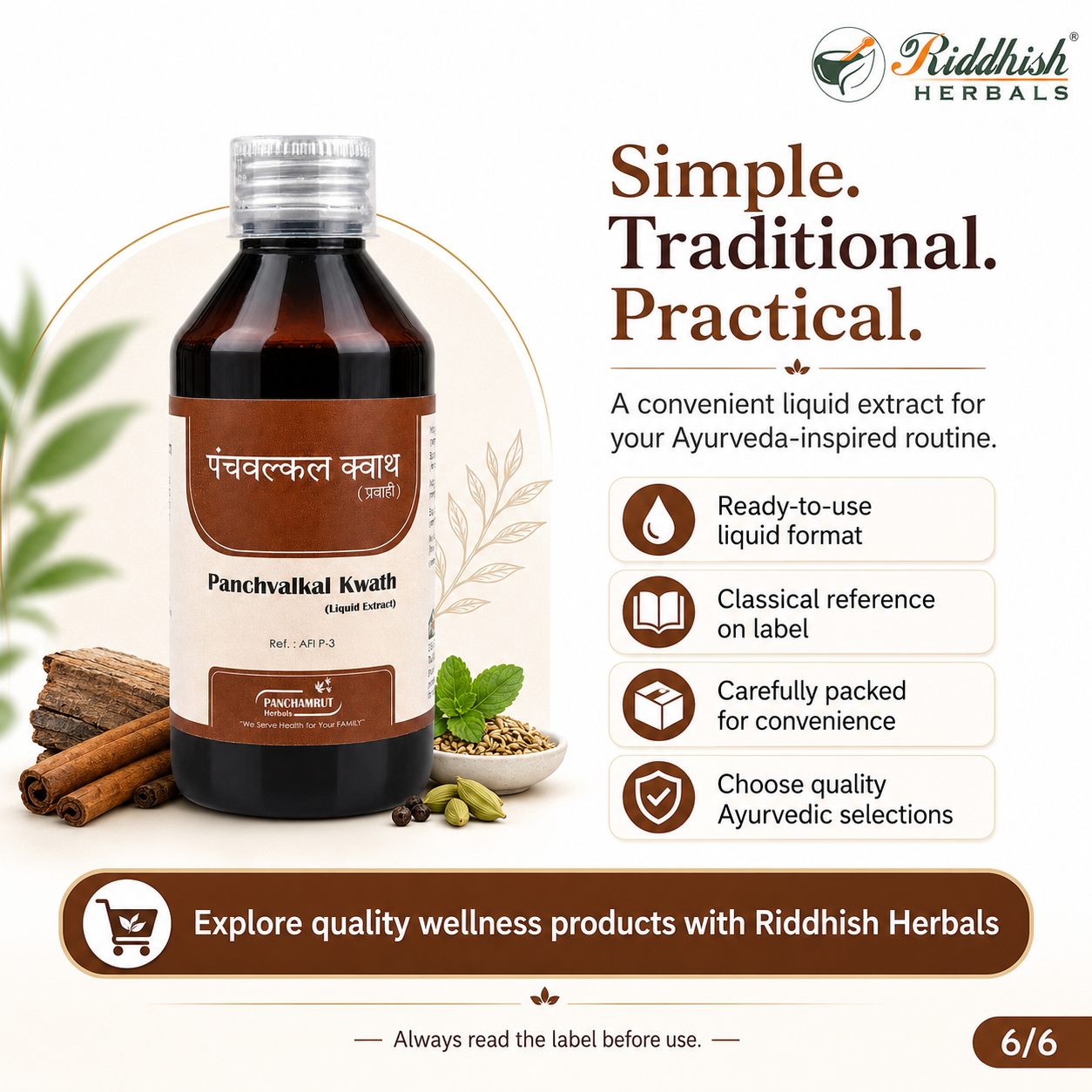
Panchvalkal Kwath Liquid (Panchavalkala) – Five-Bark Extract – Panchamrut Herbals – 200ml
Panchvalkal Kwath Liquid (Panchavalkala) – Five-Bark Extract – Panchamrut Herbals – 200ml
Couldn't load pickup availability
Panchvalkal Kwath Liquid is a classical Ayurvedic five-bark (Panchavalkala) decoction extract from Panchamrut Herbals — Vat, Udumber, Ashwath, Parish, and Plax bark extracts, each at 500 mg per 10 ml. Its oral dose is 15 ml to 30 ml with equal water, twice a day after meals, or as directed by your physician; in traditional practice, Panchavalkala preparations are also used externally, with the specific method left to your Ayurvedic physician's direction.
About Panchvalkal Kwath Liquid — Panchamrut Herbals
Panchavalkala — literally "five barks" — is a well-established classical Ayurvedic bark group: Vat (Nyagrodha), Udumber (Audumbara), Ashwath, Parish (Parisha), and Plax (Plaksha). The group is referenced in classical Shalya Tantra (Ayurvedic surgical) literature for its Kashaya Rasa (astringent taste) and Grahi (absorbent/astringent) classical properties. This liquid extract presents all five barks in equal parts, each at 500 mg per 10 ml.
Riddhish Herbals is the authorised and exclusive online seller for Panchamrut Herbals, and has supplied genuine Ayurvedic products across India since 2015. Every purchase ships with a proper bill, and our Ayurvedic physicians are available to help you confirm you're choosing the right formulation for your family's needs.
Traditional Ayurvedic Importance
Panchavalkala-based preparations appear across classical Kashaya (decoction) and external-application formats, and are referenced in classical Shalya Tantra literature. Traditional practice uses Panchavalkala Kwath both internally, as a Kashaya, and externally — as a wash or as an addition to bath water — depending on the preparation and the physician's guidance. The dose of this product is oral (internal); any external application should follow the specific direction of a qualified Ayurvedic physician.
Key Features
- Five Classical Barks, Equal Parts: Vat, Udumber, Ashwath, Parish, and Plax bark extracts, each at 500 mg per 10 ml.
- Kashaya Rasa, Grahi Guna: Classically described astringent taste and absorbent property, per traditional Dravyaguna classification.
- Ready Liquid Extract: A ready-to-dose Kwath (decoction) extract — no separate boiling or preparation needed.
- Oral Dose: 15 ml to 30 ml with equal water, twice a day after meals, or as directed by your physician.
- GMP-, ISO 9001:2015- and HACCP-certified manufacturer: made by Panchamrut Herbals, certified to GMP, ISO 9001:2015 and HACCP standards, Mfg. Lic. GA-1762.
- Panchamrut Herbals — Masma, Olpad, Surat: Manufactured under Mfg. Lic. GA-1762.
- Genuine & Billed — Riddhish Herbals: Since 2015, genuine products, bill provided, doctor-guided selection, pan-India delivery.
Composition
Panchvalkal Kwath Liquid contains all five Panchavalkala barks at 500 mg extract each per 10 ml:
| Bark | Botanical | Per 10 ml |
|---|---|---|
| Vat (Nyagrodha) | Ficus bengalensis | 500 mg |
| Udumber (Audumbara) | Ficus glomerata | 500 mg |
| Ashwath | Ficus religiosa | 500 mg |
| Parish (Parisha) | Thespescia populina | 500 mg |
| Plax (Plaksha) | Ficus lacor | 500 mg |
| Total extract per 10 ml | — | 2,500 mg |
| Water | — | Q.S. |
| Excipients | — | Q.S. |
Form: Liquid extract (Kwath) · Pack size: 200 ml · Mfg. Lic. GA-1762 · Manufactured by Panchamrut Herbals, 156-157 Honey Industrial Area, At. Po. Masma, Ta. Olpad, Dist. Surat, Gujarat.
How to Use
Dose: 15 ml to 30 ml with equal water, twice a day after meals, or as directed by your physician. Shake gently before use.
In traditional practice, Panchavalkala is also used externally (such as a wash or bath-water addition), following your Ayurvedic physician's specific direction.
Who Can Use It
Adults, under the guidance of a qualified Ayurvedic physician. Consult your physician before use if you are pregnant, lactating, on any medication, or managing an existing health condition.
Safety Information
Caution: Keep out of sight and reach of children. Before taking, always consult with your Healthcare Practitioner. To be taken under medical supervision only. Results may vary from person to person.
Storage
Store in a cool, dry, and dark place, below 25°C. Protect from heat.
Also searched as: Panchvalkal Kadha, Panchavalkala Kwath, Panch Valkal Kwath, Panchvalkal Kwatha, and Five-Bark Kwath Liquid — all names for this same formulation.
Frequently Asked Questions
What is Panchvalkal Kwath Liquid?
Panchvalkal Kwath Liquid is a classical Ayurvedic five-bark (Panchavalkala) decoction extract from Panchamrut Herbals, with all five barks — Vat, Udumber, Ashwath, Parish, and Plax — present at 500 mg extract each per 10 ml.
What are the five Panchavalkala barks?
Vat (Nyagrodha), Udumber (Audumbara), Ashwath, Parish (Parisha), and Plax (Plaksha) — five classical barks referenced together in Shalya Tantra literature, each present at 500 mg per 10 ml in this extract.
How do I take Panchvalkal Kwath Liquid?
15 ml to 30 ml with equal water, twice a day after meals, or as directed by your physician.
Is Panchvalkal Kwath used only orally, or also externally?
The dose of this product is oral (internal). In traditional practice, Panchavalkala preparations are also used externally, with the specific external-use method left to your Ayurvedic physician's direction.
What classical context is Panchavalkala referenced in?
Panchavalkala is referenced in classical Shalya Tantra (Ayurvedic surgical) literature, described by its Kashaya Rasa (astringent taste) and Grahi (absorbent/astringent) classical properties.
Is this product GMP certified?
Panchamrut Herbals, the manufacturer of this product, holds GMP, ISO 9001:2015 and HACCP certification. Good manufacturing practice (GMP) relates to how the product is made; these are not claims about any medical outcome.
Can children take Panchvalkal Kwath Liquid?
Panchvalkal Kwath Liquid is intended for adult use under the guidance of a qualified Ayurvedic physician, who can advise on suitability and dosing for a child if appropriate.
What are the alternate names and spellings?
Also written as Panchvalkal Kadha, Panchavalkala Kwath, Panch Valkal Kwath, Panchvalkal Kwatha, and Five-Bark Kwath Liquid — all referring to this same formulation.
Who manufactures Panchvalkal Kwath Liquid?
Panchvalkal Kwath Liquid is manufactured by Panchamrut Herbals (Mfg. Lic. GA-1762), Masma, Olpad, Surat. Riddhish Herbals is the authorised and exclusive online seller for Panchamrut Herbals.
How do I know this is the genuine pack?
Riddhish Herbals is the authorised and exclusive online seller for Panchamrut Herbals. Every order ships with a proper bill, and our Ayurvedic physicians are available to help confirm you're selecting the right formulation for your family's needs.
Related Products
Dashmool Kashayam Tablet — a classical Ayurvedic root-based tablet, also from Panchamrut Herbals.
Erand Bhrust Haritaki Churna — a classical single-ingredient Ayurvedic churna, also from Panchamrut Herbals.
Ayurvedic Medicines — explore classical formulations from Riddhish Herbals.
About Riddhish Herbals
Panchvalkal Kwath Liquid is manufactured by Panchamrut Herbals. Riddhish Herbals is the authorised and exclusive online seller for Panchamrut Herbals, and has supplied genuine Ayurvedic products across India since 2015. This is a traditional Ayurvedic product; information on this page is educational and is not a substitute for professional medical advice.
Since 2015 · Genuine Products · Bill Provided · Doctor-Guided Selection · 4000+ Ayurvedic Products · 130+ Trusted Brands · Pan-India Delivery