

Riddhish Herbals
Pathyadi Kwath (Dry) 100g | Classical Ayurvedic Kashaya for Head Comfort, Acidity & Pitta Balance | Riddhish Herbals
Pathyadi Kwath (Dry) 100g | Classical Ayurvedic Kashaya for Head Comfort, Acidity & Pitta Balance | Riddhish Herbals
Couldn't load pickup availability
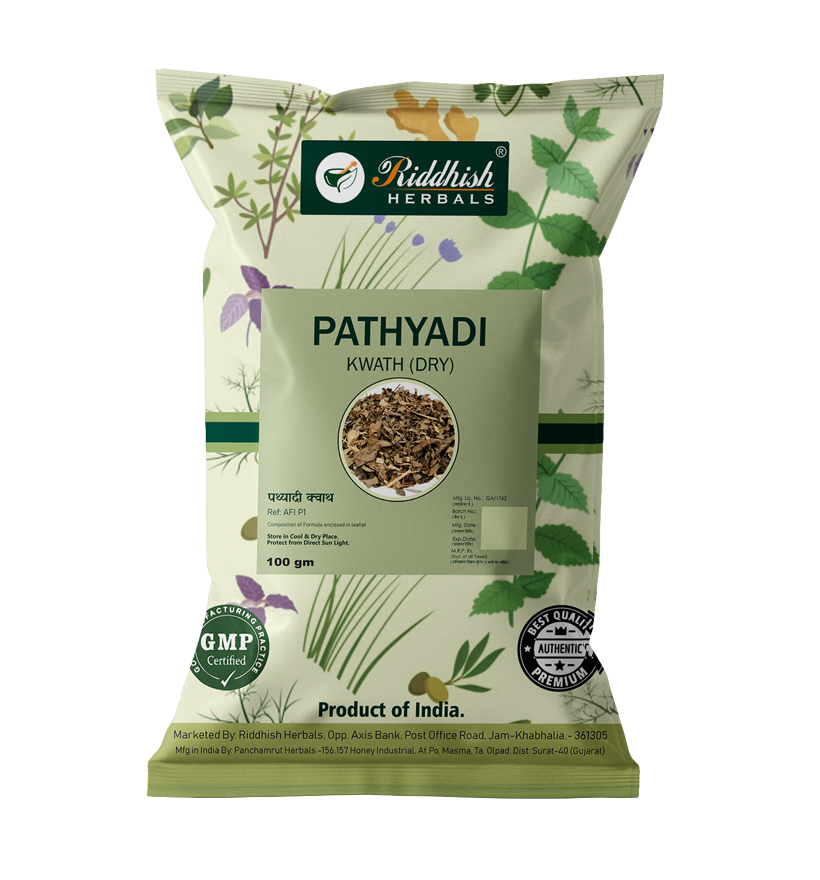
Pathyadi Kwath is a classical Ayurvedic decoction (kashaya) built around Pathya — Haritaki — together with Triphala and a group of cooling, bitter herbs. It is described in the Sharangdhara Samhita and prepared as per the Ayurvedic Formulary of India (AFI), where formulations of this kind are grouped for Shiroroga (disorders of the head) and Amlapitta (Pitta-related acidity). This is the dry coarse-powder form, which you prepare into a fresh decoction at home.
About Pathyadi Kwath (Dry)
The name Pathyadi means “the group beginning with Pathya.” Pathya is one of the classical names for Haritaki (Terminalia chebula), the herb Ayurveda calls a friend to the body. Around it sits the full Triphala trio, joined by Kalmegh, Neem, Haldi and Guduchi — a predominantly tikta (bitter) blend traditionally valued for pacifying aggravated Pitta and clearing ama (metabolic residue). In classical practice this kashaya is associated with head comfort, healthy digestion and the body’s own balance of heat.
Every batch here is the label-verified seven-herb AFI composition — nothing added, nothing implied. It is manufactured for Riddhish Herbals by our long-standing partner facility (Mfg. Lic. GA/1762), which holds GMP, ISO 9001:2015 and HACCP certifications.
Traditional Ayurvedic Importance
Classical literature places Pathyadi Kwath among the formulations for Shiroroga. The Sharangdhara Samhita describes it in the context of Pitta-dominant head discomfort, where bitter, cooling herbs are chosen to settle excess heat. Ardhavabhedaka — the classical term for one-sided head pain — is one of the eleven Shiroroga enumerated by Acharya Sushruta, and Pathyadi type decoctions appear in this tradition.
Haritaki, Bibhitaki and Amalaki together form Triphala, classically described as tridoshahara and gently anulomana (supporting downward movement). Kalmegh (Bhunimba, the “king of bitters”) and Neem are classical tikta-rasa herbs valued for cooling Pitta and supporting clean blood. Haldi is a time-honoured varnya and shodhana herb, and Guduchi (Amrita) is among Ayurveda’s most prized rasayana and jvaraghna herbs. Read together, the formula is a Pitta-pacifying, digestion-supporting kashaya as traditionally understood.
Key Features
- ◆ Classical AFI formula — the authentic seven-herb Pathyadi composition as per the Ayurvedic Formulary of India.
- ◆ Label-verified — every herb, botanical name, plant part and quantity matches the printed pack, ingredient for ingredient.
- ◆ Triphala-rich base — Haritaki, Bibhitaki and Amalaki in equal measure, traditionally valued for daily balance.
- ◆ Bitter, Pitta-friendly herbs — Kalmegh, Neem and Guduchi, classically chosen to settle excess heat.
- ◆ Dry coarse powder — you prepare the kashaya fresh, the way classical decoctions are intended to be taken.
- ◆ Quality-assured facility — made in a GMP-, ISO 9001:2015- and HACCP-certified manufacturing unit.
- ◆ Genuine & billed — from Riddhish Herbals, Gujarat’s trusted Ayurvedic store since 2015, with a proper bill on every order.
Ingredients (per 100 g — AFI composition)
| Herb (Sanskrit / common) | Botanical | Part used | Qty |
|---|---|---|---|
| Haritaki / Pathya / Harad | Terminalia chebula | Fruit pericarp | 14.29 g |
| Bibhitaki / Baheda | Terminalia bellirica | Fruit pericarp | 14.29 g |
| Amalaki / Amla | Phyllanthus emblica | Fruit pericarp | 14.29 g |
| Bhunimba / Kalmegh / Kariyatu | Andrographis paniculata | Whole plant / aerial part | 14.29 g |
| Haridra / Haldi | Curcuma longa | Rhizome | 14.29 g |
| Nimba / Neem | Azadirachta indica | Stem bark | 14.29 g |
| Guduchi / Giloy / Galo | Tinospora cordifolia | Stem | 14.29 g |
Reference: AFI P1. Total batch size 100 g, seven herbs in equal parts. Manufactured under Mfg. Lic. GA/1762.
How to Prepare & Use
This is a dry coarse powder, not a ready liquid — you make the kashaya fresh. The classical method: take about 3–6 g (roughly one teaspoon) of the powder, add to about 200 ml (one glass) of water, and gently boil until reduced to about one-fourth (roughly 50 ml). Strain and drink it lukewarm.
Anupan (vehicle): warm water is the everyday choice; some classical uses add a little honey or jaggery once the decoction has cooled slightly. Timing: traditionally taken on an empty stomach, once or twice daily, or exactly as directed by your Ayurvedic physician.
Research & Scientific References
Several herbs in this formula have been the subject of published phytopharmacological research. Standardised extracts of Andrographis paniculata (Kalmegh) have been studied for antioxidant and anti-inflammatory activity in laboratory conditions — (Low et al., 2015 — BMC Complementary and Alternative Medicine). Triphala, the three-fruit base of this kashaya, has likewise been explored for its antioxidant and neuroprotective properties under study conditions — (Suryavanshi et al., 2021 — Frontiers in Pharmacology).
Results were observed under study conditions and individual results may vary. These references describe the constituent herbs and are not a claim about this product. Consult your Ayurvedic physician before use.
Safety Information
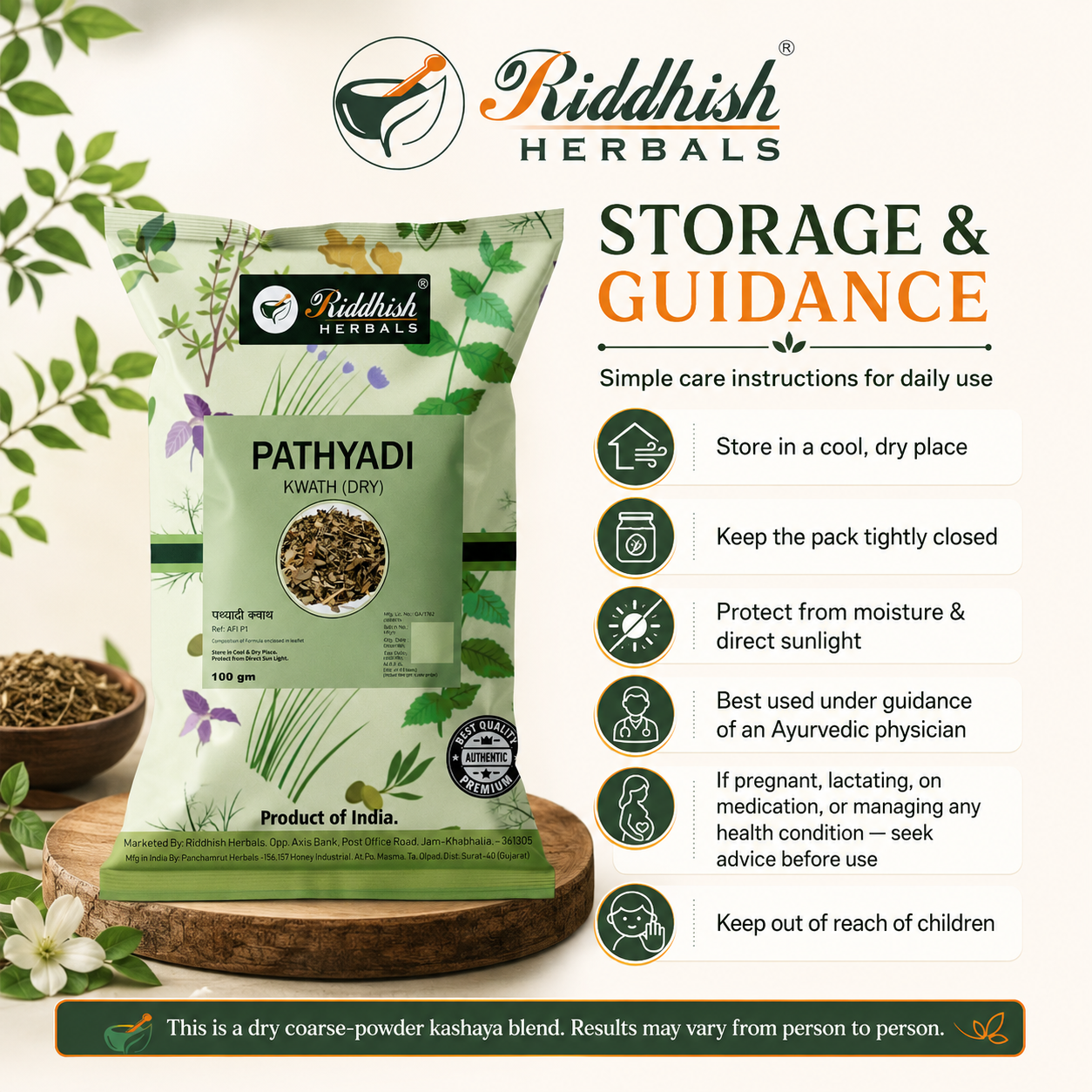
Use under the guidance of a qualified Ayurvedic physician, especially if you are pregnant, lactating, taking any medication, or managing any health condition. Keep out of reach of children. Discontinue and seek advice if any discomfort occurs. Results may vary from person to person.
Storage
Store in a cool, dry place away from direct sunlight. Keep the pack tightly closed after each use to protect the herbs from moisture.
Frequently Asked Questions
Is Pathyadi Kwath AYUSH or GMP certified?
It is manufactured in a facility holding GMP, ISO 9001:2015 and HACCP certifications (Mfg. Lic. GA/1762). These are quality and manufacturing certifications for the facility.
Can I take it without consulting a doctor?
Pathyadi Kwath is a classical multi-herb kashaya. It is best used under the guidance of a qualified Ayurvedic physician, particularly if you are pregnant, lactating, on medication, or managing any condition.
What exactly is Pathyadi Kwath?
It is a classical Ayurvedic decoction described in the Sharangdhara Samhita and prepared as per the Ayurvedic Formulary of India. It is built on Pathya (Haritaki) with the rest of Triphala plus Kalmegh, Neem, Haldi and Guduchi.
What are its other names?
It is also written as Pathyadi Kashayam, Pathyadi Kadha, Pathyadi Kwatha and Pathya Kwath. The base herb Haritaki is also called Pathya, Harad and Harade.
How is the Riddhish Herbals version different?
It is the label-verified seven-herb AFI composition in dry coarse-powder form, so you prepare a fresh decoction each time. It comes from Riddhish Herbals with a genuine bill, doctor-guided selection, and pan-India delivery.
Is this a ready liquid or a powder?
This is the dry coarse-powder (churna) form. You boil a small measure in water and reduce it to make the kashaya fresh at home, as described above.
How should I store it?
Keep it in a cool, dry place away from sunlight, in an airtight pack. Moisture is the main thing to protect a dry kwath powder from.
What is the recommended anupan?
Warm water is the everyday vehicle. Some classical uses add a little honey or jaggery to the cooled decoction. Your physician can advise the right anupan for you.
Have its herbs been studied scientifically?
Yes. Constituent herbs such as Andrographis paniculata (Kalmegh) and the Triphala fruits have appeared in peer-reviewed studies exploring antioxidant and anti-inflammatory properties under laboratory conditions (Low et al., 2015; Suryavanshi et al., 2021). Results were seen in study conditions and may not reflect individual experience.
Why is it classically linked with the head?
In the Sharangdhara tradition, Pathyadi type decoctions are grouped under Shiroroga (head disorders), with their bitter, cooling herbs chosen to settle aggravated Pitta. This is a traditional Ayurvedic description, not a medical claim.
Regional & Alternate Names
Formula: Pathyadi Kwath, Pathyadi Kwatha, Pathyadi Kashayam, Pathyadi Kadha, Pathya Kwath. Spelling variants: Pathadi Kwath, Pathyadi Quath, Pathyadi Kwath Dry, Pathyadi Kadha Powder. Key herb names: Haritaki / Harad / Harade / Pathya; Bibhitaki / Baheda / Behada; Amalaki / Amla / Awla; Bhunimba / Kalmegh / Kariyatu; Haridra / Haldi; Nimba / Neem; Guduchi / Giloy / Galo / Amrita.
Pathyadi Kwath is a traditional Ayurvedic formulation. The statements above describe its classical and traditional use as recorded in Ayurvedic literature. Use under the guidance of a qualified Ayurvedic physician. Results may vary from person to person.
About Riddhish Herbals
Since 2015 · Genuine Products · Bill Provided · Doctor-Guided Selection · 4000+ Ayurvedic Products · 130+ Trusted Brands · Pan-India Delivery
Related at Riddhish Herbals
Pathyadi Kashay 200 ml — Ayucare Pharmaceutical (the ready liquid, six dravyas at 400 mg each)