

Riddhish Herbals
Piloyam Capsule | Saptavimsatika Guggul + Suran | Rutarth Pharma
Piloyam Capsule | Saptavimsatika Guggul + Suran | Rutarth Pharma
Couldn't load pickup availability
✓ Since 2015 · ✓ Genuine Products · ✓ Bill Provided · ✓ Doctor-Guided Selection · ✓ Pan-India Delivery
About Piloyam Capsule
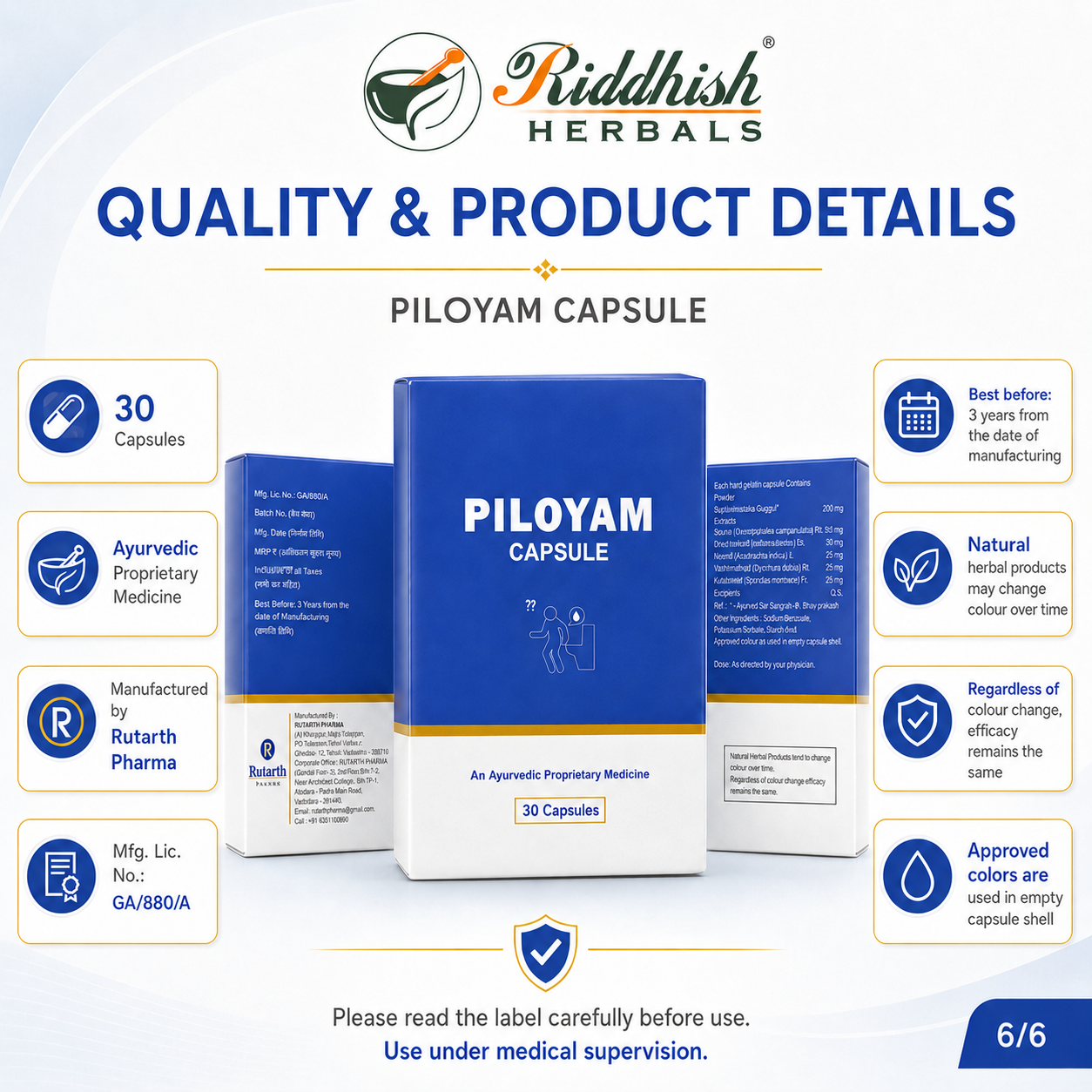
Piloyam is a six-substance Ayurvedic capsule designed around the way classical Arsha care is structured. At its core sits Saptavimsatika Guggul — a 27-ingredient guggulu compound — paired with Suran, the elephant-foot yam that classical authors single out for the ano-rectal region. Around this core, Daruharidra and Nimba bring the classical kandughna (anti-itching) and krimighna qualities, while Yashtimadhu adds a madhura, soothing note and Arishtak (soapnut) provides gentle cleansing support.
Rutarth Pharma manufactures Piloyam in Gujarat as a proprietary Ayurvedic capsule. Riddhish Herbals stocks it as a genuine, billed product and presents the composition exactly as supplied — nothing implied beyond what Ayurveda traditionally describes.
Traditional Ayurvedic Importance
Saptavimsatika Guggul is a classical 27-ingredient Guggulu Kalpa described in Sharangdhara Samhita (Madhyama Khanda, Guggulu Kalpana) and Bhaishajya Ratnavali, classically described in the context of Arsha, Bhagandara and Nadivrana.
Suran / Surana (Amorphophallus paeoniifolius) is the principal arshoghna dravya, described as a pathya food-medicine in Bhavaprakasha Nighantu and across Sushruta Samhita Chikitsasthana (Arsha-adhyaya). Daruharidra (Berberis aristata) belongs to the kandughna group of the Samhitas, valued for shodhana and ropana qualities. Nimba (Azadirachta indica) is the classical kandughna-krimighna cornerstone. Yashtimadhu (Glycyrrhiza glabra) is the madhura, pittahara soothing herb of the Samhitas, and Arishtak (Sapindus mukorossi) is the classical phenila cleansing dravya.
Key Features
- Classical Arsha design — six substances built around the Guggulu-Kalpa-plus-Suran grouping of the Arsha-chikitsa tradition.
- Saptavimsatika Guggul 200 mg — the classical 27-ingredient guggulu compound, leading the formula.
- Suran 150 mg — the principal arshoghna elephant-foot-yam dravya.
- Daruharidra + Nimba — the classical kandughna support pair.
- Yashtimadhu — a madhura, soothing pittahara herb.
- Label-derived composition — ingredient names, plant parts and quantities presented as supplied.
- Genuine & billed — doctor-guided dispensing at Riddhish Herbals with pan-India delivery from Gujarat.
Composition — Each Capsule Contains
| Ingredient | Botanical / English | Part Used | Qty |
|---|---|---|---|
| Saptavimsatika Guggul | Classical 27-ingredient Guggulu Kalpa | Compound | 200 mg |
| Suran / Surana | Elephant Foot Yam (Amorphophallus paeoniifolius) | Corm / tuber | 150 mg |
| Daruharidra | Indian Barberry (Berberis aristata) | Stem | 50 mg |
| Nimba (Neem) | Azadirachta indica | Leaf / bark | 25 mg |
| Yashtimadhu | Liquorice (Glycyrrhiza glabra) | Root | 25 mg |
| Arishtak (Reetha) | Soapnut (Sapindus mukorossi) | Fruit | 25 mg |
Note: Composition presented as supplied for this proprietary formulation (total fill ~475 mg per capsule). Hard-gelatin capsule shell. The physical pack remains the single source of truth — confirm against the printed label.
Research & Scientific References
The two principals of this formula — Suran and Daruharidra — have been examined in published phytopharmacological research relevant to ano-rectal and inflammatory contexts.
Findings were observed under study conditions and relate to individual ingredients, not to this finished product. They are shared for educational context only. Individual results may vary. Consult your Ayurvedic physician before use.
How to Use & Anupan
Initial: 2 capsules twice daily after meals until discomfort eases. Maintenance: 1 capsule twice daily after meals — or as directed by your Ayurvedic physician. The classical anupan for Arsha-directed formulations is takra (buttermilk) or warm water. Dose may vary with age, digestion, bowel pattern and diet, and should be set by a qualified physician.
Who Can Use It
Intended for adults seeking traditional Ayurvedic ano-rectal and digestive-routine support, under professional guidance. Not for children. Pregnant or lactating women should consult a physician before use. Anyone taking regular medication or managing a medical condition should consult their physician first.
Safety Information
Do not self-medicate in cases of severe pain, bleeding, pus discharge, fever or long-standing complaints — these need proper medical evaluation. Do not stop any prescribed medicine without medical advice. Alongside the product, a suitable diet (limiting spicy, oily and fried foods), adequate hydration and a regular bowel routine are traditionally advised.
Storage
Store in a cool, dry place away from direct sunlight. Keep the container tightly closed and out of reach of children.
Frequently Asked Questions
Is Piloyam Capsule AYUSH or GMP certified?
Piloyam is a licensed proprietary Ayurvedic medicine manufactured by Rutarth Pharma in Gujarat. Riddhish Herbals stocks it as genuine, billed product. Any AYUSH or GMP certification reflects the manufacturer’s licensing; we do not add certification claims beyond what is declared on the pack.
Can I take Piloyam Capsule without consulting a doctor?
No. This is a classical-style Arsha formulation built on a guggulu kalpa and should be used strictly under the guidance of a qualified Ayurvedic physician, who can confirm dose and suitability for you.
What is Saptavimsatika Guggul?
It is a classical 27-ingredient Guggulu Kalpa described in Sharangdhara Samhita (Madhyama Khanda) and Bhaishajya Ratnavali, classically described in the context of Arsha, Bhagandara and Nadivrana.
Does Piloyam Capsule contain Suran?
Yes. Each capsule contains Suran / Elephant Foot Yam extract (Amorphophallus paeoniifolius) at 150 mg — the principal classical arshoghna herb of the formula.
What is it classically described for?
Its ingredients are classically described in the context of Arsha (the traditional Ayurvedic term for ano-rectal conditions). This describes classical textual use, not a claim of treatment or cure.
What are the alternate names for the ingredients?
Suran = Surana = Jimikand = Elephant Foot Yam (Amorphophallus paeoniifolius). Daruharidra = Daruhaldi = Indian Barberry (Berberis aristata). Nimba = Neem (Azadirachta indica). Yashtimadhu = Mulethi = Liquorice (Glycyrrhiza glabra). Arishtak = Reetha = Soapnut (Sapindus mukorossi).
How is Piloyam different from Pilewell, Proctocare or Arsaquit?
All belong to the ano-rectal wellness family but differ in formula. Piloyam is built on Saptavimsatika Guggul + Suran. Pilewell and Proctocare are separate proprietary capsules, and Arsaquit is a Virgo tablet led by Arshoghni Vati. See related products below to compare.
What is the recommended anupan and how should I take it?
Initial: 2 capsules twice daily after meals until discomfort eases; maintenance: 1 capsule twice daily — or as your physician directs. Classical anupan is takra (buttermilk) or warm water.
How should I store it?
Store in a cool, dry place away from direct sunlight, with the container tightly closed and out of reach of children.
Has Suran been studied scientifically?
Yes. In an experimental ano-rectal model, tuber extracts of Amorphophallus paeoniifolius showed anti-inflammatory and antioxidant activity under study conditions (Dey et al., 2016, Journal of Ethnopharmacology). These findings relate to the isolated ingredient, not to this finished product.
▸ Pilewell Capsule (Therachem) — Suran + Daruharidra base
▸ Proctocare Capsule (Ayucare)
▸ Arsaquit Tablet (Virgo) — Arshoghni-led, AYUSH Mark
▸ Arshoghni Vati (Virgo) — classical Siddha Yoga Sangraha tablet
▸ Full Ano-Rectal Wellness range