

Riddhish Herbals
Rakta Pachak Tablets (Rakta Pachak Vati) – Ayurvedic Tablet – Panchamrut Herbals
Rakta Pachak Tablets (Rakta Pachak Vati) – Ayurvedic Tablet – Panchamrut Herbals
Couldn't load pickup availability
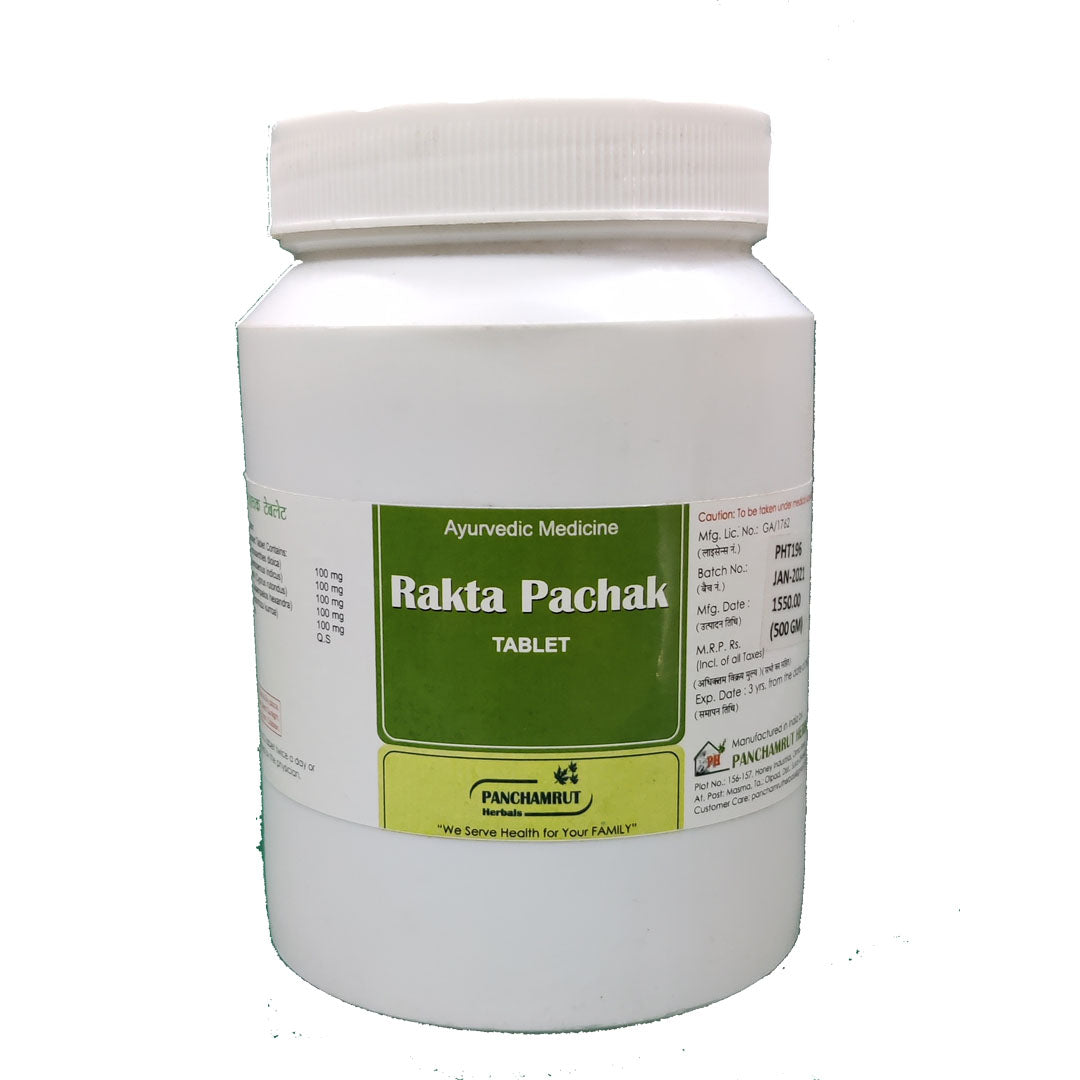
Rakta Pachak Tablets by Panchamrut Herbals are Ayurvedic tablets in which each tablet declares five dravyas in exactly equal parts at 100 mg each: Patol (Trichosanthes dioica), Sariva (Hemidesmus indicus), Nagarmoth (Cyperus rotundus), Patha (Cissampelos hexandra) and Katuki (Picrorhiza kurroa), with excipients Q.S. — 500 mg of declared actives per tablet, in a 60-tablet bottle or a 500 g bulk jar. The name places it in the classical Dhatvagni scheme: Rakta is the second of the seven dhatus and pachaka means that which digests, so Rakta Pachak is the second member of a seven-part series. It is made under Mfg. Lic. No. GA-1762 at Masma, Olpad, Surat, in a facility carrying the GMP certified mark; Panchamrut Herbals’ corporate office is at Naroda, Ahmedabad. Riddhish Herbals is the authorised and exclusive online seller for Panchamrut Herbals — Gujarat’s trusted Ayurvedic store since 2015.
About Rakta Pachak Tablets
Five dravyas, equal parts, 100 mg each. Patol, Sariva, Nagarmoth, Patha and Katuki, and nothing else but excipients. Every figure is printed on the bottle.
We have to start with what this page used to say, because it was the worst copy in our catalogue and it was live until today. It claimed this tablet cleanses the blood, and attributed a blood-cleansing action to one of the dravyas by name. It promised results in three to four weeks, answered “are there any side effects?” with a reassurance, and listed named medical conditions it was said to address. Indian advertising law — the Drugs and Magic Remedies (Objectionable Advertisements) Act, 1954 — forbids every one of those claims, and blood-cleansing claims are among the ones it names most specifically. All of it is gone. We are telling you rather than quietly deleting it, because you may have bought on the strength of that wording.
So what does the name actually mean? Classical Ayurveda holds that each of the seven dhatus has its own agni — dhatvagni — and that the dhatus form in sequence: Rasa, Rakta, Mamsa, Meda, Asthi, Majja, Shukra. Pachaka means that which digests. Rakta is the second in that sequence, formed from Rasa, and Rakta Pachak is simply the tablet named for that stage. The name describes a position in a classical scheme. It is not a claim about what the tablet does to your blood, and anyone selling it to you as one is going beyond both the label and the law.
A design detail across the whole series that nobody has noticed. Look at the arithmetic. Ras Pachak: three dravyas at 165 mg = 495 mg. Asthi Majja Pachak: three at 165 mg = 495 mg. Shauthlya Med Pachak: five at 100 mg = 500 mg. This one: five at 100 mg = 500 mg. Mansh Pachak: six at 82 mg = 492 mg. Every tablet in the series lands between 492 and 500 mg of declared actives, whatever the dravya count. The formulator held the tablet constant and divided it. That is a deliberate design, and you can only see it because the quantities are printed.
Please read this if you take more than one Pachak. Patol is in this one, in Ras Pachak and in Mansh Pachak — three of the five. Nagarmoth is in this one, in Mansh Pachak and in Asthi Majja Pachak. Katuki is in this one and in Ras Pachak. If your Vaidya has you on two of these at once, that is their call to make knowingly — and they can only make it knowingly if somebody prints the composition.
The brand is Panchamrut Herbals. Its manufacturing unit is at 156-157 Honey Industrial, At. Po. Masma, Ta. Olpad, Dist. Surat 394540, Gujarat, under Mfg. Lic. No. GA-1762; its corporate office is at 5th Floor, 511, Naroda Business Hub, Nava Naroda Road, Naroda, Ahmedabad 382330. One company, two addresses. Riddhish Herbals is the stockist, and specifically the authorised and exclusive online seller for Panchamrut Herbals. We sell it; we do not make it. Both pack sizes are on this one page — until today they were two listings, one of them spelled Rakta Pachan, which split the product out of the series in search.
Who else sells this formula, and how they differ. Checked 21 August 2026. BVG Life Sciences is the best-known brand and names the same five dravyas — but its published list ends with “and more” and gives no quantities at all. Its 30-tablet pack sells at ₹122 against a ₹143 MRP and its 60-tablet pack at ₹245 against a ₹289 MRP. Trade sellers list a Rakta Pachak Vati at ₹250 in New Delhi and this same Panchamrut 60-tablet bottle at ₹280 in Ahmedabad. Our 60-tablet bottle is ₹209 against a printed ₹260 MRP — below every one of them, with all five quantities printed and no “and more”.
One difference in the dravyas themselves, and it is a real one. BVG’s list gives Patha as Cissampelos pareira. This label declares Cissampelos hexandra — a different species of the same genus. Both are used as Patha in Indian practice and C. pareira is the more commonly cited, so this is worth knowing rather than worrying about; it is exactly the kind of thing that only shows up when a manufacturer prints the binomial. Ask your Vaidya if the distinction matters for you.
Traditional Ayurvedic Importance
Four of the five dravyas here belong to the classical Tikta group — the bitter taste, described in classical Ayurvedic literature as the principal Deepana-Pachana category, the tastes that kindle agni and assist pachana.
Patol (Trichosanthes dioica) is the pointed gourd, a standing member of the classical Patoladi group and the connective thread of this whole series — it appears in three of the five Pachak tablets. Katuki (Picrorhiza kurroa), Katurohini in the texts, is among the most intensely bitter dravyas in the pharmacopoeia, and Patol and Katuki are a classical pair: the Patolakaturohinyadi group is named for exactly those two.
Sariva (Hemidesmus indicus) is the Indian sarsaparilla, classically Tikta-Madhura and Sheeta — one of the few dravyas in this formula that is not sharp. It is the dravya most associated with Rakta in classical literature, which is precisely why it attracts the claims we are not making.
Nagarmoth (Cyperus rotundus), Musta in the texts, heads the Mustadi group and is one of the standard Deepana-Pachana dravyas. Patha (Cissampelos sp.) is a classical Tikta root and a member of the Pittashamana group.
So the shape is four bitters and one cooling Madhura dravya, in exactly equal parts, named for the second dhatu. The bottle describes it as an Ayurvedic classical product, though it prints no classical text reference — see the note under the composition table.
Key Features
- All five quantities printed, in exactly equal parts: Patol, Sariva, Nagarmoth, Patha and Katuki at 100 mg each — 500 mg of declared actives per tablet, excipients Q.S. The market-leading brand names the same five and then writes “and more”, with no quantities.
- Cheaper than every price we found: ₹209 for 60 tablets against a printed ₹260 MRP, where BVG’s 60-tablet pack is ₹245 and trade listings run ₹250–₹280. Checked 21 August 2026.
- No cleansing claim about the blood, and we say why. Our own page carried one until today. Indian advertising law forbids it, so it is gone — and the section above explains what the name actually means instead.
- The series arithmetic, revealed: every Pachak tablet lands between 492 and 500 mg of declared actives whatever the dravya count — 3×165, 5×100, 6×82. You can only see that because the quantities are printed.
- Patol and Katuki are a classical pair — the Patolakaturohinyadi group is named for them — with Sariva as the one cooling, Madhura dravya in an otherwise sharp formula.
- An overlap warning nobody else gives: Patol also appears in Ras Pachak and Mansh Pachak, Nagarmoth in Mansh Pachak and Asthi Majja Pachak, Katuki in Ras Pachak. If you take more than one Pachak, your Vaidya needs to know.
- Two listings became one: the 60-tablet page spelled it Rakta Pachan, which split it from the series in search. One page, one spelling, one composition table.
- Bought from the authorised online seller: Riddhish Herbals holds authorised and exclusive online-selling rights for Panchamrut Herbals, under Mfg. Lic. No. GA-1762. A tax invoice on every order.
Research on the Constituents
◆ No PMID is asserted on this page, and the reason matters more here than on most. Peer-reviewed work exists on all five of these dravyas, and on Picrorhiza kurroa and Hemidesmus indicus there is a considerable amount. The difficulty is that essentially all of it sits in clinical categories that Indian advertising law does not permit an Ayurvedic listing to reference at all — naming the studies would mean naming the conditions they were run in, and on this particular formula those conditions are exactly the ones the Drugs and Magic Remedies Act singles out. We would rather publish an honest empty section than a citation we cannot describe lawfully, and far rather than one we invented. The useful information on this page is the declared composition, the equal-parts ratio and the classical reasoning behind the name. If you want the research, ask your Vaidya, who can discuss it with you in the clinical setting where it belongs. Individual results may vary.
Results were observed under study conditions. Individual results may vary. This is shared for general educational interest and is not a medical claim. Consult your Ayurvedic physician before use.
Composition (label-verified, per tablet)
| Declared dravya (as printed) | Botanical (accepted spelling) | Quantity |
|---|---|---|
| Patol (Patola) | Trichosanthes dioica | 100 mg |
| Sariva (Anantamula) | Hemidesmus indicus | 100 mg |
| Nagarmoth (Musta) | Cyperus rotundus | 100 mg |
| Patha | Cissampelos hexandra | 100 mg |
| Katuki (Katurohini) | Picrorhiza kurroa | 100 mg |
| Total declared actives per tablet | — | 500 mg |
| Excipients | — | Q.S. |
Transcribed from the Panchamrut Herbals 60-tablet bottle, read from founder-supplied photographs on 21 August 2026, stated per tablet exactly as the panel prints it. The five declared dravyas are in exactly equal parts and sum to 500 mg; the label prints no total, so the total row above is arithmetic, not a label claim. Mfg. Lic. No. GA-1762. The pack does not print plant parts, so we have not added any. Botanical spellings. The panel mis-sets four binomials — Trichosabthes dioica for Trichosanthes dioica, Hemidemus indicus for Hemidesmus indicus, Cyprus rutondus for Cyperus rotundus, and Cissampleos hexandra for Cissampelos hexandra. The fifth, Picrorhiza kurroa, is printed correctly. Above we show the accepted spelling of the same dravya; nothing has been substituted. This is the sixth Panchamrut pack in a row on which we have found mis-set Latin names, so the artwork template has been raised with them rather than the individual packs. One species note, stated because it is real. This label declares Patha as Cissampelos hexandra; the market-leading competing brand declares Cissampelos pareira, which is the more commonly cited species for this dravya. Both are used as Patha in Indian practice. We print what the pack prints and flag the difference rather than silently harmonising it. The bottle describes the product as “An Ayurvedic Classical Product” but prints no classical text reference. A five-dravya equal-parts formula of Patol, Sariva, Musta, Patha and Katuki is not one we can match to a named classical yoga, so we have not attached a text citation of our own to make the page look better. The 500 g jar is the same formula in a larger pack; its own panel has not been separately photographed, and we say so rather than imply we read two labels when we read one. Nothing here is inferred; where the pack prints Q.S., we print Q.S.
How to Use
As directed by your qualified Ayurvedic physician. The bottle states 1 to 2 tablets twice a day, or as directed by the physician. Classical practice gives Tikta preparations with warm water, and your Vaidya may specify a different anupan according to what else you are taking. Please read the printed range as the boundary your physician works within rather than a starting point you choose for yourself.
Who Can Use It
Adults, under the direction of a qualified Ayurvedic physician — the bottle itself directs you to consult your practitioner before taking. Katuki is one of the most intensely bitter dravyas in the pharmacopoeia and this is not a casual daily tablet. Not for use in pregnancy or lactation without physician advice. For children, the dose is decided by a qualified Ayurvedic physician and is not printed here. If you are on any other medication, discuss it before starting. If you are already taking another product from the Pachak series, say so — Patol, Nagarmoth and Katuki all recur across the set.
Safety Information
The bottle states: keep out of sight and reach of children, always consult your healthcare practitioner before taking, and that it is to be taken under medical supervision only. We reproduce all three because they are the manufacturer’s own instructions and they matter. Do not exceed the printed dose, and stop and speak to your physician if anything is not right. Two things our previous page said that we will not repeat. It answered “are there any side effects?” with a reassurance, and it told you the tablet was safe for daily use. Neither is ours to promise about a medicine the manufacturer itself directs a practitioner to oversee, and Indian advertising law does not permit that kind of assurance. Your Vaidya decides how long you take this and how often. One further disclosure: four botanical names on this pack are mis-set typographically — the dravyas are not in question, only the Latin spelling, and the composition note above lists all four. Results may vary from person to person.
Storage
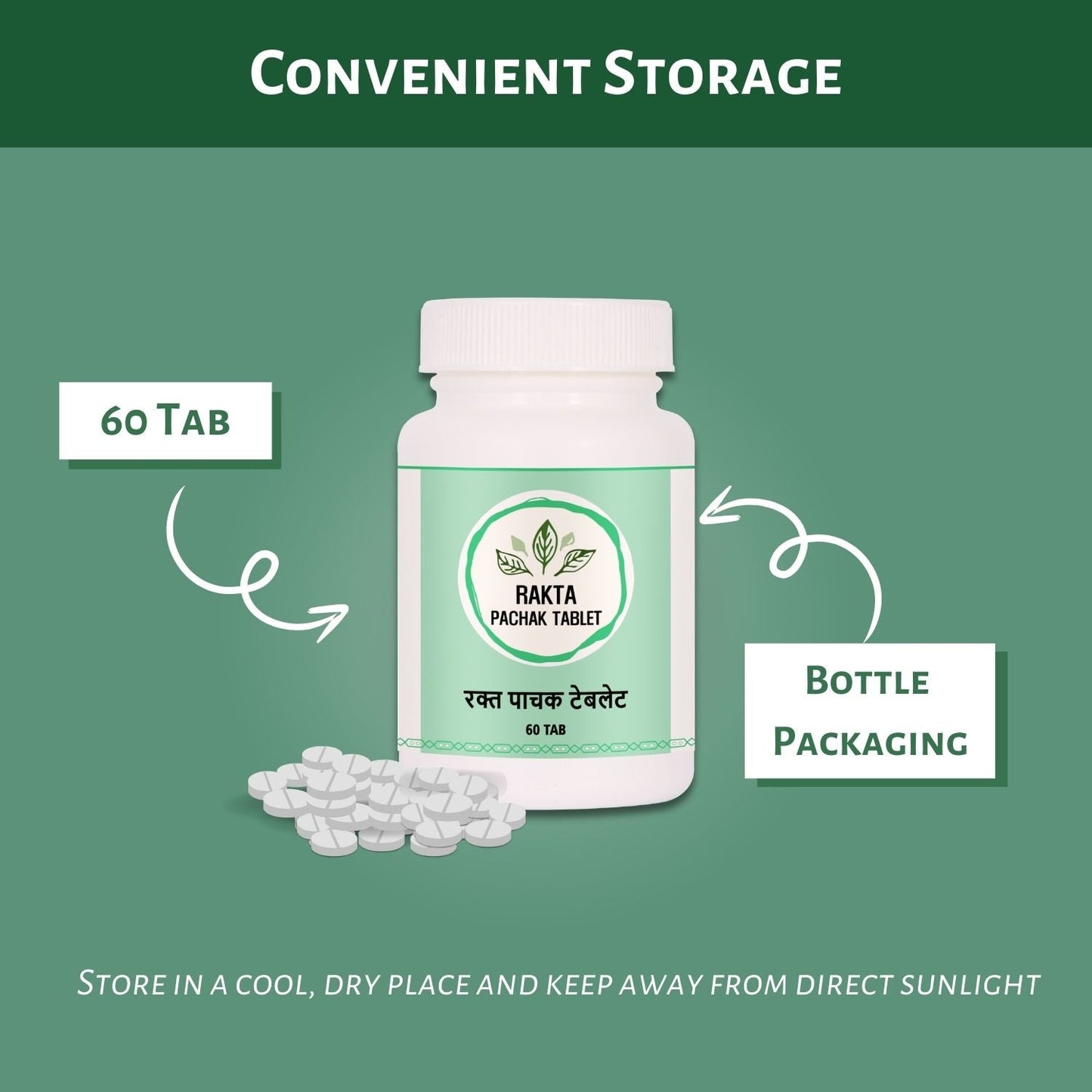
The bottle directs: store in a cool, dry and dark place. Keep it tightly closed — uncoated bitter tablets take up moisture readily and will clump, and a bulk jar stays open for a long time. Use before the expiry date printed on your pack.
Frequently Asked Questions
What is Rakta Pachak Tablet?
An Ayurvedic tablet in which each tablet declares five dravyas in exactly equal parts at 100 mg each: Patol (Trichosanthes dioica), Sariva (Hemidesmus indicus), Nagarmoth (Cyperus rotundus), Patha (Cissampelos hexandra) and Katuki (Picrorhiza kurroa), with excipients Q.S. — 500 mg of declared actives per tablet. Made by Panchamrut Herbals, stocked here in a 60-tablet bottle and a 500 g bulk jar.
Does Rakta Pachak cleanse the blood?
We are not going to tell you that it does, and until today this page did. Blood-cleansing claims are among the specific things Indian advertising law — the Drugs and Magic Remedies (Objectionable Advertisements) Act, 1954 — does not permit an Ayurvedic listing to advertise. Our old copy carried one anyway. It is gone. What the name actually means is a position in a classical scheme: Rakta is the second of the seven dhatus and pachaka means that which digests, so this is the second tablet in a seven-part series. What it is appropriate for in your case is a clinical question for your Vaidya, not a marketing one for us.
What does the Pachak series mean?
Classical Ayurveda holds that each of the seven dhatus has its own agni — dhatvagni — and that they form in sequence: Rasa, Rakta, Mamsa, Meda, Asthi, Majja, Shukra. Pachaka means that which digests, so the series runs one tablet per stage: Ras Pachak (first), Rakta Pachak (second), Mansh Pachak (third), Shauthlya Med Pachak (fourth) and Asthi Majja Pachak (fifth and sixth together). Which one suits you is a question for your Vaidya.
Is this the same as the Rakta Pachak Vati other brands sell?
Same five dravyas, different disclosure. BVG Life Sciences, the best-known brand, names Patol, Sariva, Musta, Patha and Kutaki — and then writes “and more”, with no quantities. This panel prints 100 mg against each of five and lists nothing else but excipients. Checked 21 August 2026: BVG’s 60-tablet pack is ₹245 against a ₹289 MRP; ours is ₹209 against a printed ₹260 MRP. Always compare the composition panel rather than the name on the front.
Why does your Patha have a different Latin name from theirs?
Because the packs declare different species of the same genus. This label declares Cissampelos hexandra; the market-leading brand declares Cissampelos pareira, which is the more commonly cited species for Patha. Both are used as Patha in Indian practice. We print what the pack prints and tell you about the difference rather than quietly harmonising it — if the distinction matters for your case, your Vaidya will know.
Why do all the Pachak tablets weigh about the same?
Because the formulator held the tablet constant and divided it. Ras Pachak is three dravyas at 165 mg = 495 mg. Asthi Majja Pachak, three at 165 mg = 495 mg. Shauthlya Med Pachak, five at 100 mg = 500 mg. This one, five at 100 mg = 500 mg. Mansh Pachak, six at 82 mg = 492 mg. Every tablet in the series lands between 492 and 500 mg of declared actives, whatever the dravya count. It is a deliberate design, and you can only see it because Panchamrut prints the quantities.
I already take another Pachak tablet. Does anything overlap?
Yes, and this one overlaps more than most. Patol is in this tablet, in Ras Pachak and in Mansh Pachak. Nagarmoth is in this one, in Mansh Pachak and in Asthi Majja Pachak. Katuki is in this one and in Ras Pachak. Taking two Pachaks together is a decision for your physician to make knowingly — which they can only do if the composition is printed. It is, on this page.
Why are some Latin names on my bottle spelt differently from this page?
Four binomials on the panel are mis-set: Trichosabthes dioica should read Trichosanthes dioica, Hemidemus indicus should read Hemidesmus indicus, Cyprus rutondus should read Cyperus rotundus, and Cissampleos hexandra should read Cissampelos hexandra. The fifth, Picrorhiza kurroa, is correct. These are typesetting slips, not different dravyas. We have raised the artwork template with Panchamrut Herbals — this is the sixth of their packs on which we have found the same class of error.
Can I take it without a doctor, and how much?
The bottle answers the first part itself: always consult your healthcare practitioner before taking. On dose, it states 1 to 2 tablets twice a day, or as directed by the physician. Katuki is intensely bitter and potent. Riddhish Herbals stocks this for people already working with a Vaidya.
Is this a classical formula?
The bottle says “An Ayurvedic Classical Product”, but it prints no classical text reference — no Bhaishajya Ratnavali number, no A.F.I. page, nothing. A five-dravya equal-parts formula of Patol, Sariva, Musta, Patha and Katuki is not one we can match to a named classical yoga, so we have not attached a citation of our own to make the page look better. Panchamrut’s Yograj Guggulu jar does print its reference, so we have asked them whether this one has one.
Which pack size should I choose?
Pack size is the only difference — the per-tablet composition is what the label declares either way, from the same manufacturer under the same licence. The 60-tablet bottle suits a first or short course. The 500 g bulk jar is what a clinic dispensary or a long course runs on and works out considerably cheaper per tablet. Both are selectable above. Until today they sat on two separate pages, one of which spelled the product Rakta Pachan.
Who makes it, and is it available at Riddhish Herbals?
It is made by Panchamrut Herbals, whose brand it is, at 156-157 Honey Industrial, At. Po. Masma, Ta. Olpad, Dist. Surat 394540, Gujarat, under Mfg. Lic. No. GA-1762; corporate office 5th Floor, 511, Naroda Business Hub, Nava Naroda Road, Naroda, Ahmedabad 382330. The bottle carries the GMP certified mark. Alternate spellings you may see: Rakta Pachak, Rakta Pachan, Raktapachak, Rakt Pachak, Rakta Pachak Vati, Raktpachak, and on the pack in Devanagari as रक्त पाचक टेबलेट. Yes, it is in stock: Riddhish Herbals is the authorised and exclusive online seller for Panchamrut Herbals, available at our Jam-Khambhalia, Gujarat store and online at riddhishherbals.com with Pan-India delivery, doctor-guided selection and a tax invoice on every purchase.
Related at Riddhish Herbals
Ras Pachak Tablets (60 Tab & 500 g), the first dhatu, shares Patol and Katuki — Panchamrut Herbals · Mansh Pachak Tablets (the third dhatu, shares Patol and Nagarmoth) — Panchamrut Herbals · Shauthlya Med Pachak Tablets (the fourth dhatu) — Panchamrut Herbals · Asthi Majja Pachak Tablets (fifth and sixth, shares Nagarmoth) — Panchamrut Herbals · Yograj Guggulu 500g — Panchamrut Herbals · Digestion Improvement collection · Panchamrut Herbals brand collection · Ayurveda Knowledge Hub · Consult a Vaidya