

Riddhish Herbals
Mansh Pachak Tablets (Mansa Pachak Vati) – Ayurvedic Tablet – Panchamrut Herbals
Mansh Pachak Tablets (Mansa Pachak Vati) – Ayurvedic Tablet – Panchamrut Herbals
Couldn't load pickup availability
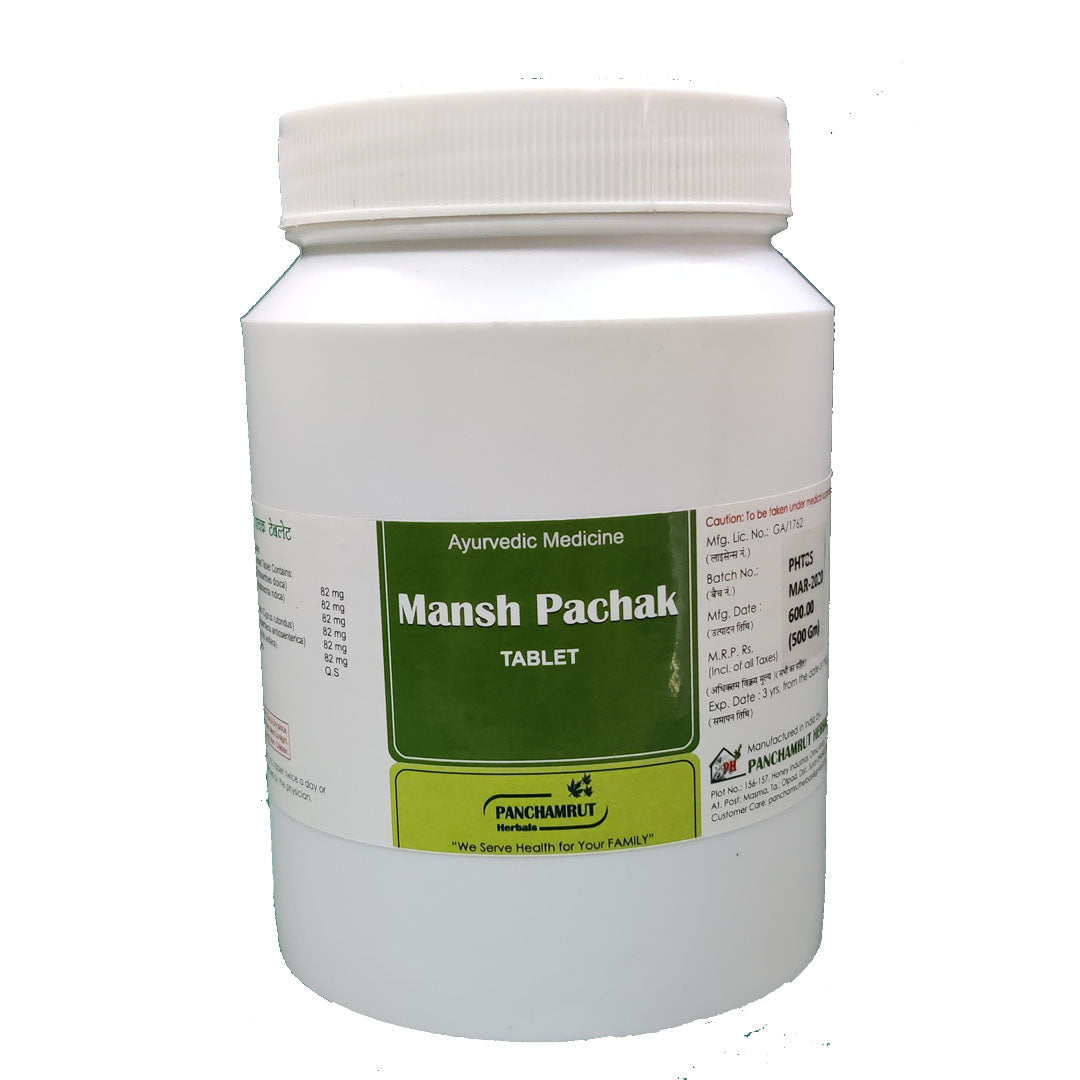
Mansh Pachak Tablets (Mansa Pachak Vati) is a proprietary Ayurvedic tablet from Panchamrut Herbals, one tablet in their Dhatu Pachak series — a set of formulations, each built around one of the seven classical dhatus (bodily tissues). This one is formulated for Mamsa dhatu, the muscle tissue, combining six dravyas at 82 mg each.
About Mansh Pachak Tablets — Panchamrut Herbals
Ayurveda doesn't view digestion as one undifferentiated process. Classical physiology describes seven dhatus — the tissues that build the body, from rasa (plasma) through to shukra (reproductive tissue) — and each is said to carry its own agni, its own capacity to process what reaches it. Mansh Pachak Tablets is built around one of these: Mamsa dhatu, the muscle tissue, and the digestive-metabolic fire specific to it.
This is a proprietary formulation from Panchamrut Herbals, part of their Dhatu Pachak series — a family of tablets, each addressing digestion at the level of one specific dhatu rather than the digestive system as a whole. Six dravyas make up this tablet, each at 82 mg, for 492 mg of actives per tablet.
Riddhish Herbals is the authorised and exclusive online seller for Panchamrut Herbals. Every purchase ships with a proper bill, and our Ayurvedic physicians are available to help you confirm you're choosing the right pack for what your own physician has prescribed.
Traditional Ayurvedic Importance
The idea of dhatvagni — a distinct digestive-metabolic fire said to operate at the level of each individual tissue — appears across classical Ayurvedic physiology, alongside the more familiar jatharagni (the central digestive fire) and the five bhutagnis. Where a general digestive formulation is aimed at jatharagni, a dhatu-specific pachaka like this one is intended to work further downstream, at the tissue level Mamsa dhatu governs.
The six dravyas are each long-established individually in classical Ayurvedic materia medica. Patol and Neem fall within the tikta rasa (bitter-taste) group traditionally associated with pachana (digestive processing). Triphala — Haritaki, Bibhitaki, and Amalaki together — is one of the most widely used rasayana combinations in Ayurvedic practice. Nagarmoth (Musta) is classically regarded as a primary deepana-pachana (appetite-and-digestion) herb. Kutaj bark carries a long traditional role in gastrointestinal comfort. Draksha (raisin) contributes a madhura rasa (sweet taste) balancing element traditionally used in tonic formulations. This tablet brings these six together as a proprietary Panchamrut Herbals formulation directed at Mamsa dhatu — the formulation itself is proprietary to Panchamrut Herbals, not a direct citation from a named classical text, and this page does not present it as one.
Key Features
- Six Dravyas, Each Quantified: Patol, Neem, Triphala, Nagarmoth, Kutaj, and Draksh — each listed with its milligram quantity per tablet.
- Mamsa Dhatu Focus: Part of Panchamrut Herbals' Dhatu Pachak series, positioned toward the muscle tissue (Mamsa dhatu) specifically, rather than digestion in general.
- Manufactured Under a Valid Licence: Produced by Panchamrut Herbals at Mfg. Lic. GA-1762.
- GMP-, ISO 9001:2015- and HACCP-certified manufacturer: made by Panchamrut Herbals, certified to GMP, ISO 9001:2015 and HACCP standards, Mfg. Lic. GA-1762.
- Two Pack Sizes: 60 Tablets or a 500 g Bulk Jar, for regular or extended physician-directed use.
- Manufactured by Panchamrut Herbals: Corporate office in Ahmedabad, manufacturing unit at Masma, Olpad, Surat — Mfg. Lic. GA-1762.
- Physician-Directed Use: A classical proprietary tablet intended for use under Ayurvedic physician guidance, not self-selection.
- Genuine & Billed — Riddhish Herbals: Since 2015, genuine products, bill provided, doctor-guided selection, pan-India delivery.
Composition
Each Mansh Pachak Tablet contains six dravyas at an equal 82 mg, for 492 mg of total actives, with the balance made up of Q.S. excipients:
| Dravya | Botanical (accepted spelling) | Quantity |
|---|---|---|
| Patol (Patola) | Trichosanthes dioica | 82 mg |
| Neem (Nimba) | Azadirachta indica | 82 mg |
| Triphala | Haritaki + Bibhitaki + Amalaki | 82 mg |
| Nagarmoth (Musta) | Cyperus rotundus | 82 mg |
| Kutaj (Kutaja — bark) | Holarrhena antidysenterica | 82 mg |
| Draksh (Draksha) | Vitis vinifera | 82 mg |
| Total actives per tablet | — | 492 mg |
| Excipients | — | Q.S. |
Note: the pack carries minor typesetting variants in three of the botanical names above (Trichosanthes dioica, Cyperus rotundus, Holarrhena antidysenterica). The spellings shown here are the accepted botanical names for the same dravyas.
Net weight: 500 g Bulk Jar or 60 Tablets · Form: Ayurvedic Tablet (Vati) · Manufactured under Mfg. Lic. GA-1762.
How to Use
Dose: 1 to 2 tablets twice daily, with warm water or as directed by your Ayurvedic physician. Not intended for self-administration — follow the dosage and duration your physician sets for you.
Who Can Use It
Adults, under the guidance of a qualified Ayurvedic physician. Not recommended during pregnancy or lactation without physician advice. Consult your physician before use if you are on any medication or managing an existing health condition.
Safety Information
Use under the guidance of a qualified Ayurvedic physician. Consult your physician before use, especially if you are pregnant, lactating, taking any medication, or managing any medical condition. Keep out of reach of children. Results may vary from person to person.
Storage
Store in a cool, dry place away from direct sunlight and moisture. Keep the container tightly closed after use. Do not refrigerate.
The Six Dravyas — Common Names
| Sanskrit | Hindi | Gujarati | English / Botanical |
|---|---|---|---|
| Patola | Parwal | પરવળ (Parwad) | Pointed gourd — Trichosanthes dioica |
| Nimba | Neem | લીમડો (Limdo) | Neem — Azadirachta indica |
| Haritaki | Harad / Harde | હરડે (Harde) | Chebulic myrobalan — Terminalia chebula |
| Bibhitaki | Baheda | બહેડા (Beheda) | Beleric myrobalan — Terminalia bellirica |
| Amalaki | Amla | આમળા (Aamla) | Indian gooseberry — Phyllanthus emblica |
| Musta | Nagarmotha | નાગરમોથ (Nagarmoth) | Nutgrass — Cyperus rotundus |
| Kutaja | Kutaj / Indrajav (bark) | Kadavo Indrajav | Kurchi bark — Holarrhena antidysenterica |
| Draksha | Draksh / Munakka | દ્રાક્ષ (Draksh) | Raisin — Vitis vinifera |
Also searched as: Mansh Pachan, Mamsa Pachak, Mans Pachak, Mamsa Pachak Vati, and Manspachak — all names for this same tablet.
Frequently Asked Questions
What is Mansh Pachak Tablets?
Mansh Pachak Tablets (Mansa Pachak Vati) is a proprietary Ayurvedic tablet from Panchamrut Herbals, part of their Dhatu Pachak series, positioned toward Mamsa dhatu (muscle tissue). It combines Patol, Neem, Triphala, Nagarmoth, Kutaj, and Draksh, each at 82 mg per tablet. Available at Riddhish Herbals as the authorised and exclusive online seller, with genuine billing.
What does "Mamsa dhatu" mean, and why does this formula target it specifically?
In classical Ayurvedic physiology, Mamsa dhatu is the muscle tissue, one of seven dhatus that together build the body. Each dhatu is described as having its own agni, or digestive-metabolic fire. Mansh Pachak Tablets is one tablet in Panchamrut Herbals' Dhatu Pachak series, each formulated toward a specific dhatu rather than digestion as a whole — this one toward Mamsa dhatu.
What is the difference between Kutaj and Indrajav?
Kutaj and Indrajav both come from the same plant, Holarrhena antidysenterica — Kutaj is the bark, Indrajav is the seed. Classical Ayurvedic practice regards them as distinct dravyas with distinct roles. This tablet contains Kutaj, the bark.
Why do the botanical names in the composition table read slightly differently from the pack?
The pack carries minor typesetting variants in three botanical names (Trichosanthes dioica, Cyperus rotundus, Holarrhena antidysenterica). The names shown in our composition table are the accepted botanical spellings for the same dravyas — the identity and quantity of each ingredient is unchanged.
Which pack size should I choose?
Mansh Pachak Tablets comes in two sizes at Riddhish Herbals — a 60-tablet pack for regular use, and a 500 g bulk jar for extended use. Both carry the identical composition; choose based on how long you expect to be using it, as directed by your physician.
What is the recommended dosage?
Dose: 1 to 2 tablets twice daily, or as directed by your Ayurvedic physician. This is a physician-directed classical formulation, not intended for self-administration.
Can this be taken alongside other Ayurvedic formulations?
This is a classical proprietary formulation, and combining it with other Ayurvedic medicines should be assessed by your prescribing physician, since suitability can vary from one combination and one individual to another.
Is this suitable for long-term use?
Dhatu Pachak formulations are traditionally taken over a course set by the prescribing physician rather than on an indefinite basis. Follow the duration your Ayurvedic physician recommends for your specific case.
Who manufactures Mansh Pachak Tablets?
Mansh Pachak Tablets is manufactured by Panchamrut Herbals at Mfg. Lic. GA-1762 — corporate office in Ahmedabad, manufacturing unit at Masma, Olpad, Surat.
Is this product GMP certified?
Panchamrut Herbals, the manufacturer of this product, holds GMP, ISO 9001:2015 and HACCP certification. Good manufacturing practice (GMP) relates to how the product is made; these are not claims about any medical outcome.
What are the alternate names and spellings?
Also written as Mansh Pachan, Mamsa Pachak, Mans Pachak, Mamsa Pachak Vati, and Manspachak — all referring to this same Panchamrut Herbals tablet.
How do I know this is the genuine pack?
Riddhish Herbals is the authorised and exclusive online seller for Panchamrut Herbals. Every order ships with a proper bill, and our Ayurvedic physicians are available to help confirm you're selecting the right pack for what your physician has prescribed.
Related Products
Pet Nirogi Churna — a classical digestive powder blend for everyday gut comfort.
Drakshasava — a Virgo UAP Pharma digestive asava tonic built around Draksha, one of this tablet's six dravyas.
Ganthoda Powder (Pippalimool) — a classical deepana-pachana root powder, in the same digestive-support family as Nagarmoth.
Gokshur Powder — a single-herb classical powder for general Ayurvedic wellness support.
About Riddhish Herbals
Mansh Pachak Tablets is manufactured by Panchamrut Herbals — corporate office in Ahmedabad, manufacturing unit at Masma, Olpad, Surat, Mfg. Lic. GA-1762. Riddhish Herbals is the authorised and exclusive online seller for Panchamrut Herbals. This is a traditional Ayurvedic product; information on this page is educational and is not a substitute for professional medical advice.
Since 2015 · Genuine Products · Bill Provided · Doctor-Guided Selection · 4000+ Ayurvedic Products · 130+ Trusted Brands · Pan-India Delivery