

Riddhish Herbals
Shatavari Powder | Asparagus racemosus | Riddhish Herbals | 100gm
Shatavari Powder | Asparagus racemosus | Riddhish Herbals | 100gm
Couldn't load pickup availability
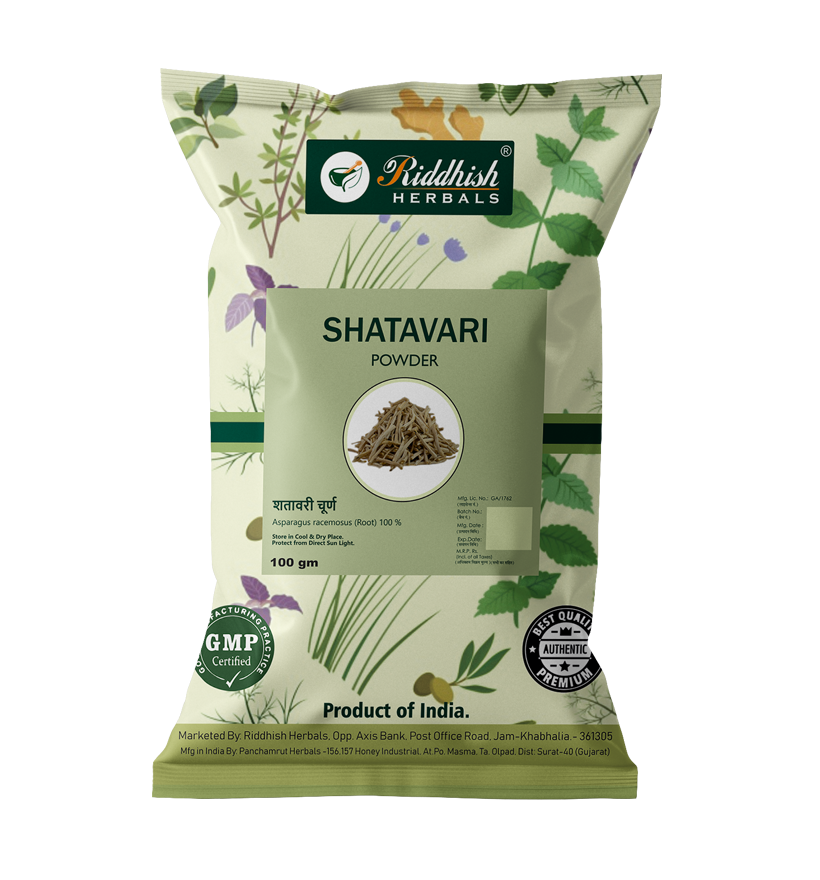
Shatavari Powder (शतावरी चूर्ण) by Riddhish Herbals is a single-herb Ayurvedic churna of Asparagus racemosus (Root), 100%, in a 100 g pack. Known in Sanskrit as Shatavari or Shatamuli, it is classed in Ayurveda as a cooling Balya (strengthening) and Rasayana herb that pacifies Vata and Pitta, traditionally associated with women’s wellness and everyday strength and vitality. Dose: As directed by the Ayurvedic physician. Supplied by Riddhish Herbals, Gujarat’s Ayurvedic store since 2015, with a bill on every order.
About Shatavari and Its Traditional Ayurvedic Importance
Shatavari is a climbing species of asparagus, Asparagus racemosus, that is found across India. Its name is usually read as “one with a hundred roots”, after the cluster of pale, finger-like tuberous roots it carries, and its other Sanskrit name, Shatamuli, says the same thing. Shatavari Powder is this root, ground into a fine churna.
Bhavaprakasha Nighantu describes Shatavari in the Guduchyadi Varga, and Charaka Samhita names it, as Atirasa, among the Balya (strengthening) herbs. Its classical properties are summarised below:
- Rasa (taste): Madhura (sweet), Tikta (bitter).
- Guna (qualities): Guru (heavy), Snigdha (unctuous).
- Virya (potency): Sheeta (cool).
- Vipaka (post-digestive effect): Madhura (sweet).
- Dosha: traditionally regarded as pacifying Vata and Pitta.
- Karma (traditional actions): Balya (strengthening), Rasayana, and nourishing to the body.
Sweet, heavy, unctuous and cool, Shatavari is read in Ayurveda as a gentle, nourishing herb, the cooling counterpart to warming Balya herbs such as Ashwagandha. That is why it holds a central place in traditional women’s wellness routines, why it is equally used in general strength and vitality routines, and why it is so often taken with warm milk, a vehicle that shares its nourishing, Pitta-pacifying character.
Key Features
- Single herb, 100%: Asparagus racemosus (Root), 100%, nothing else added to the formula.
- Root powder: Shatavari Powder is the root of the plant, finely ground into churna.
- Classical Balya and Rasayana herb: described in Bhavaprakasha Nighantu and listed among the Balya herbs of Charaka Samhita.
- Cooling and Vata–Pitta pacifying: Madhura in taste, Guru and Snigdha in quality and Sheeta in potency.
- Women’s wellness: the herb most closely associated with women’s wellness in Ayurvedic tradition, also used for everyday strength and vitality.
- Traditional with warm milk: usually taken with warm milk, sometimes with a little ghee or mishri, or with warm water.
- Riddhish Herbals own brand: manufactured by Panchamrut Herbals, a GMP-, ISO 9001:2015- and HACCP-certified manufacturer, Mfg. Lic. No. GA/1762.
- Genuine and billed: 100 g pack, supplied by Riddhish Herbals since 2015, with a bill on every order and pan-India delivery.
Composition (each pack contains)
Shatavari Powder is a single-herb root powder. Ingredients:
| Ingredient | Botanical name | Part | Quantity |
|---|---|---|---|
| Shatavari (Shatamuli) | Asparagus racemosus | Root | 100% |
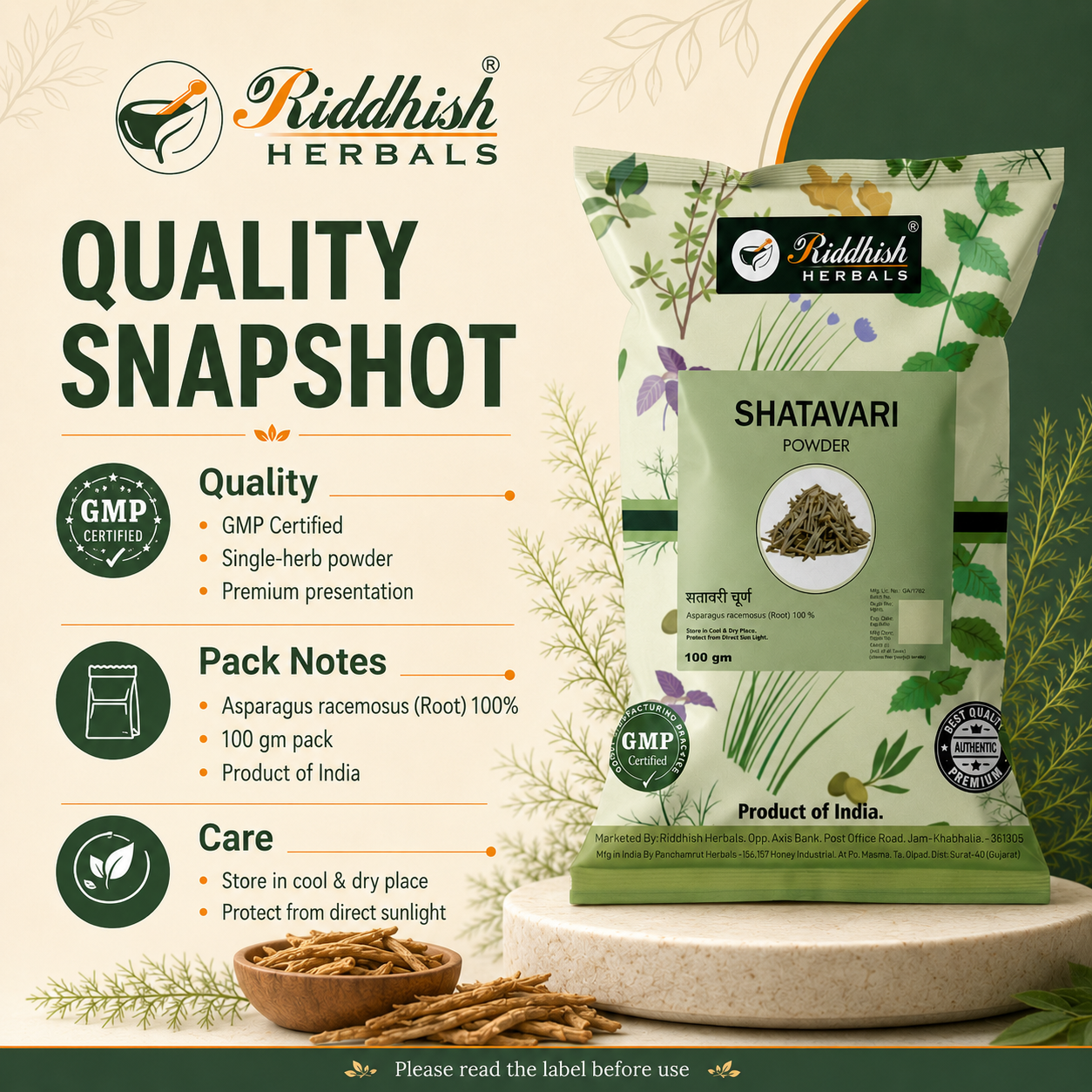
Pack: 100 g · Form: Powder (churna) · Mfg. Lic. No.: GA/1762 · Manufactured by Panchamrut Herbals. Marketed by Riddhish Herbals. Product of India.
How to Use
Dose: As directed by the Ayurvedic physician.
In traditional practice, Shatavari root powder is stirred into warm milk, sometimes with a little ghee or mishri, which suits its cooling, nourishing nature. It may also be taken with warm water. It is often used alongside other Balya herbs such as Ashwagandha. Your physician will set the quantity, timing and vehicle that suit you.
Safety, Storage & Pack Information
Use under the guidance of a qualified Ayurvedic physician. Consult your physician before use, especially if you are pregnant, lactating, taking any medication, or managing any medical condition. Shatavari is a heavy, cooling herb, so take only the quantity your physician advises, and stop use and seek advice if any discomfort occurs. For children, use only as directed by a physician. Keep out of reach of children. Results may vary from person to person.
Storage: Store in a cool and dry place. Protect from direct sunlight. Close the pack well after each use.
Pack: 100 g. Check the batch number, manufacturing date and expiry date on your pack before use.
Ingredient Names in Hindi, Gujarati and Sanskrit
| Ingredient | Hindi | Gujarati | Sanskrit | English — Botanical |
|---|---|---|---|---|
| Shatavari | शतावरी (Shatavari) | શતાવરી (Shatavari) | शतावरी, शतमूली (Shatavari, Shatamuli) | Indian asparagus, wild asparagus — Asparagus racemosus |
Also searched as: Shatavari Churna, Shatavari Root Powder, Satavari Powder, Shatawari Churna, Shataveri Powder, Shatvari Powder, Shatamuli Churna, Shatamuli Powder, Asparagus racemosus Root Powder, Indian Asparagus Powder, Wild Asparagus Root Powder, Thannir Vittan Kizhangu Powder, Challa Gadda Powder.
Frequently Asked Questions
What is Shatavari Powder?
Shatavari Powder (शतावरी चूर्ण) by Riddhish Herbals is a single-herb Ayurvedic churna of the root of Asparagus racemosus, 100%, in a 100 g pack. Also known as Shatamuli, Shatavari is one of the best-known herbs of classical Ayurveda, described as Balya (strengthening) and Rasayana, and traditionally associated with women’s wellness and everyday strength and vitality.
What does this pack contain?
Ingredients: Asparagus racemosus (Root), 100%. Net weight: 100 g.
How do I take Shatavari Powder?
Dose: As directed by the Ayurvedic physician. In traditional practice, Shatavari root powder is taken with warm milk, sometimes with a little ghee or mishri, or with warm water. Your physician will set the quantity, timing and vehicle that suit you.
How is Shatavari described in classical Ayurveda?
Bhavaprakasha Nighantu (Guduchyadi Varga) describes Shatavari as Madhura (sweet) and Tikta (bitter) in taste, Guru (heavy) and Snigdha (unctuous) in quality, Sheeta (cool) in potency and Madhura (sweet) in post-digestive effect. It is described as Balya (strengthening) and Rasayana, and as pacifying Vata and Pitta.
Is Shatavari traditionally used for women’s wellness?
Yes. In Ayurvedic tradition Shatavari is the herb most closely associated with women’s wellness, valued as a cooling, nourishing Balya and Rasayana dravya that pacifies Vata and Pitta. It is used in daily routines for general strength and vitality, by women and men alike, under the guidance of an Ayurvedic physician.
Can I take Shatavari Powder if I am pregnant or lactating, or with other medicines?
Please consult your physician before use if you are pregnant or lactating, taking any medication, or managing any medical condition, and use it only under their guidance. For children, use only as directed by a physician.
Who manufactures and markets this Shatavari Powder?
Manufactured by Panchamrut Herbals (Mfg. Lic. No. GA/1762). Marketed by Riddhish Herbals, Khambhalia, Gujarat.
Is this product GMP certified?
Panchamrut Herbals, the manufacturer of this product, holds GMP, ISO 9001:2015 and HACCP certification. Good manufacturing practice (GMP) relates to how the product is made; these are not claims about any medical outcome.
How do I know this is the genuine pack?
A genuine pack has the Riddhish Herbals logo, the name Shatavari Powder with शतावरी चूर्ण in Hindi, Asparagus racemosus (Root) 100%, Mfg. Lic. No. GA/1762, a 100 gm net weight, and its own batch number, manufacturing date and expiry date. Every order from Riddhish Herbals ships with a proper bill, and our team can help you confirm the pack you received.
What are the other names of Shatavari?
Shatavari is also written Satavari, Shatawari or Shatvari. It is called Shatavari (शतावरी) in Hindi, Shatavari (શતાવરી) in Gujarati, Shatavari and Shatamuli (शतावरी, शतमूली) in Sanskrit, Shatamuli in Bengali, Thannir Vittan Kizhangu in Tamil and Challa Gadda in Telugu. In English it is Indian asparagus or wild asparagus, and its botanical name is Asparagus racemosus.
How should I store Shatavari Powder?
Store in a cool and dry place. Protect from direct sunlight. Close the pack well after each use and use a clean, dry spoon, so the powder stays dry.
Related Products
- Ashwagandha Powder (Asgandh Churna) 100g — Riddhish Herbals
- Kaucha Churna (Kapikacchu) 100g — Riddhish Herbals
- Gokshur Powder 100g — Riddhish Herbals
- Yastimadhu Powder (Mulethi) 100g — Riddhish Herbals
About Riddhish Herbals
Manufactured by Panchamrut Herbals. Marketed by Riddhish Herbals. Riddhish Herbals has supplied genuine Ayurvedic products across India since 2015. This is a traditional Ayurvedic product; information on this page is educational and is not a substitute for professional medical advice.
Since 2015 · Genuine Products · Bill Provided · Doctor-Guided Selection · 4000+ Ayurvedic Products · 130+ Trusted Brands · Pan-India Delivery