Skip to product information
1 of 4

Riddhish Herbals

Varunadi Kashay (Varunadi Kashayam) – Classical Kadha – Ayucare Pharmaceutical – 200ml

Varunadi Kashay (Varunadi Kashayam) – Classical Kadha – Ayucare Pharmaceutical – 200ml

Regular price Rs. 155.00
Regular price Rs. 155.00 Sale price Rs. 155.00
Sale Sold out

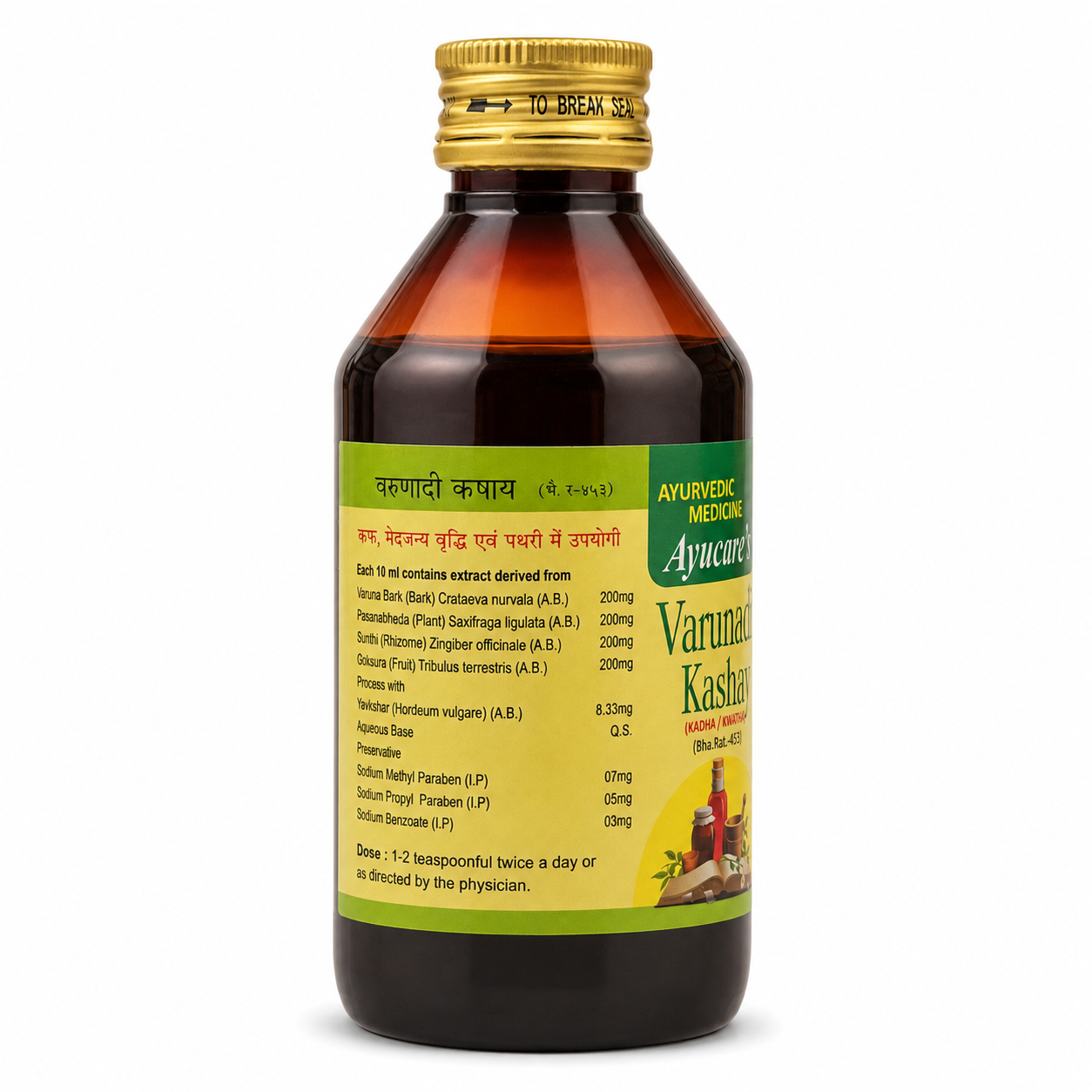
Varunadi Kashay 200 ml by Ayucare Pharmaceutical is a classical Ayurvedic kwath (kadha) in which each 10 ml carries extract derived from four dravyas at 200 mg each — Varuna bark (Crataeva nurvala), Pashanabheda (Saxifraga ligulata), Sunthi rhizome (Zingiber officinale) and Gokshura fruit (Tribulus terrestris) — processed with Yavakshara (Hordeum vulgare) 8.33 mg. The pack carries the classical reference Bha. Rat.-453 and states the formula is useful in Kapha, in Medaja vriddhi and in the Ashmari context. It is made under Mfg. Lic. No. GA/1491 at a GMP-certified facility in Moraiya, Ahmedabad, and the pack directs 1 to 2 teaspoonful twice a day, or as the physician directs. It is not preservative-free: the label declares Sodium Methyl Paraben 07 mg, Sodium Propyl Paraben 05 mg and Sodium Benzoate 03 mg per 10 ml. Sold by Riddhish Herbals, Gujarat's trusted Ayurvedic store since 2015.

About Varunadi Kashay

Varuna gives the formula its name, and the classical texts give the formula its shape. The Ayucare pack prints the reference Bha. Rat.-453, so the recension can be checked rather than taken on trust. Four dravyas at 200 mg per 10 ml, processed with Yavakshara — a short, deliberate formula rather than a long one.

One distinction matters more than anything else on this page, and the market gets it wrong constantly. Varunadi is not Varanadi. Varanadi Kashayam is the Kerala formula of the Varanadi gana, sold by Kottakkal, Vaidyaratnam and AVP and described for Kapha and Meda. This is Varunadi — Varuna-led, four dravyas, Bha. Rat.-453, and classically a Mutravaha Srotas formula. Amazon itself autocorrects one spelling to the other, so buyers land on the wrong medicine every day. If your Vaidya wrote Varanadi, this is not it.

On the Varunadi side the composition is consistent across brands, which is a good sign. Tansukh publish their Varunadhya Kadha as Varun, Sunthi, Gokhru and Pashanbhed — the same four dravyas this Ayucare label declares. The difference is that Ayucare print the quantities and the Yavakshara step, and most of the shelf does not. We priced the shelf on 18 August 2026: across 200 ml bottles, Kerala Ayurveda comes to about ₹55 per 100 ml, a generic Varunadi Kashaya ₹65.50 and IMIS ₹82.50. This bottle sits at ₹77.50 — upper-middle, not the cheapest, and we say so rather than let you find out at checkout.

One correction we owe you in the open. This listing previously described the product as preservative-free. The label declares three preservatives, quantified. It also previously printed a dose of 15 to 20 ml; the pack says 1 to 2 teaspoonful. Both have been corrected against the physical label, which is the only authority we accept on composition.

Traditional Ayurvedic Importance

Varuna (Crataeva nurvala) is the lead, and the bark is the part the label specifies. Classical authors group Varuna with the Mutravaha Srotas and the Basti, and it is the dravya with the longest published research trail of the four. Pashanabheda stands beside it: pashana is stone, bheda is to break, and classical literature places it first among the dravyas of the Ashmari context. Between them they define what this kwath is classically for.

Gokshura (Tribulus terrestris) is the third pillar and a long-standing Mutrala dravya — the fruit, as the label specifies. Sunthi, dry ginger, is the Deepana that carries the rest; a kwath of cooling and Mutrala dravyas sits badly on a weak Agni without it, and its presence here is a formulation decision rather than a filler.

Yavakshara is the detail that marks this out as a classical preparation rather than a modern blend. It is the alkaline ash of barley, and classical Rasashastra uses the Kshara group for exactly this kind of formula — the pack lists it under “process with”, at 8.33 mg, which is how a Kshara is used: catalytically, in a small quantity, not as a bulk ingredient. The pack's own Hindi line names Kapha, Medaja vriddhi and the Ashmari context as its classical territory.

Key Features

  • All four dravyas declared with quantities: 200 mg each per 10 ml, plus Yavakshara at 8.33 mg, printed on the Ayucare label rather than described as a herbal blend.
  • Classical reference on the pack: Bha. Rat.-453, so the recension is checkable against the classical text instead of asserted.
  • Varunadi, not Varanadi — and we say so: these are two different classical formulas that the market constantly conflates. Varanadi Kashayam (Kottakkal, Vaidyaratnam, AVP) is a Kerala Kapha-Meda formula. This is the Varuna-led Mutravaha Srotas one.
  • Plant parts specified, not vague: Varuna bark, Pashanabheda whole plant, Sunthi rhizome, Gokshura fruit — exactly as the label gives them.
  • Yavakshara processing declared: the alkaline barley ash listed under “process with” at 8.33 mg — a classical Kshara step most liquid kadhas do not print.
  • Preservatives disclosed, and a past claim corrected: Sodium Methyl Paraben 07 mg, Sodium Propyl Paraben 05 mg, Sodium Benzoate 03 mg per 10 ml. This page previously said preservative-free. It was wrong, and the label is what stands.
  • GMP-certified manufacture: Ayucare Pharmaceutical, Mfg. Lic. No. GA/1491, Moraiya, Ahmedabad.
  • Ready-to-use liquid kwath: no boiling and no measuring of churna — the classical decoction supplied as a 200 ml bottle.

Research on the Constituents

Varuna is the dravya in this formula with the longest published research trail. Researchers at the University of Madras studied a bark decoction of Crataeva nurvala in an experimental animal model and reported a marked reduction in the activity of glycolate oxidase, the oxalate-synthesising enzyme, together with reduced calcium-oxalate crystal deposition. — (Varalakshmi, Shamila & Latha, 1990 — Journal of Ethnopharmacology 28(3):313–21. PMID 2335959). An animal study on one dravya, and on the bark — the part this label specifies — not a trial of this finished preparation.

Results were observed under study conditions. Individual results may vary. This is shared for general educational interest and is not a medical claim. Consult your Ayurvedic physician before use.

Composition (label-verified, per 10 ml)

Dravya (plant part) Botanical Quantity
Varuna (Bark) Crataeva nurvala (A.B.) 200 mg
Pashanabheda (Whole plant) Saxifraga ligulata (A.B.) — also read as Bergenia ligulata 200 mg
Sunthi / Shunthi (Rhizome) Zingiber officinale (A.B.) 200 mg
Gokshura (Fruit) Tribulus terrestris (A.B.) 200 mg
Process with — Yavakshara Hordeum vulgare (A.B.) 8.33 mg
Aqueous base Q.S.
Sodium Methyl Paraben (I.P.) preservative 07 mg
Sodium Propyl Paraben (I.P.) preservative 05 mg
Sodium Benzoate (I.P.) preservative 03 mg

Per 10 ml, reproduced from the Ayucare Pharmaceutical label, which states “Each 10 ml contains extract derived from” and marks every dravya (A.B.) — Arya Bhishak. Declared an Ayurvedic Medicine against Bha. Rat.-453 (Bhaishajya Ratnavali), Mfg. Lic. No. GA/1491, Ayucare Pharmaceutical, a G.M.P. certified company at 77 New Ahmedabad Ind. Estate, Moraiya, Ahmedabad 382213. Plant parts are given exactly as the pack specifies them. The pack prints Saxifraga ligulata for Pashanabheda; the currently accepted binomial is Bergenia ligulata and the dravya is the same. This product is not preservative-free — a claim this listing previously carried and which the label contradicts.

How to Use

As directed by your Ayurvedic physician. The Ayucare pack states 1 to 2 teaspoonful twice a day, or as directed by the physician — roughly 5 to 10 ml per dose. Shake the bottle well before each dose. The traditional anupan for a kwath of this kind is lukewarm water, taken before food; your Vaidya may direct otherwise. Do not exceed the dose printed on the pack. An earlier version of this page stated 15 to 20 ml; that figure did not come from the label and has been removed.

Who Can Use It

Adults, on the direction of a qualified Ayurvedic physician, as part of a Mutravaha Srotas protocol they are already guiding. Not for use in pregnancy or lactation without your physician's clearance. If you are on regular medication, tell your physician before starting — this is a Mutrala formula and that matters. It contains declared parabens and sodium benzoate, which matters if you react to preservatives. For children, dose and suitability are a decision for a qualified Ayurvedic physician, and no paediatric dose is printed here.

Safety Information

Use as directed by a qualified Ayurvedic physician and do not exceed the dose printed on the pack — 1 to 2 teaspoonful twice a day. Because this is a Mutrala formula, keep your fluid intake normal and tell your physician if you are taking any medicine that acts on the Mutravaha Srotas or on fluid balance. Yavakshara makes this an alkaline preparation; if you have a sensitive stomach, take it after food and tell your Vaidya how you get on. Avoid in pregnancy and lactation unless your physician has cleared it. Declared preservatives: Sodium Methyl Paraben, Sodium Propyl Paraben, Sodium Benzoate. Keep out of reach of children. Results may vary from person to person.

Storage

The pack directs: shake well before use, keep in a cool and dry place, and away from direct sunlight. Keep the cap tightly closed and do not decant the kashay into another bottle. Expiry is three years from the date of manufacture printed on the pack.

Frequently Asked Questions

Is this the same as Varanadi Kashayam? (Please read this one.)

No. They are two different classical formulas and the market confuses them constantly. Varanadi Kashayam is the Kerala formula built on the Varanadi gana — Kottakkal, Vaidyaratnam and AVP all sell it, described for Kapha and Meda. Varunadi, this one, is Varuna-led at Bha. Rat.-453 and classically a Mutravaha Srotas formula. Amazon's own search autocorrects one spelling to the other. If your Vaidya wrote Varanadi, this is not the bottle you want — ask us and we will get you the right one.

What is Varunadi Kashay used for?

Varunadi Kashay is a classical Ayurvedic liquid kwath (kadha) led by Varuna bark (Crataeva nurvala). The Ayucare pack states it is useful in Kapha, in Medaja vriddhi and in the Ashmari context — the classical Ayurvedic terms the formula is indicated for — and classical literature groups Varuna and Pashanabheda with the Mutravaha Srotas. Use it only as your Ayurvedic physician directs.

What exactly does the label declare?

Per 10 ml: Varuna bark, Pashanabheda whole plant, Sunthi rhizome and Gokshura fruit at 200 mg each; processed with Yavakshara (Hordeum vulgare) 8.33 mg; aqueous base Q.S.; and preservatives Sodium Methyl Paraben 07 mg, Sodium Propyl Paraben 05 mg and Sodium Benzoate 03 mg. Classical reference Bha. Rat.-453, Mfg. Lic. No. GA/1491.

Is this product preservative-free?

No, and an earlier version of this page wrongly said it was. The label declares three preservatives with quantities: Sodium Methyl Paraben 07 mg, Sodium Propyl Paraben 05 mg and Sodium Benzoate 03 mg per 10 ml. A ready-to-drink aqueous kwath in a 200 ml bottle needs them. We would rather correct the record in public than leave a comfortable claim standing.

How much should I take, and with what?

The pack states 1 to 2 teaspoonful — about 5 to 10 ml — twice a day, or as directed by the physician. Shake well before each dose. The traditional anupan is lukewarm water before food, though your Vaidya may direct differently. An earlier version of this page said 15 to 20 ml; that was not from the label and it has been removed.

What is Yavakshara, and why is it in a kwath?

Yavakshara is the alkaline ash of barley (Hordeum vulgare), and the label lists it under “process with” rather than as a bulk ingredient — at 8.33 mg per 10 ml. Classical Rasashastra uses the Kshara group in exactly this way: a small, catalytic quantity that changes how the preparation behaves. Its presence is one sign this is a classical formula rather than a modern blend.

Why only four dravyas? Other Varunadi products list many more.

Usually because they are a different formula, not a different recension. The long multi-dravya gana belongs to Varanadi, which is a separate Kerala preparation. Varunadi at Bha. Rat.-453 is genuinely this compact — Varuna and Pashanabheda, plus a Mutrala and a Deepana, finished with Yavakshara. Tansukh's Varunadhya Kadha declares the same four dravyas. If a product calls itself Varunadi and lists fifteen, check which formula you are actually holding.

What are Varuna and Pashanabheda?

Varuna is Crataeva nurvala, and the bark is the part used — the label specifies bark. Classical authors group it with the Mutravaha Srotas and the Basti. Pashanabheda means stone-breaking (pashana, stone; bheda, to break); the pack prints Saxifraga ligulata, whose currently accepted binomial is Bergenia ligulata. Classical literature places it first among the dravyas of the Ashmari context.

How is this different from your Ashmarihar Kashay?

Different formula, different legal class. Ashmarihar Kashay is a fifteen-dravya Siddha Yoga Sangraha kwath and it contains Parasika Yavani, a Schedule E(1) dravya, so it is physician-prescription only. Varunadi Kashay is a four-dravya Bhaishajya Ratnavali kwath with no Schedule E(1) ingredient. They are not substitutes for one another — ask your Vaidya which they meant.

Is Ayucare GMP certified?

The pack carries the marking “G.M.P. CERTIFIED COMPANY” for Ayucare Pharmaceutical, with Mfg. Lic. No. GA/1491 and the address 77 New Ahmedabad Ind. Estate, Moraiya, Ahmedabad 382213. Riddhish Herbals stocks only genuine packs from verified manufacturers and provides a bill with every purchase.

Have these dravyas been studied scientifically?

Varuna has the longest trail: a University of Madras team studied a Crataeva nurvala bark decoction in an experimental animal model and reported reduced glycolate-oxidase activity and reduced calcium-oxalate crystal deposition (Varalakshmi et al., 1990 — J Ethnopharmacol 28(3):313–21, PMID 2335959). We cite one study rather than padding the list: the other papers we found on these dravyas concern different preparations, different routes or conditions we may not lawfully discuss, so they are left out rather than reworded. That is an animal study on one dravya and on the bark, not a trial of this bottle. Results were observed under study conditions and individual results may vary.

What are the alternate names and spellings?

Varunadi Kashay, Varunadi Kashayam, Varunadi Kwath, Varunadi Kwatham, Varunadi Kadha, Varunadhya Kadha, Varunadi Kashaya and Varun Kwath. Varanadi Kashayam is deliberately NOT in that list — it is a different formula. Buyers also search it as a Varuna or Mutrala kadha, and misspell it as Varunadhi Kashay, Warunadi Kwath or Varnadi Kashayam.

How should I store it, and is it available at Riddhish Herbals?

Shake well before use, keep in a cool and dry place away from direct sunlight, cap tightly closed, and out of reach of children; use within three years of the manufacturing date on the pack. It is stocked at our Khambhalia, Gujarat store and online at riddhishherbals.com with Pan-India delivery. Since 2015, genuine products, bill provided, doctor-guided selection.

Related at Riddhish Herbals

Since 2015Genuine ProductsBill ProvidedDoctor-Guided Selection4000+ Ayurvedic Products130+ Trusted BrandsPan-India Delivery
રીધ્ધીશ હર્બલ્સ — ગુજરાતનો વિશ્વાસપાત્ર આયુર્વેદિક સ્ટોર, જ્યાં સાચી સલાહ અને genuine Ayurvedic products એક જ જગ્યાએ મળે છે.
View full details
%}