Riddhish Herbals
Ashmarihar Kashay 200ml – Classical Ayurvedic Kwath – Ayucare Pharmaceutical
Couldn't load pickup availability
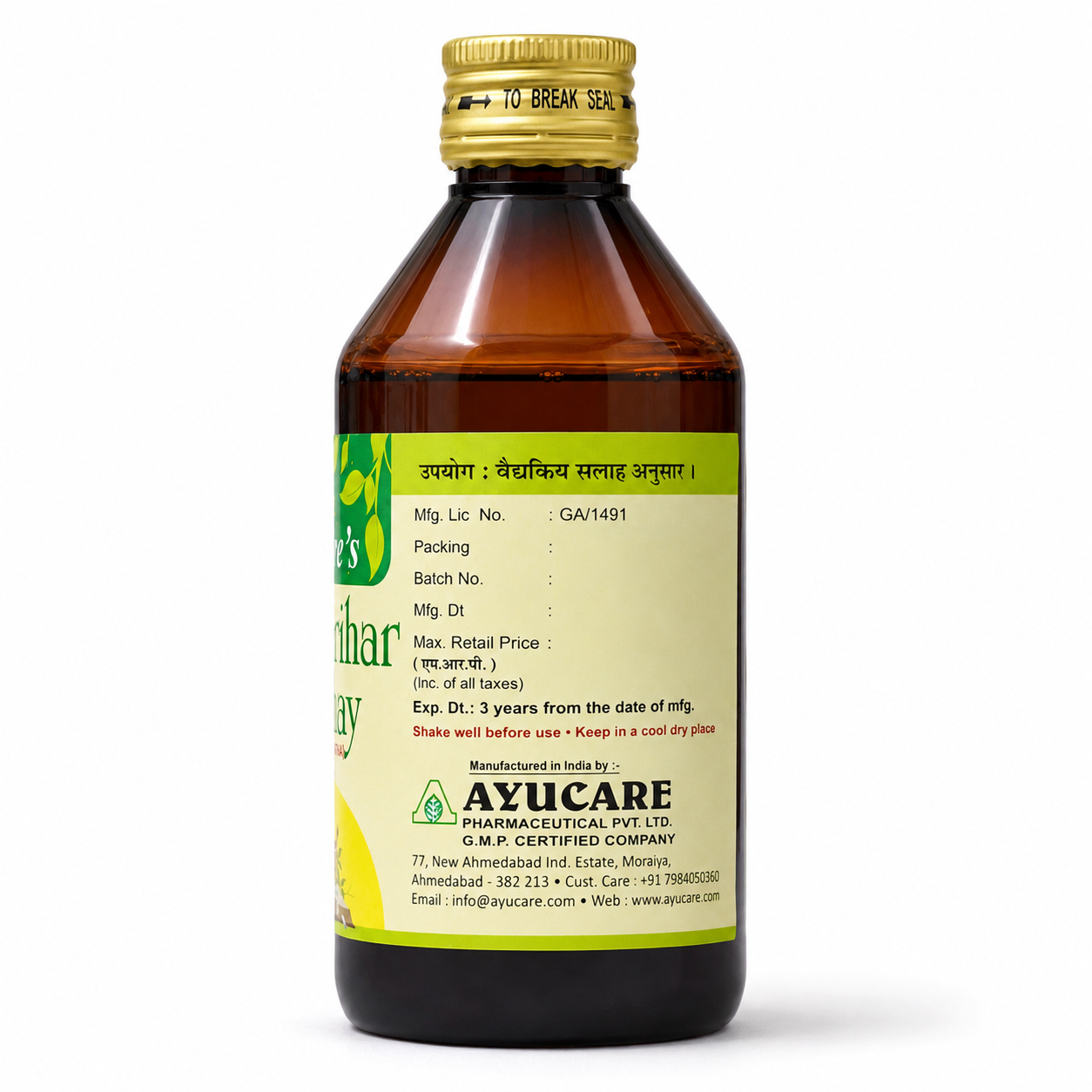
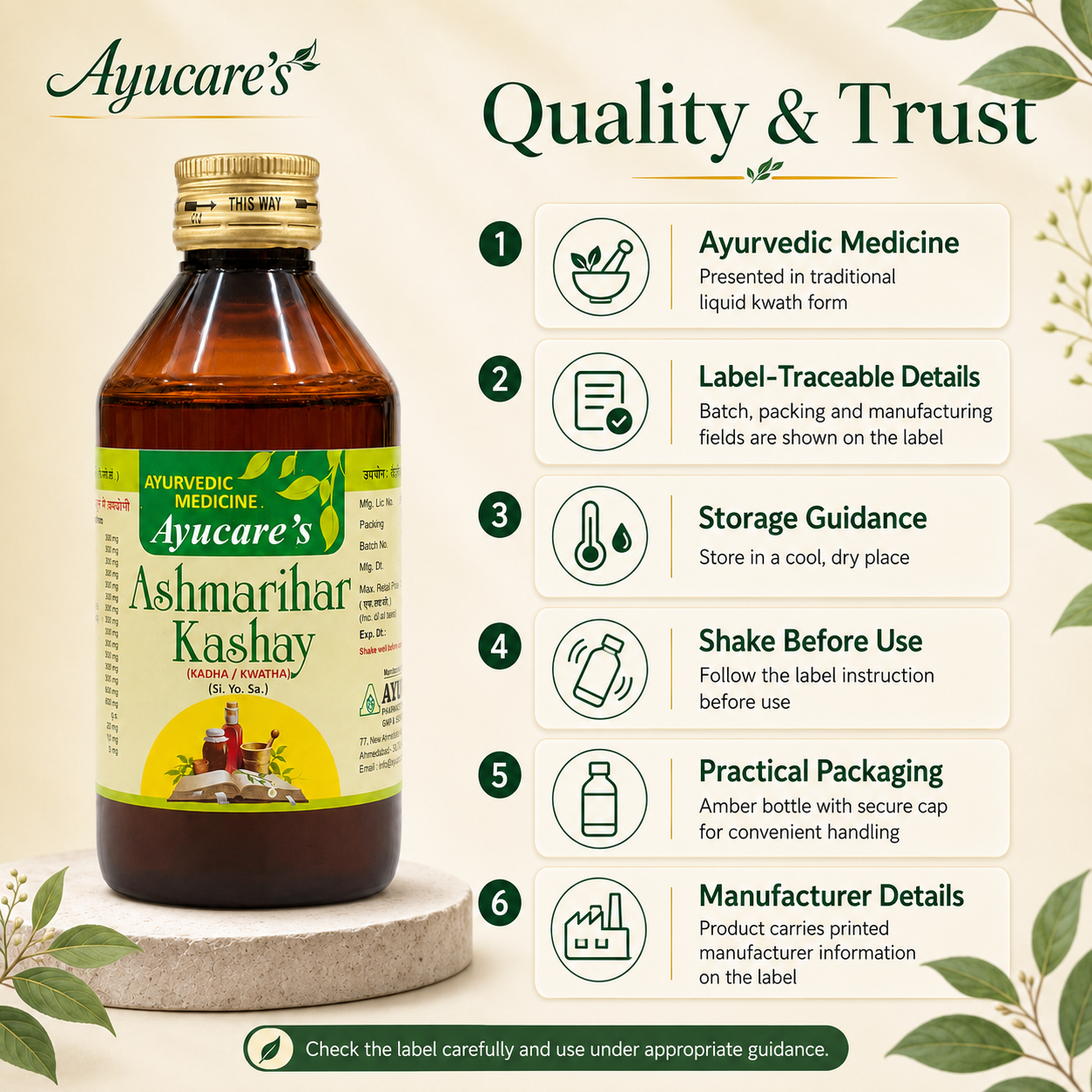
Ashmarihar Kashay 200 ml by Ayucare Pharmaceutical is a classical Ayurvedic kwath (kadha) of the Siddha Yoga Sangraha, in which each 10 ml carries extract derived from fifteen named dravyas — thirteen at 300 mg each, with Jatamansi and Parasika Yavani at 600 mg each. The formula is built on Pashanbhed (Bergenia ligulata) and Varuna (Crataeva religiosa), the two dravyas classical literature associates most closely with the Ashmari context and the Mutravaha Srotas. It is made under Mfg. Lic. No. GA/1491 at a GMP-certified facility in Moraiya, Ahmedabad. One of its dravyas, Parasika Yavani (Khursani Ajmo, Hyoscyamus niger), is listed in Schedule E1 of the Drugs and Cosmetics Rules, 1945 — so this preparation is for use only on the direction of a registered Ayurvedic physician. Sold by Riddhish Herbals, Gujarat's trusted Ayurvedic store since 2015.
Reviewed by Dr. Riddhish Padiya — B.Pharm (Ayurveda), M.Pharm (Pharmacognosy), Ph.D. (Dravyaguna), ITRA Jamnagar. Publications under “Padiya RH”.
About Ashmarihar Kashay
The name is a description. Ashmari is the classical Ayurvedic term for a stony concretion, and hara means that which removes — so Ashmarihar Kashay names the classical category it belongs to rather than a modern indication. The Ayucare pack carries the reference Si. Yo. Sa. — Siddha Yoga Sangraha — which is where the formula is set down.
Fifteen dravyas is a wide formula for a kwath, and Ayucare declare all of them with quantities on the label: thirteen at 300 mg per 10 ml, and two — Jatamansi and Parasika Yavani — at 600 mg. That level of disclosure is unusual in the ready-to-drink kadha category and it is the reason this page can be specific where competitors are vague.
It is worth being plain about one thing. This is not a general wellness drink. One of its declared dravyas sits on Schedule E1 of the Drugs and Cosmetics Rules, and the pack itself says only that it is to be used as per medical advice. Riddhish Herbals stocks it for patients already under a Vaidya's care, not for self-selection.
Traditional Ayurvedic Importance
Pashanbhed carries its purpose in its name — pashana is stone, bheda is to break — and classical Ayurvedic literature places it first among the dravyas of the Ashmari context. Varuna (Vayvarna on this label) is the second pillar; classical authors group it with the Mutravaha Srotas and the Basti. Between them they define what this kwath is for in classical terms.
Around those two sits a recognisable classical supporting set. Gokshura and Punarnava are both long-standing Mutrala dravyas. Dabh (Kusha), Kasha and Dangar are the classical Trina-panchamula grasses used in cooling Mutravaha formulations. Shatavari and Guduchi add the Rasayana and Pitta-cooling element, Apamarga and Kakdi beeja the Mutrala, and Sag (Tectona grandis) and Papaya complete a formula that reads as a considered classical whole rather than a list.
Jatamansi and Parasika Yavani are the two at double strength, and both are classically Vedanasthapana — the group used where classical texts describe Shula, colic pain, accompanying the Ashmari state (Siddha Yoga Sangraha, the reference printed on this pack). Parasika Yavani is the reason the whole preparation is physician-directed rather than over-the-counter, and that is a feature of the classical formula, not an accident of manufacture.
Key Features
- The Schedule E1 disclosure nobody else on this shelf makes: we checked the Ashmarihar shelf on 18 August 2026 — Patanjali, Punarvasu, Nagarjun, Dhanvantari and Sanjeevika all sell this classical formula, and not one of their listings tells you it carries a Schedule E1 dravya. That single fact decides whether the product is safe for you to choose without a Vaidya.
- All fifteen dravyas declared with quantities: thirteen at 300 mg and two at 600 mg per 10 ml, printed on the Ayucare label rather than described as a proprietary blend.
- Classical Siddha Yoga Sangraha formula: the reference Si. Yo. Sa. is printed on the pack, so the composition is checkable against the classical text.
- Built on Pashanbhed and Varuna: the two dravyas classical literature ties most closely to the Ashmari context and the Mutravaha Srotas.
- Schedule E1 dravya declared: Parasika Yavani (Hyoscyamus niger) at 600 mg per 10 ml. We state it openly because it decides how the product may be used.
- Preservatives disclosed, not hidden: Sodium Methyl Paraben 20 mg, Sodium Propyl Paraben 10 mg and Sodium Benzoate 5 mg per 10 ml, exactly as the label declares.
- GMP-certified manufacture: Ayucare Pharmaceutical, Mfg. Lic. No. GA/1491, Moraiya, Ahmedabad.
- Ready-to-use liquid kwath: no boiling, no measuring of churna — the classical decoction supplied as a 200 ml bottle.
Research on the Constituents
◆ Varuna — Crataeva — is the dravya in this formula with the longest published research trail. Researchers at the University of Madras studied a bark decoction of Crataeva nurvala in an experimental animal model and reported a marked reduction in the activity of glycolate oxidase, the oxalate-synthesising enzyme, together with reduced calcium-oxalate crystal deposition. — (Varalakshmi, Shamila & Latha, 1990 — Journal of Ethnopharmacology 28(3):313–21. PMID 2335959). This is an animal study, not a human trial, and it concerns one dravya rather than this finished preparation — we report it as published and claim nothing beyond it.
Results were observed under study conditions. Individual results may vary. This is shared for general educational interest and is not a medical claim. Consult your Ayurvedic physician before use.
Composition (label-verified, per 10 ml)
| Dravya | Botanical | Quantity |
|---|---|---|
| Pashanbhed | Bergenia ligulata (label: Saxifraga ligulata) | 300 mg |
| Sag | Tectona grandis | 300 mg |
| Papaya | Carica papaya | 300 mg |
| Shatavari | Asparagus racemosus | 300 mg |
| Gokharu (Gokshura) | Tribulus terrestris | 300 mg |
| Vayvarna (Varuna) | Crataeva religiosa | 300 mg |
| Dabh / Dabhado (Kusha) | Desmostachya bipinnata (label: Eragrostis cynosuroides) | 300 mg |
| Kasha / Kansado | Saccharum spontaneum | 300 mg |
| Dangar (Chaval) | Oryza sativa | 300 mg |
| Punarnava | Boerhaavia diffusa | 300 mg |
| Gioy (Guduchi) | Tinospora cordifolia | 300 mg |
| Apamarga | Achyranthes aspera | 300 mg |
| Kakdi (beeja) | Cucumis utilissimus | 300 mg |
| Jatamansi | Nardostachys jatamansi | 600 mg |
| Parasika Yavani (Khursani Ajmo) | Hyoscyamus niger — Schedule E1 | 600 mg |
| Aqueous base | — | q.s. |
| Sodium Methyl Paraben (I.P.) | preservative | 20 mg |
| Sodium Propyl Paraben (I.P.) | preservative | 10 mg |
| Sodium Benzoate (I.P.) | preservative | 5 mg |
Per 10 ml, reproduced from the Ayucare Pharmaceutical label, which states “Each 10 ml contains extract derived from” and marks every dravya (A.B.) — Arya Bhishak. Declared an Ayurvedic Medicine against Si. Yo. Sa. (Siddha Yoga Sangraha), Mfg. Lic. No. GA/1491, Ayucare Pharmaceutical, a G.M.P. certified company at 77 New Ahmedabad Ind. Estate, Moraiya, Ahmedabad 382213. Botanical binomials are given in their currently accepted form where the pack prints an older synonym; the dravyas are unchanged.
How to Use
Strictly as directed by your Ayurvedic physician. The Ayucare pack states 1 to 2 teaspoonful twice a day, or as directed by the physician, and its usage line reads simply that it is to be used as per medical advice. Shake the bottle well before each dose. Because the formula contains a Schedule E1 dravya, the dose and the duration are decisions for your Vaidya and not for the label alone.
Who Can Use It
Adults to whom a registered Ayurvedic physician has prescribed it. This is not a product for self-selection: it carries Parasika Yavani (Hyoscyamus niger), a Schedule E1 dravya of the Drugs and Cosmetics Rules, 1945. Not for use in pregnancy or lactation. Not for anyone on regular medication without their physician's knowledge, and it contains declared parabens and sodium benzoate, which matters if you react to preservatives. For children, any decision rests entirely with a qualified Ayurvedic physician and no dose is printed here.
Safety Information
This preparation contains a Schedule E1 dravya and the pack instructs use as per medical advice. Take it only on a registered Ayurvedic physician's direction, at the dose and for the duration they set, and stop and contact them if anything changes — dryness of the mouth, blurring of vision, drowsiness or a racing heartbeat are the effects classical and modern literature both associate with Parasika Yavani and none of them should be waited out at home. Never exceed the printed dose. Avoid in pregnancy and lactation. Declared preservatives: Sodium Methyl Paraben, Sodium Propyl Paraben, Sodium Benzoate. Keep out of reach of children. Results may vary from person to person.
CAUTION — TO BE TAKEN UNDER MEDICAL SUPERVISION. सावधानी — चिकित्सक की देखरेख में ही लें।
This preparation contains a dravya listed in Schedule E(1) of the Drugs and Cosmetics Rules, 1945. Rule 161 of those Rules requires the caution above on a medicine of this class intended for internal use. Consult a qualified Ayurvedic physician before usage. Take it only at the dose and for the duration your physician directs, never above the dose printed on the pack, and not as self-medication. Keep out of reach of children. Results may vary from person to person.
Use strictly under the guidance of a qualified Ayurvedic physician. Consult your physician before use, especially if you are pregnant, lactating, taking any medication, or managing any medical condition. Keep out of reach of children. Results may vary from person to person.
Storage
The pack directs: shake well before use and keep in a cool, dry place. Keep the cap tightly closed, keep it out of direct sunlight, and do not decant it into another bottle. Expiry is three years from the date of manufacture printed on the pack.
Frequently Asked Questions
What is Ashmarihar Kashay?
Ashmarihar Kashay is a classical Ayurvedic liquid kwath (kadha) of the Siddha Yoga Sangraha. The Ayucare 200 ml pack declares fifteen dravyas — thirteen at 300 mg and two at 600 mg per 10 ml — built around Pashanbhed and Varuna. Ashmari is the classical term the formula is named for.
Why does this need a doctor's prescription when other kadhas do not?
Because of one dravya. Parasika Yavani (Khursani Ajmo, Hyoscyamus niger) is declared at 600 mg per 10 ml and it is listed in Schedule E1 of the Drugs and Cosmetics Rules, 1945 — the schedule of substances that may be used in Ayurvedic medicine only on a registered practitioner's direction. The pack's own usage line says use as per medical advice. We will not sell this as a self-service wellness product.
What exactly does the label declare?
Per 10 ml: Pashanbhed, Sag, Papaya, Shatavari, Gokharu, Vayvarna, Dabh, Kasha, Dangar, Punarnava, Gioy, Apamarga and Kakdi at 300 mg each; Jatamansi and Parasika Yavani at 600 mg each; aqueous base q.s.; and preservatives Sodium Methyl Paraben 20 mg, Sodium Propyl Paraben 10 mg, Sodium Benzoate 5 mg. Mfg. Lic. No. GA/1491.
What are Pashanbhed and Varuna, and why are they the core?
Pashanbhed (Bergenia ligulata) means stone-breaking, and classical Ayurvedic literature places it first among the dravyas of the Ashmari context. Varuna (Crataeva religiosa, Vayvarna on the label) is the second pillar and is classically grouped with the Mutravaha Srotas and the Basti. The other thirteen dravyas support those two.
Does it contain preservatives?
Yes, and the label says so: Sodium Methyl Paraben 20 mg, Sodium Propyl Paraben 10 mg and Sodium Benzoate 5 mg per 10 ml. We reproduce that rather than describe the product as preservative-free, because it is not. A ready-to-drink aqueous kwath in a 200 ml bottle needs them.
How much should I take?
The pack states 1 to 2 teaspoonful twice a day, or as directed by the physician — and given the Schedule E1 dravya, please read that as an outer boundary your Vaidya works within, not a starting point you choose yourself. Shake well before each dose.
How is this different from the other Ashmarihar products on the market?
Start with format, because it is the commonest mix-up. Patanjali's Divya Ashmarihar Kwath and Punarvasu's Ashmarihar Kwatha are churna — a powder you boil down yourself. Dhanvantari sell a 450 ml kadha, Sanjeevika a 200 ml. This Ayucare bottle is a ready-to-drink liquid kwath, so there is nothing to measure or boil. Then composition: we could not find a competing listing that publishes quantities for all fifteen dravyas, and none of them disclose the Schedule E1 dravya at all. Several advertise the formula against a named medical condition, which Indian law does not permit and which we will not copy. Shelf checked 18 August 2026.
How is the Ayucare version different from the Nagarjun one you also sell?
They are two different manufacturers of the same classical formula, and we stock both because a physician may specify one. Ayucare's is made at Moraiya, Ahmedabad under Mfg. Lic. No. GA/1491 in a GMP-certified facility, and prints a full quantified composition for all fifteen dravyas. Ask your Vaidya which they prefer.
Is Ayucare GMP certified?
The pack carries the marking “G.M.P. CERTIFIED COMPANY” for Ayucare Pharmaceutical, with Mfg. Lic. No. GA/1491 and the address 77 New Ahmedabad Ind. Estate, Moraiya, Ahmedabad 382213. Riddhish Herbals stocks only genuine packs from verified manufacturers and provides a bill with every purchase.
Has any dravya in this formula been studied scientifically?
Yes. Varuna has the longest research trail: a University of Madras team studied a Crataeva nurvala bark decoction in an experimental animal model and reported reduced glycolate-oxidase activity and reduced calcium-oxalate crystal deposition (Varalakshmi et al., 1990 — J Ethnopharmacol 28(3):313–21, PMID 2335959). An animal study on one dravya, not a trial of this finished preparation. Results were observed under study conditions and individual results may vary.
What are the alternate names and spellings?
Ashmarihar Kashay, Ashmarihar Kashayam, Ashmarihar Kadha, Ashmarihar Kwath, Ashmarihara Kashaya, Ashmari Har Kashay and Ashmarihar Kashaya Kadha. Buyers also search it as a Mutrala or Ashmari kadha.
How should I store it?
Shake well before use and keep in a cool, dry place, as the pack directs. Cap tightly closed, away from direct sunlight, and keep it out of reach of children. Use within three years of the manufacturing date printed on the pack.
Is it available at Riddhish Herbals?
Yes — at our Khambhalia, Gujarat store and online at riddhishherbals.com with Pan-India delivery, on presentation of your physician's direction. Since 2015, genuine products, bill provided, doctor-guided selection.
Related at Riddhish Herbals
Ashmarihar Kashay 200ml (Nagarjun) · Varunadi Kashay 200ml (Ayucare) · Gokshur Powder 100g · Punarnava Powder 100g · Varun Chhal Churna 100g · Kwath & Kashaya collection · Ayurvedic Medicines collection
Share