
Riddhish Herbals
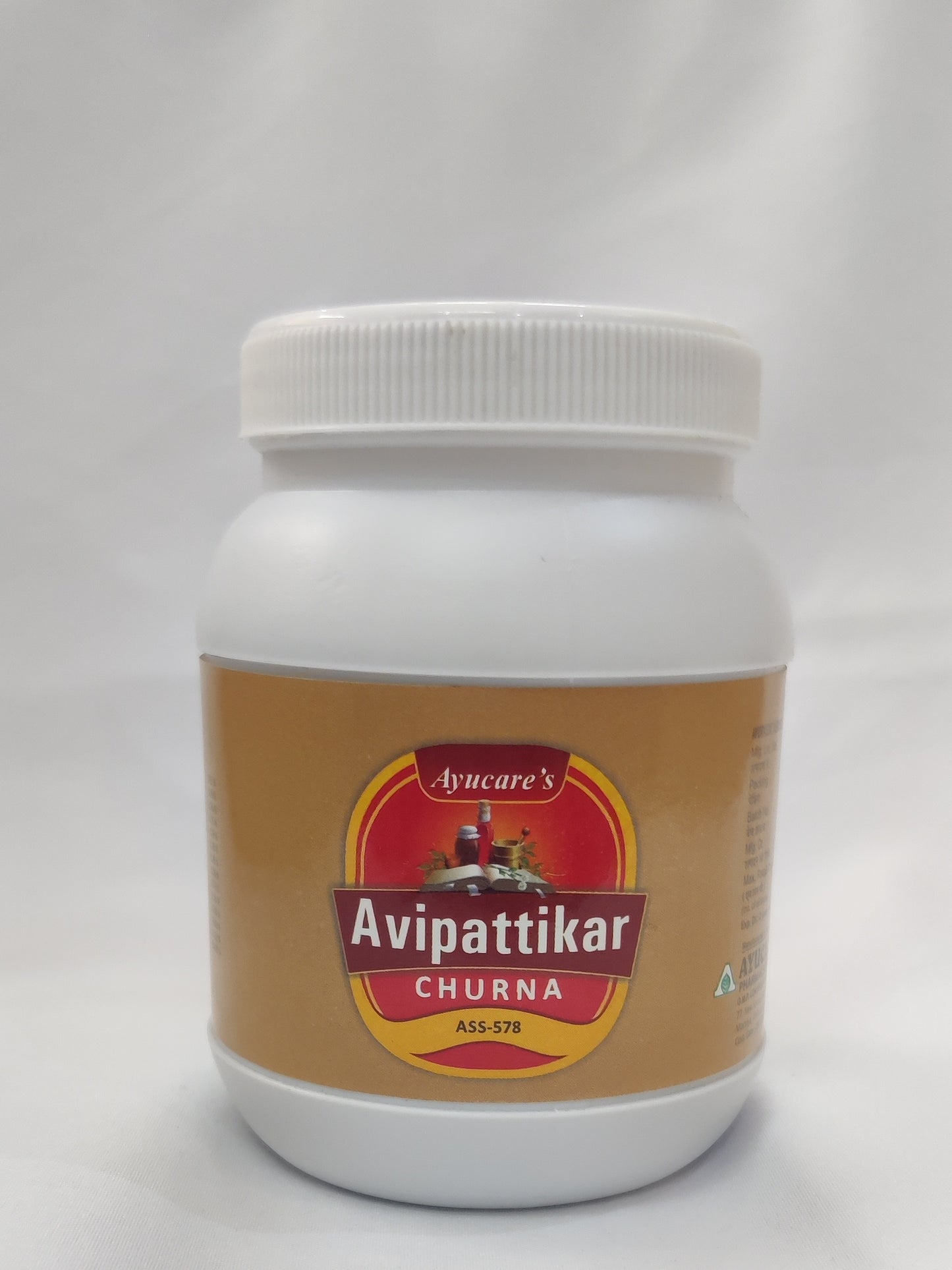
Avipattikar Churna 100g - Ayucare - Classical Ayurvedic Digestive Churna
Avipattikar Churna 100g - Ayucare - Classical Ayurvedic Digestive Churna
Couldn't load pickup availability
Avipattikar Churna is one of the best-known classical Ayurvedic digestive powders — a multi-herb churna built on Trikatu, Triphala and Trivrit, with Sharkara. Classical texts group it among the Pitta-balancing deepana-pachana (digestion-kindling) and anulomana churnas. This 100 g pack is from Ayucare, supplied by Riddhish Herbals with a bill on every order. Take it only as directed by a qualified Ayurvedic physician.
About Avipattikar Churna
Avipattikar Churna is a classical formulation found in the Ayurvedic Formulary of India. Its character comes from three familiar classical groups working together — Trikatu (shunthi, pippali, maricha), Triphala (amla, haritaki, bibhitaki) and a group of aromatic dravyas including musta, ela, tejpatra, lavanga and vidanga — with Trivrit and sharkara.
It is among the churnas most often written on an Ayurvedic prescription in India, which is precisely why it is worth saying clearly: the amount and the duration belong to your vaidya, not to a label or a website.
Classical Context
In classical terms Avipattikar is described as a Pitta-shamaka churna with deepana (kindling digestion), pachana (digestive) and anulomana (downward-directing) character. The Trikatu group contributes the deepana-pachana action, Triphala the broad digestive support, and Trivrit the anulomana quality — which is also why the amount matters and why it is not a churna for casual daily self-use.
These are classical descriptions of the formulation's character, presented for educational interest. They are not claims that this product diagnoses, prevents or alters any medical condition.
Composition (classical formulation)
| Group | Ingredient | Botanical / classical name |
|---|---|---|
| Trikatu | Shunthi (sunth) | Zingiber officinale |
| Trikatu | Maricha | Piper nigrum |
| Trikatu | Pippali | Piper longum |
| Triphala | Haritaki | Terminalia chebula |
| Triphala | Bibhitaki | Terminalia bellirica |
| Triphala | Amalaki | Phyllanthus emblica |
| Aromatic | Musta | Cyperus rotundus |
| Aromatic | Ela | Elettaria cardamomum |
| Aromatic | Tejpatra (patra) | Cinnamomum tamala |
| Aromatic | Lavanga | Syzygium aromaticum |
| Supporting | Vidanga | Embelia ribes |
| Supporting | Vida lavana | Classical salt |
| Anulomana | Trivrit (nishoth) | Operculina turpethum |
| Base | Sharkara | Saccharum officinarum |
This is the classical Avipattikar Churna ingredient list. Please confirm the exact proportions and any variation against the printed pack, which governs. Net weight 100 g.
How to Use
Use only as directed by a qualified Ayurvedic physician, or exactly as printed on the pack. Because this formulation contains Trivrit, the amount, the anupan and the duration should be set by your physician rather than chosen at home. Riddhish Herbals does not publish a dose for this product.
Who Can Use It
For adults, under the guidance of a qualified Ayurvedic physician. Not for use in children except under physician supervision. Not recommended during pregnancy or breastfeeding without advice. If you take any regular medication, tell your doctor before starting.
Safety Information
Use under the guidance of a qualified Ayurvedic physician. This formulation contains Trivrit and is not intended for unsupervised long-term daily use. Consult your physician before use if you are pregnant, lactating, taking any medication, or managing any health condition. Not a substitute for medical care — seek medical attention for anything acute or persistent. Keep out of reach of children. Results may vary from person to person.
Storage
Store in a cool, dry place away from direct sunlight and moisture. Keep the pack tightly closed after each use.
Regional Names & Spellings
| Language | Name |
|---|---|
| Sanskrit | अविपत्तिकर चूर्ण (Avipattikara Churna) |
| Hindi | अविपत्तिकर चूर्ण |
| Gujarati | અવિપત્તિકર ચૂર્ણ |
| Common spellings | Avipattikar, Avipattikara, Avipathikara, Avipattikar Churna, Avipattikar powder |
Frequently Asked Questions
What is Avipattikar Churna?
It is a classical multi-herb Ayurvedic powder from the Ayurvedic Formulary of India, built on Trikatu, Triphala, a group of aromatic dravyas, Trivrit and sharkara. It is classically described as a Pitta-balancing deepana-pachana churna.
What are its ingredients?
Shunthi, maricha, pippali, haritaki, bibhitaki, amalaki, musta, ela, tejpatra, lavanga, vidanga, vida lavana, trivrit and sharkara. The full list is in the table above; the printed pack governs.
How should Avipattikar Churna be taken?
Only as directed by a qualified Ayurvedic physician, or exactly as printed on the pack. Because it contains Trivrit, the amount and duration should be set by your vaidya rather than chosen at home.
Can it be taken daily on my own?
No. This is a physician-guided classical formulation, not an unsupervised daily churna.
What does the name mean?
Avipattikar derives from the Sanskrit sense of removing vipatti — disturbance or trouble. It is a classical formulation name rather than a description of what the product does for any individual.
Is it suitable during pregnancy or for children?
Not without a qualified physician's advice. It is not for children except under physician supervision.
Can it be taken with other medicines?
Tell your doctor before combining it with anything you take regularly.
Who manufactures this pack?
This 100 g pack is manufactured by Ayucare and supplied by Riddhish Herbals with a bill on every order.
How should it be stored?
In a cool, dry place away from sunlight and moisture, with the pack tightly closed.
How do I know this is the genuine pack?
Riddhish Herbals sources this directly and ships every order with a bill, and has served customers since 2015.
Related at Riddhish Herbals
Other classical digestive churnas: Triphala Churna · Rasayan Churna
Read next: Kwath, Kadha and Kashayam explained · Baheda (Bibhitaki), one of the three fruits in this formula