
Riddhish Herbals
Bal Chaturbhadra Syrup (Balachaturbhadra) – Ayurvedic Children's Syrup – Panchamrut Herbals – 100 ml
Bal Chaturbhadra Syrup (Balachaturbhadra) – Ayurvedic Children's Syrup – Panchamrut Herbals – 100 ml
Couldn't load pickup availability
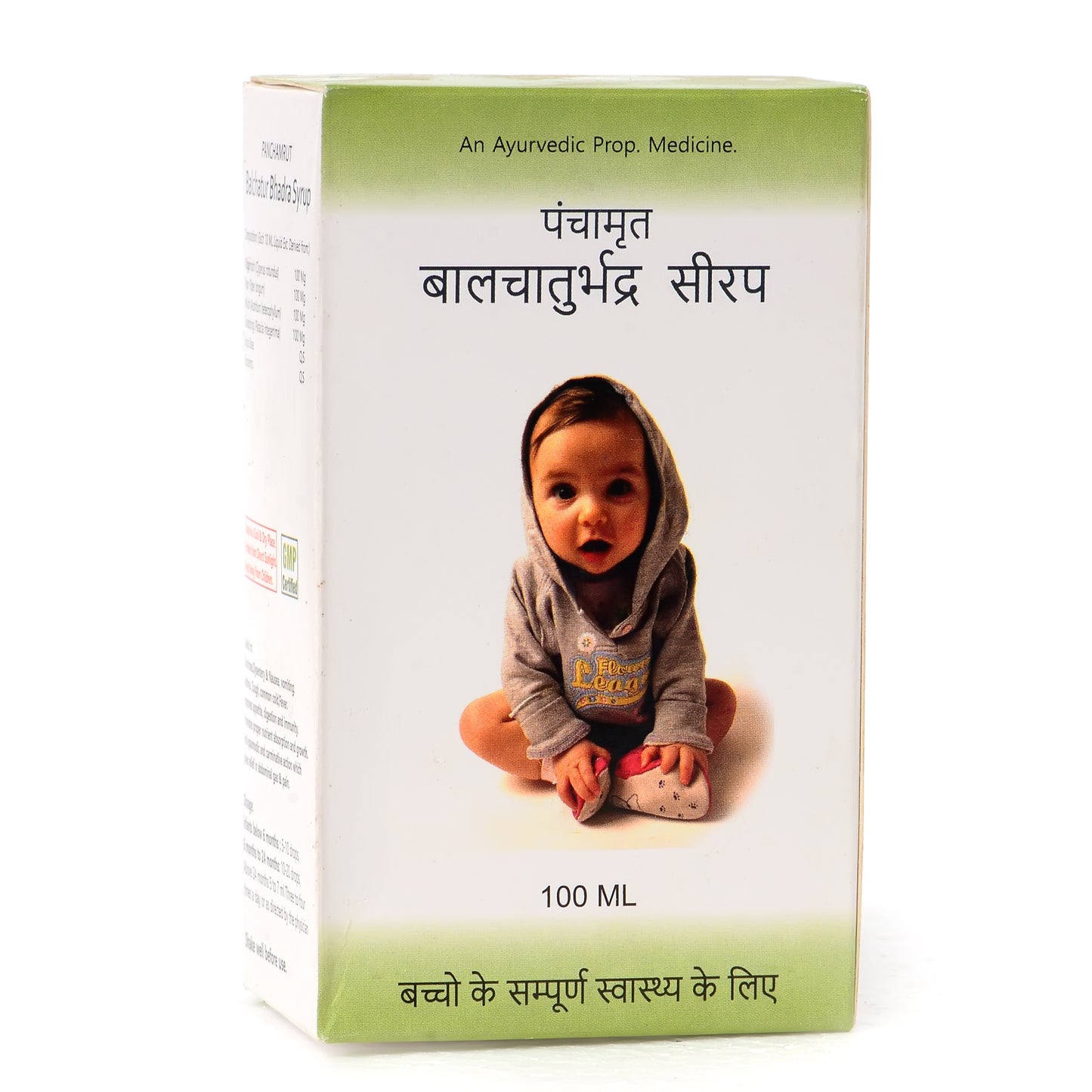
Bal Chaturbhadra Syrup (बालचातुर्भद्र सीरप) by Panchamrut Herbals is an Ayurvedic proprietary medicine for children, in a 100 ml syrup. Each 10 ml is a liquid extract derived from the four Balachaturbhadra herbs, Nagarmoth (Musta), Pippali, Ativisha and Karkatashringi, 100 mg each. Dose: Infants below 6 months: 5–10 drops, 6 months to 24 months: 10–20 drops, above 24 months 5 to 7 ml three to four times a day, or as directed by the physician. Supplied by Riddhish Herbals, Gujarat’s Ayurvedic store since 2015, with a bill on every order.
About Bal Chaturbhadra Syrup and Its Traditional Ayurvedic Importance
Balachaturbhadra (Bala = child, Chatur = four, Bhadra = beneficial) is one of the best-known formulations of Kaumarabhritya, the branch of Ayurveda devoted to the care of children. Chakradatta and Bhaishajya Ratnavali describe it in their chapters on children’s care as an equal-part combination of four herbs, traditionally given as a fine churna mixed with honey.
Bal Chaturbhadra Syrup by Panchamrut Herbals is a proprietary formulation built on the same four herbs, in equal measure, as a liquid extract in a syrup base. A measured liquid is simpler to give to a small child than a bitter powder, and the dose is set by age, from drops for infants to millilitres for older children.
All four herbs are light, warming and kindling to digestion in the classical reading, which is why Ayurveda has grouped them together for children, whose constitution is described as Kapha-predominant:
- Musta (Nagarmotha, Cyperus rotundus): Tikta, Katu and Kashaya in taste, Laghu and Ruksha in quality; classically Deepana, Pachana and Grahi, balancing Kapha and Pitta.
- Pippali (long pepper, Piper longum): Katu in taste with a Madhura vipaka; a classical Deepana herb that balances Vata and Kapha.
- Ativisha (Aconitum heterophyllum): Tikta and Katu in taste, Ushna in potency; Deepana, Pachana and Grahi.
- Karkatashringi (Pistacia integerrima): the gall of the Pistacia tree; Kashaya and Tikta in taste, Ushna in potency, classically valued for the respiratory tract and for balancing Kapha and Vata.
Ativisha (Aconitum heterophyllum) is a different species from Vatsanabha (Aconitum ferox), the poisonous aconite listed in Schedule E(1). Ativisha is not a Schedule E(1) ingredient and has a long history in classical children’s formulations.
Riddhish Herbals is the authorised and exclusive online seller for Panchamrut Herbals. Every order ships with a proper bill, and our team can help you confirm you have the pack your physician recommended.
Key Features
- Four classical herbs, equal parts: Nagarmoth, Pippali, Ativisha and Karkatashringi, 100 mg each per 10 ml.
- Balachaturbhadra herbs: the four herbs of the classical Kaumarabhritya formulation described in Chakradatta and Bhaishajya Ratnavali.
- Liquid extract in syrup: each 10 ml is a liquid extract derived from the four herbs, in a syrup base.
- Age-wise dose: drops for infants and toddlers, 5 to 7 ml for children above 24 months.
- Digestive comfort in the classical reading: Musta, Pippali and Ativisha are classical Deepana and Pachana herbs.
- Ayurvedic proprietary medicine: from Panchamrut Herbals, Mfg. Lic. No. GA/1762.
- GMP-, ISO 9001:2015- and HACCP-certified manufacturer: made by Panchamrut Herbals.
- Genuine and billed: 100 ml pack, supplied by Riddhish Herbals since 2015, with a bill on every order and pan-India delivery.
Composition (each 10 ml contains)
Each 10 ml liquid extract is derived from:
| Ingredient | Botanical name | Per 10 ml |
|---|---|---|
| Nagarmoth (Musta) | Cyperus rotundus | 100 mg |
| Piper (Pippali) | Piper longum | 100 mg |
| Ativish (Ativisha) | Aconitum heterophyllum | 100 mg |
| Karkatsringi (Karkatashringi) | Pistacia integerrima | 100 mg |
| Syrup base | — | Q.S. |
| Excipients | — | Q.S. |
Pack: 100 ml · Form: Syrup · Category: Ayurvedic proprietary medicine · Mfg. Lic. No.: GA/1762 · Manufactured by Panchamrut Herbals. Made in India.
How to Use
Dose: Infants below 6 months: 5–10 drops, 6 months to 24 months: 10–20 drops, above 24 months 5 to 7 ml three to four times a day, or as directed by the physician.
Shake well before use. Measure drops and millilitres carefully for your child’s age. Your physician will confirm the amount and timing that suit your child.
Safety, Storage & Pack Information
Use under the guidance of a qualified Ayurvedic physician. Give your child only the dose for their age, or the dose your physician advises. If your child is taking any medicine or is under medical care for any condition, consult your physician before use. Honey is not given to infants under one year of age. Keep out of reach of children. Results may vary from child to child.
Storage: Store in a cool and dry place. Protect from direct sunlight. Keep away from children. Close the bottle well after each use.
Pack: 100 ml. Expiry: 3 years from the date of manufacture. Check the batch number, manufacturing date and MRP on your pack before use.
Ingredient Names in Hindi, Gujarati and Sanskrit
| Ingredient | Hindi | Gujarati | Sanskrit | English — Botanical |
|---|---|---|---|---|
| Nagarmoth | नागरमोथा (Nagarmotha) | નાગરમોથ (Nagarmoth) | मुस्ता (Musta) | Nut grass — Cyperus rotundus |
| Piper | पीपल, पिप्पली (Pipal, Pippali) | પીપર (Piper) | पिप्पली (Pippali) | Long pepper — Piper longum |
| Ativish | अतीस (Atis) | Ativikhni Kali | अतिविषा (Ativisha) | Indian atees — Aconitum heterophyllum |
| Karkatsringi | काकड़ासिंगी (Kakadasingi) | કાકડાશિંગી (Kakdashingi) | कर्कटशृङ्गी (Karkatashringi) | Pistacia gall — Pistacia integerrima |
Also searched as: Balachaturbhadra Syrup, Balchatur Bhadra Syrup, Balchaturbhadra Syrup, Bala Chaturbhadra Syrup, Bal Chatur Bhadra Syrup, Balachaturbhadrika Syrup, Bal Chaturbhadra Syp, Panchamrut Bal Chaturbhadra, बालचातुर्भद्र सीरप, Nagarmotha Pippali Ativisha Karkatashringi Syrup.
Frequently Asked Questions
What is Bal Chaturbhadra Syrup?
Bal Chaturbhadra Syrup (बालचातुर्भद्र सीरप) by Panchamrut Herbals is an Ayurvedic proprietary medicine for children in a 100 ml syrup. Each 10 ml is a liquid extract derived from four herbs, Nagarmoth (Musta), Pippali, Ativisha and Karkatashringi, 100 mg each. These are the four herbs of Balachaturbhadra, a classical formulation of Kaumarabhritya, the branch of Ayurveda devoted to the care of children.
What does Bal Chaturbhadra Syrup contain?
Each 10 ml liquid extract is derived from: Nagarmoth (Cyperus rotundus) 100 mg, Piper (Piper longum) 100 mg, Ativish (Aconitum heterophyllum) 100 mg and Karkatsringi (Pistacia integerrima) 100 mg, with syrup base and excipients Q.S.
What is the dose of Bal Chaturbhadra Syrup?
Dose: Infants below 6 months: 5–10 drops, 6 months to 24 months: 10–20 drops, above 24 months 5 to 7 ml three to four times a day, or as directed by the physician. Shake well before use. Your child’s physician will confirm the right amount and timing.
Is Ativisha the same as Vatsanabha?
No. Ativisha is Aconitum heterophyllum, a different species from Vatsanabha (Aconitum ferox). Vatsanabha is a poisonous aconite listed in Schedule E(1) of the Drugs and Cosmetics Rules; Ativisha is not a Schedule E(1) ingredient and has a long history in classical children’s formulations, including Balachaturbhadra.
Should a physician guide its use for my child?
Yes. Use it under the guidance of a qualified Ayurvedic physician, who will match the dose to your child’s age and needs. If your child is taking any medicine or is under medical care for any condition, check with your physician before use.
How is Balachaturbhadra described in classical Ayurveda?
Balachaturbhadra, the “four beneficial herbs for children”, is described in Chakradatta and Bhaishajya Ratnavali in the chapter on the care of children. Its four herbs are Musta, Pippali, Ativisha and Karkatashringi, classically known for Deepana (kindling digestion), Pachana (supporting digestion) and Kapha-balancing qualities. The classical churna is traditionally given mixed with honey; this syrup presents the same four herbs as a ready-to-use liquid.
Who manufactures Bal Chaturbhadra Syrup?
Manufactured by Panchamrut Herbals, Mfg. Lic. No. GA/1762. Riddhish Herbals is the authorised and exclusive online seller for Panchamrut Herbals.
Is this product GMP certified?
Panchamrut Herbals, the manufacturer of this product, holds GMP, ISO 9001:2015 and HACCP certification. Good manufacturing practice (GMP) relates to how the product is made; these are not claims about any medical outcome.
How do I know this is the genuine pack?
A genuine pack is a green-and-white carton with पंचामृत बालचातुर्भद्र सीरप on the front, the Panchamrut Herbals name and PH logo, Mfg. Lic. No. GA/1762, a 100 ml net content, and its own batch number, manufacturing date and MRP. Every order from Riddhish Herbals ships with a proper bill, and our team can help you confirm the pack you received.
What are the other names of Bal Chaturbhadra?
It is also written Balachaturbhadra, Balchatur Bhadra, Balchaturbhadra, Bala Chaturbhadra, Bal Chatur Bhadra and Balachaturbhadrika. Its herbs are known as Nagarmotha or Musta (Cyperus rotundus), Pipli or Pippali (long pepper, Piper longum), Atis or Ativisha (Aconitum heterophyllum) and Kakadasingi or Karkatashringi (Pistacia integerrima).
How should I store Bal Chaturbhadra Syrup?
Store in a cool and dry place. Protect from direct sunlight. Keep away from children. Close the bottle well after each use. Expiry is 3 years from the date of manufacture.
Related Products
- Sitopaladi Tablet 40T — Panchamrut Herbals
- Dashmool Kashay 200ml — Panchamrut Herbals
- Ajmodadi Tablet 60T — Panchamrut Herbals
About Riddhish Herbals
Manufactured by Panchamrut Herbals, Mfg. Lic. No. GA/1762. Riddhish Herbals is the authorised and exclusive online seller for Panchamrut Herbals. Riddhish Herbals has supplied genuine Ayurvedic products across India since 2015. This is a traditional Ayurvedic product; information on this page is educational and is not a substitute for professional medical advice.
Since 2015 · Genuine Products · Bill Provided · Doctor-Guided Selection · 4000+ Ayurvedic Products · 130+ Trusted Brands · Pan-India Delivery