
Riddhish Herbals
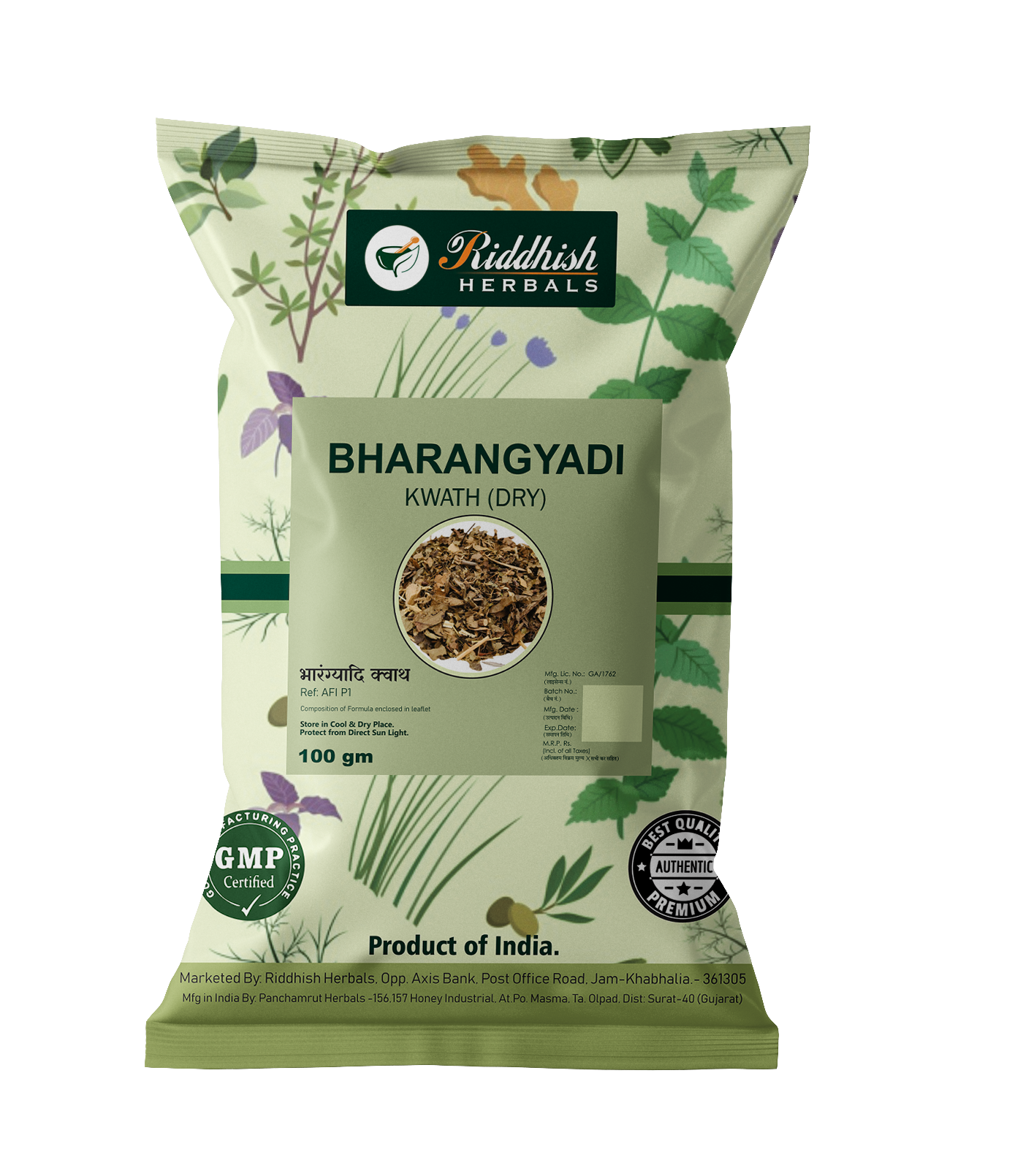
Bharangyadi Kwath (Dry) 100g | Classical AFI Decoction with Bharangi for Respiratory & Kapha Wellness | Riddhish Herbals
Bharangyadi Kwath (Dry) 100g | Classical AFI Decoction with Bharangi for Respiratory & Kapha Wellness | Riddhish Herbals
Couldn't load pickup availability
Bharangyadi Kwath (Dry) is a classical Ayurvedic herbal decoction (kwath / kashayam) prepared in a convenient dry, coarse form, built around Bharangi (Clerodendrum serratum) together with a time-tested blend of supporting herbs described in the Ayurvedic Formulary of India (AFI Part 1). Traditionally sipped warm as a daily and seasonal kadha, it is valued in Ayurveda for balancing Kapha and supporting clear, comfortable breathing and throat comfort through changes of weather.
About Bharangyadi Kwath
Some formulas earn their place in Ayurveda by lasting. Bharangyadi Kwath is one of them. It takes its name from Bharangi — the root that classical physicians turned to again and again when the breath felt heavy, and the chest felt blocked. Around that central herb sits a careful supporting cast: Musta, Parpata, Dhanyaka, Yavasa, Shunthi, Kiratatikta, Kushtha, Pippali, Brihati and Guduchi, each contributing its own quality to the decoction.
This is the dry kwath form — a coarse herbal mix you boil fresh at home into a warm decoction, rather than a ready-bottled liquid. Many households prefer it this way: nothing is pre-extracted, you control the strength, and the herbs stay shelf-stable in cool, dry storage. In Ayurvedic routines, a warm bitter-pungent kwath like this is associated with Kapha balance, easy digestion (Agni), and seasonal respiratory wellness during monsoon and winter.
Traditional Ayurvedic Importance
In classical Ayurvedic literature, Bharangi (Clerodendrum serratum) is widely described in the context of Shwasa (difficulty in breathing) and Kasa (cough), and as a Kapha-pacifying respiratory herb. The Bharangyadi group of formulations is recorded in the Ayurvedic Formulary of India (AFI Part 1), and the classical tradition around Bharangi for respiratory care runs through the Charaka Samhita (Chikitsa Sthana, Shwasa-Kasa context) and later compendia such as Sharangdhara Samhita and Bhaishajya Ratnavali.
The supporting herbs round out the formula in classically logical ways. Shunthi (Zingiber officinale) and Pippali (Piper longum) are Deepana-Pachana (kindling digestion) and classical respiratory companions. Guduchi (Tinospora cordifolia) is the great Rasayana and Jvarahara herb. Kiratatikta (Swertia chirata) and Parpata (Fumaria parviflora) bring the bitter, Pitta-cooling quality classical texts associate with fevers and seasonal imbalance, while Musta (Cyperus rotundus) is a trusted Deepana and Kapha-Pitta balancer. Together, the eleven herbs form the kind of balanced, multi-herb decoction Ayurveda favours over any single ingredient.
Key Features
- Classical AFI formula: prepared as referenced in the Ayurvedic Formulary of India (Ref: AFI P1) — an authentic, documented combination, not a modern proprietary mix.
- Bharangi at its heart: built around Clerodendrum serratum, the herb classically associated with Shwasa-Kasa and Kapha respiratory wellness.
- Eleven-herb synergy: a complete decoction blend — Bharangi, Musta, Parpata, Dhanyaka, Yavasa, Shunthi, Kiratatikta, Kushtha, Pippali, Brihati and Guduchi.
- Convenient dry form: a coarse kwath you boil fresh — control your own strength, no pre-mixed liquid, easy shelf-stable storage.
- Kapha & seasonal support: traditionally taken as a warm kadha for throat comfort and clear, comfortable breathing through monsoon and winter.
- Pure plant material: made only from carefully selected herbs — no added colours, chemicals, sugar or preservatives.
- GMP-, ISO 9001:2015- and HACCP-certified manufacturer: made by Panchamrut Herbals, certified to GMP, ISO 9001:2015 and HACCP standards, Mfg. Lic. No. GA/1762.
Composition (Label / AFI Verified)
Prepared as per the Ayurvedic Formulary of India (Part 1). Each herb is taken in equal parts (1 part each) as a coarse powder (Yavakut) for decoction.
| # | Ayurvedic Name | Botanical Name | Part Used | Ratio |
|---|---|---|---|---|
| 1 | Bharangi (Bhārṅgī) | Clerodendrum serratum | Root | 1 part |
| 2 | Musta (Abda) | Cyperus rotundus | Rhizome | 1 part |
| 3 | Parpata (Parpaṭaka) | Fumaria parviflora | Whole plant | 1 part |
| 4 | Dhanyaka (Dhānya) | Coriandrum sativum | Fruit | 1 part |
| 5 | Yavasa (Yāvāsa) | Alhagi pseudalhagi | Whole plant | 1 part |
| 6 | Shunthi (Viśvā) | Zingiber officinale | Rhizome | 1 part |
| 7 | Kiratatikta (Bhūnimba) | Swertia chirata | Whole plant | 1 part |
| 8 | Kushtha (Kuṣṭha) | Saussurea lappa | Root | 1 part |
| 9 | Pippali (Kaṇā) | Piper longum | Fruit | 1 part |
| 10 | Brihati (Siṃhī) | Solanum indicum | Whole plant | 1 part |
| 11 | Guduchi (Amṛtā) | Tinospora cordifolia | Stem | 1 part |
The composition of the formula is also enclosed in the product leaflet, as printed on the pack.
Research & Scientific References
The lead herb Bharangi has been the subject of published phytopharmacological research exploring its traditionally recognised respiratory properties.
Ethanolic root extract of Clerodendrum serratum (Bharangi) was studied in an ovalbumen-induced animal model, where researchers observed changes in inflammatory and allergic markers under study conditions. — Arora P, Ansari SH, Nainwal LM (2022), Turkish Journal of Chemistry, 46(2):330–341. PMID 38143476. Findings were observed under study conditions, in animals rather than in people. Individual results may vary.
A phytochemical and pharmacological review of Bharangi (C. serratum) documented its long classical use for Shwasa and Kapha respiratory conditions and surveyed its studied constituents. — Kumar PA, Nishteswar K (2013), International Journal of Research in Ayurveda & Pharmacy, 4(2).
The findings above were observed under experimental study conditions and relate to individual herbs, not to this finished product. They are shared for educational context only. Results may vary from person to person. No claim about any illness is made or implied by the research summarised above. Please consult a qualified Ayurvedic physician before use.
How to Use & Anupan
Take about 5–10 g (one to two heaped teaspoons) of the dry kwath and add to 150–200 ml of water. Boil and reduce to roughly one-quarter, then strain. Sip the warm decoction once or twice a day, ideally on an empty stomach, or as directed by your Ayurvedic physician.
Traditional anupan (vehicle): a little warm water; honey may be added to the strained, lukewarm decoction as classically advised for throat comfort. Do not add honey to very hot liquid.
Who Can Use It
Suitable for adults looking to include a classical Ayurvedic respiratory and Kapha-balancing decoction in their daily or seasonal routine. Best used under the guidance of a qualified Ayurvedic physician, who can advise dose and duration for your constitution (Prakriti). Not recommended during pregnancy or lactation, for children, or alongside ongoing medication without professional advice.
Safety Information
For use under the guidance of a qualified Ayurvedic physician. Consult your physician before use, especially if you are pregnant, lactating, taking any medication, or managing any health condition. Keep out of reach of children. Use only the recommended quantity — bitter-pungent decoctions taken in excess may cause digestive discomfort. Results may vary from person to person.
Storage
Store in a cool, dry place, away from direct sunlight. Keep the pack tightly closed and away from moisture to preserve freshness and aroma.
Names of Bharangi, the Lead Herb, Across India
Bharangi — the lead herb of this formula — is known across India by many names:
| Language | Native Script | Romanised |
|---|---|---|
| Sanskrit | भार्ङ्गी / ब्राह्मणयष्टिका | Bhāraṅgī / Brāhmaṇayaṣṭikā |
| Hindi | भारंगी / बभनेटी | Bhārangī / Babhneti |
| Gujarati | ભારંગી | Bhārangī |
| Marathi | भारंगी / भारंग | Bhārangī / Bhārang |
| Bengali | — | Withdrawn — see the note below the table |
| Tamil | சிறுதேக்கு | Cirutēkku |
| Telugu | script not verified | Gantu Bharangi · Guntubharangi |
| Kannada | script not verified | Gantu Bharangi · Gantabharangi · Gontagida |
| Malayalam | ചെറുതേക്ക് | Cheruthekku |
| English | — | Blue Glory / Beetle Killer |
| Botanical | — | Clerodendrum serratum |
Also searched as: Bharangyadi Kwath, Bharangyadi Kwatha, Bhrangyadi Kadha, Bharangi Kwath, Bharangyadi Kashayam, Bharangyadi Kvatha Churna, Bharngyadi Kwath.
Frequently Asked Questions
Is Bharangyadi Kwath a classical or proprietary medicine?
It is a classical formulation, prepared as referenced in the Ayurvedic Formulary of India (Ref: AFI P1) — a documented, traditional combination rather than a modern proprietary blend.
Is this product GMP certified?
Panchamrut Herbals, the manufacturer of this product, holds GMP, ISO 9001:2015 and HACCP certification. Good manufacturing practice (GMP) relates to how the product is made; these are not claims about any medical outcome.
Can I take this without consulting a doctor?
Bharangyadi Kwath is best taken under the guidance of a qualified Ayurvedic physician, who can advise the right dose and duration for your constitution. Self-use without guidance is not recommended, especially if you are managing any health condition.
What is Bharangi?
Bharangi (Clerodendrum serratum) is the lead herb of this formula — a root classically described in Ayurveda in the context of Shwasa (breathing difficulty) and Kasa (cough), and valued as a Kapha-balancing respiratory herb.
What are the alternate names and spellings?
Also written as Bharangyadi Kwatha, Bhrangyadi Kadha, Bharngyadi Kwath, and Bharangyadi Kashayam (the liquid decoction form).
How is the dry kwath different from the liquid kashayam?
This is the dry, coarse herbal form that you boil fresh into a decoction at home, so you control the strength, and there is no pre-mixed liquid. The bottled kashayam is a ready-to-use liquid version of the same family of formula.
How should I prepare and store it?
Boil 5–10 g in 150–200 ml of water, reduce to a quarter, strain and sip warm. Store the pack in a cool, dry place away from sunlight and moisture.
What is the recommended anupan?
Warm water is the simplest vehicle; a little honey may be stirred into the lukewarm (not hot) strained decoction as traditionally advised for throat comfort.
Has Bharangi been studied scientifically?
Yes — the lead herb Clerodendrum serratum has been examined in published phytopharmacological research for its traditionally recognised respiratory properties (see References above). These studies relate to the individual herb under study conditions and are shared for educational context only.
Is it available at Riddhish Herbals?
Yes. Riddhish Herbals has been a trusted Ayurvedic store in Gujarat since 2015, offering genuine products with a bill and doctor-guided selection, delivered pan-India.
Same formula, ready liquid form: Bharangyadi Kashay 200ml (Ayucare) · Bharangyadi Kashay 200ml (Nagarjun)
Another classical dry kwath: Maha Rasnadi Kwath (Dry) 100g
Shares Guduchi (Giloy): Rasayan Churna (Amrutadi Churna) 100g
Browse more: Ayurvedic Medicines · Ayurvedic Raw Herbs & Materials
રીધ્ધીશ હર્બલ્સ — ગુજરાતનો વિશ્વાસપાત્ર આયુર્વેદિક સ્ટોર, જ્યાં સાચી સલાહ અને genuine Ayurvedic products એક જ જગ્યાએ મળે છે.
Marketed by Riddhish Herbals, Opp. Axis Bank, Post Office Road, Jam-Khambhalia – 361305, Gujarat. Manufactured in India by Panchamrut Herbals. Po. Masma, Ta. Olpad, Dist. Surat (Gujarat), Mfg. Lic. No. GA/1762. This product is a traditional Ayurvedic preparation. Information here is for educational purposes and is not a substitute for professional medical advice. No claim is made here about any illness, and nothing on this page should be read as one.