

Riddhish Herbals
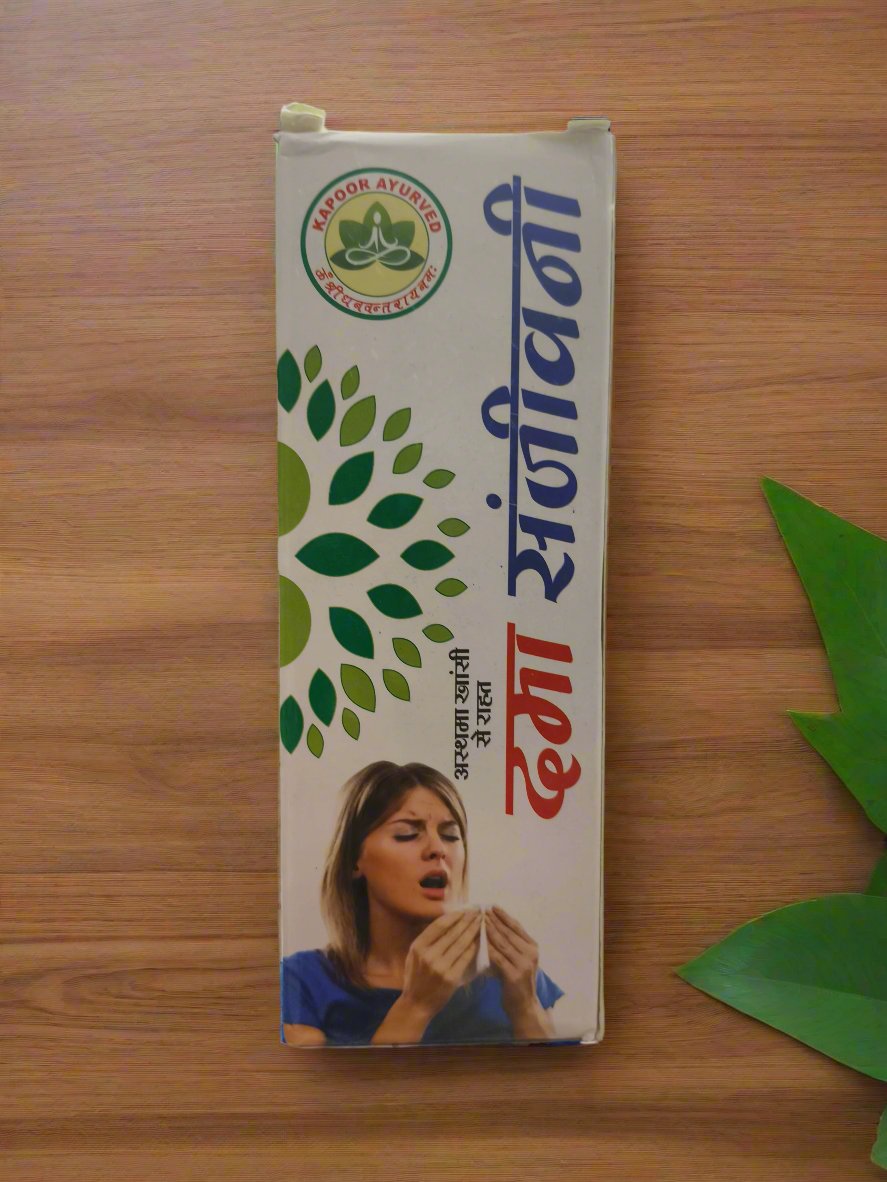
Dama Sanjeevani Syrup (Vasa & Karkat Shringi) – Ayurvedic Kashaya Syrup – Kapoor Ayurved – 200ml
Dama Sanjeevani Syrup (Vasa & Karkat Shringi) – Ayurvedic Kashaya Syrup – Kapoor Ayurved – 200ml
Couldn't load pickup availability
Dama Sanjeevani by Kapoor Ayurved is a sugar-free Ayurvedic herbal syrup built on a kashaya (decoction) base, carrying 26 label-declared dravyas per 100 ml. Its principal respiratory dravya is Vasa / Vasaka (Adhatoda vasica, 3 g), supported by Karkat Shringi (Pistacia integerrima, 4 g), Pippali (Piper longum, 4 g), Tulsi (Ocimum sanctum, 3 g), Yashtimadhu (Glycyrrhiza glabra, 3 g) and the classical Triphala trio. Vasa is the dravya on which the formulation rests: classical Ayurvedic literature describes it in the context of Shwasa and Kasa, and it is a recognised expectorant of long standing. Manufactured under Mfg. Lic. No. 1233-ISM(HR) in a GMP- and ISO 9001:2015-certified facility. Stocked at Riddhish Herbals with a genuine bill and doctor-guided selection.
An Important Correction to This Listing
The previous version of this page declared Dhattura (Datura metel) — 3 g among the ingredients.
Datura is not in this product. It does not appear anywhere on the physical pack. It was in our listing in error, and we have removed it. Datura is a Schedule E1 poison, and a syrup that a parent might give a child is precisely the last place such an entry should ever have appeared. We are stating this plainly rather than editing it away quietly, because anyone who read the old listing deserves to know it was wrong.
The same audit found that Vasa / Vasaka (Adhatoda vasica) — the single most important dravya in the entire formulation — had been omitted from our listing altogether, and that three botanical names were attached to the wrong plants. Every ingredient below has now been transcribed directly from the printed pack.
The Dravyas — What the Classical Texts Record
Vasa / Vasaka — Adhatoda vasica, 3 g. The dravya the formulation is built around. Classical Ayurvedic literature describes Vasa in the context of Shwasa and Kasa; the Bhavaprakasha Nighantu places it among the Guduchyadi dravyas and describes it under that heading. Vasa is a recognised expectorant — an ordinary, lawful description of classical pharmacological action. Its principal alkaloids are vasicine and vasicinone.
Karkat Shringi — Pistacia integerrima, 4 g. The classical galls, long paired with Vasa in Shwasa-Kasa formulations across the Ayurvedic literature.
Pippali — Piper longum, 4 g. Classically Yogavahi — a carrier that directs the action of the dravyas alongside it — and one of the three pungents of Trikatu. Deepana and Pachana.
Tulsi — Ocimum sanctum, 3 g, and Yashtimadhu — Glycyrrhiza glabra, 3 g. Two of the most widely used dravyas in classical Shwasa-Kasa preparations. Yashtimadhu is also what gives this sugar-free syrup its sweetness.
The Triphala trio — Amla 4 g, Baheda 3 g, Haritaki 2 g. The classical three-fruit combination, present here in full.
Chitrak — Plumbago zeylanica, 5 g. The largest single herbal quantity in the formula. Chitrak is a powerful classical Deepana dravya and requires proper Shodhana; it is one reason this syrup is a physician-guided preparation rather than a casual purchase.
The two lavanas — Saindhav 5 g and Sauvarchala 5 g. Rock salt and black salt, both classical, together making 10 g per 100 ml. Worth knowing if you watch your salt.
On Giving This to Children
The carton carries a paediatric dosage line. We are not going to reprint it.
This syrup contains Karpura (camphor) at 2 g and Chitrak (Plumbago zeylanica) at 5 g per 100 ml. Both are potent classical dravyas. A number printed on a web page is a number a parent will measure out, and we are not willing to be the reason a child receives a dose that nobody qualified has thought about.
For children, this preparation is to be given only as directed by a qualified Ayurvedic physician who has examined the child. No other instruction will appear on this page. Ask us and we will connect you with one.
Research on the Constituents
◆ RP-HPLC quantification of Adhatoda vasica confirmed vasicine and vasicinone as its two principal quinazoline alkaloids and mapped their distribution across the plant — CSIR-Central Institute of Medicinal and Aromatic Plants (2024) — PMID 39671465.
Results were observed under study conditions. Individual results may vary. This is shared for general educational interest and is not a medical claim. Consult your Ayurvedic physician before use.
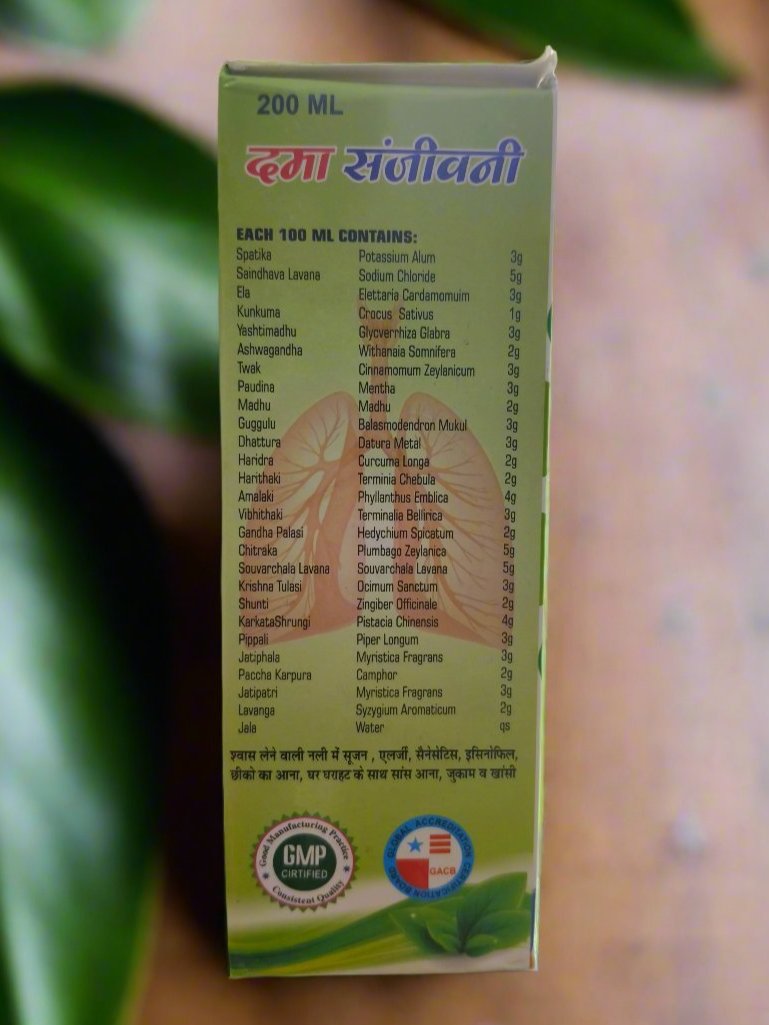
Composition — each 100 ml contains (label-verified)
| Ingredient (label name) | Botanical / material | Qty |
|---|---|---|
| Chitrak | Plumbago zeylanica | 5 g |
| Saindhav Lavan | Rock salt (sodium chloride) | 5 g |
| Sauvarchala Lavan | Black salt | 5 g |
| Amla | Phyllanthus emblica | 4 g |
| Karkat Shringi | Pistacia integerrima | 4 g |
| Pippali | Piper longum | 4 g |
| Vasaka (Vasa) | Adhatoda vasica | 3 g |
| Sphatika | Alum (potash alum) | 3 g |
| Ela | Elettaria cardamomum | 3 g |
| Yashtimadhu | Glycyrrhiza glabra | 3 g |
| Pudina | Mentha spicata | 3 g |
| Twak | Cinnamomum zeylanicum | 3 g |
| Guggulu Shuddh | Commiphora mukul (purified) | 3 g |
| Baheda | Terminalia bellirica | 3 g |
| Tulsi | Ocimum sanctum | 3 g |
| Jatiphal | Myristica fragrans | 3 g |
| Jati Patri | Cinnamomum zeylanicum | 3 g |
| Ashvagandha | Withania somnifera | 2 g |
| Madhu | Honey | 2 g |
| Haridra | Curcuma longa | 2 g |
| Haritaki | Terminalia chebula | 2 g |
| Gandh Prasarini | Paederia foetida | 2 g |
| Sunthi | Zingiber officinale | 2 g |
| Karpura | Cinnamomum camphora (camphor) | 2 g |
| Lavang | Syzygium aromaticum | 2 g |
| Kesar | Crocus sativus | see note |
All 26 ingredients transcribed directly from the printed Kapoor Ayurved pack. Kesar: the pack prints the figure “19” with no unit legible; rather than guess at a quantity we are flagging it and will confirm with the manufacturer. Datura / Dhattura does NOT appear on this pack and is not in this product — an earlier version of this listing wrongly said otherwise. Marketed by Kapoor Ayurved (Kangra, Himachal Pradesh); manufactured by Hiraeh Herbals, Ambala. Mfg. Lic. No. 1233-ISM(HR). GMP Certified · ISO 9001:2015 Certified · Sugar Free · 200 ml.
How to Use
As directed by your qualified Ayurvedic physician. The pack guidance for adults is 10–15 ml, once or twice daily, before or after food, taken in half a glass of warm water. Shake well before use — this is a thick kashaya-base preparation and settling is natural. For children we print no dose at all: give it only as directed by a qualified Ayurvedic physician.
Who Can Use It
Adults, under Ayurvedic guidance. For children, only as directed by a qualified Ayurvedic physician who has examined the child — this syrup carries camphor and Chitrak, and we print no paediatric dose. Not recommended in pregnancy or lactation without a physician's direction. Note the salt content: the two lavanas together contribute 10 g per 100 ml, which matters if you are on a sodium-restricted diet. Consult your physician before use if you take any medication.
Safety Information
This is an Ayurvedic herbal medicine, not a supplement, and it must not replace anything you have been prescribed. It contains Karpura (camphor) 2 g and Chitrak (Plumbago zeylanica) 5 g per 100 ml, along with 10 g of combined salts. Never stop, reduce or substitute a prescribed medicine in favour of this preparation without your doctor's direction. If you are under medical care for any breathing-related condition, bring this product to your doctor before you begin it. Do not exceed the directed dose.
Use strictly under the guidance of a qualified Ayurvedic physician. Consult your physician before use, especially if you are pregnant, lactating, taking any medication, or managing any medical condition. Keep out of reach of children. Results may vary from person to person.
Storage
Store in a cool, dry place away from direct sunlight. Keep the cap tightly closed. Shake well before each use — settling in a kashaya-base syrup is normal. Keep out of reach of children.
Frequently Asked Questions
What is Dama Sanjeevani?
Dama Sanjeevani by Kapoor Ayurved is a sugar-free Ayurvedic herbal syrup on a kashaya (decoction) base, carrying 26 label-declared dravyas per 100 ml. Its principal dravya is Vasa / Vasaka (Adhatoda vasica), classically described in the context of Shwasa and Kasa. It is manufactured under Mfg. Lic. No. 1233-ISM(HR).
Does it contain Datura?
No. Datura (Dhattura) does not appear anywhere on the physical pack and is not in this product. An earlier version of this listing wrongly declared 3 g of Datura metel. That was an error in our listing, it has been removed, and we are telling you about it rather than deleting it quietly. Every ingredient now shown has been transcribed from the printed pack.
What is in it, exactly?
26 ingredients per 100 ml. The largest are Chitrak 5 g, Saindhav Lavan 5 g and Sauvarchala Lavan 5 g; then Amla, Karkat Shringi and Pippali at 4 g each; Vasaka, Tulsi, Yashtimadhu, Sphatika, Ela, Pudina, Twak, Guggulu Shuddh, Baheda, Jatiphal and Jati Patri at 3 g each; and Ashvagandha, Madhu, Haridra, Haritaki, Gandh Prasarini, Sunthi, Karpura and Lavang at 2 g each. Kesar is present but its unit is not legible on this pack. Full table above.
What do the classical texts say about Vasa?
Classical Ayurvedic literature describes Vasa (Adhatoda vasica) in the context of Shwasa and Kasa, and the Bhavaprakasha Nighantu places it among the Guduchyadi dravyas. It is a recognised expectorant. That is a statement of classical record with its source named — not a promise of any outcome, and none is offered here.
Can I give this to my child?
Only as directed by a qualified Ayurvedic physician who has examined the child. We deliberately print no paediatric dose on this page — not our own, and not the one on the carton. This syrup carries camphor at 2 g and Chitrak at 5 g per 100 ml, and a number on a web page is a number a parent will measure out. That decision belongs to a physician. Riddhish Herbals will connect you with one.
Is it sugar-free?
Yes — the pack states Sugar Free. Its sweetness comes from Yashtimadhu (Glycyrrhiza glabra) and Madhu (honey), both label-declared.
How much salt does it contain?
The two classical lavanas — Saindhav Lavan and Sauvarchala Lavan — are 5 g each, so 10 g of combined salts per 100 ml. At a 10–15 ml adult dose that is roughly 1–1.5 g of salt per dose. If you are on a sodium-restricted diet, show that figure to your doctor.
Who manufactures it, and is it certified?
Marketed by Kapoor Ayurved (V.P.O. Dhameta, Teh. Fatehpur, Distt. Kangra, Himachal Pradesh) and manufactured by Hiraeh Herbals, Ambala, under Mfg. Lic. No. 1233-ISM(HR). The pack carries GMP Certified and ISO 9001:2015 Certified marks. The AYUSH Standard Mark is not on this pack, so we do not claim it.
Have the ingredients been studied scientifically?
Vasa has been characterised in detail: RP-HPLC quantification confirmed vasicine and vasicinone as its principal quinazoline alkaloids (PMID 39671465, CSIR-CIMAP). That is a phytochemical characterisation of the plant. It is not a medical claim about this product, and individual results may vary.
Can I take it with my other medicines?
Only with your doctor's knowledge. Show them the composition above. Never stop or reduce a prescribed medicine in order to take this.
How should I store it?
Cool, dry place, away from direct sunlight, cap tightly closed. Shake well before each use — this is a thick kashaya-base syrup and settling is normal. Keep out of reach of children.
Related at Riddhish Herbals