Riddhish Herbals
Methi Akhi (Methika) – Whole Fenugreek Seed – Riddhish Herbals – 100g
Couldn't load pickup availability
Methi Akhi from Riddhish Herbals is whole dried fenugreek seed — Trigonella foenum-graecum L., family Fabaceae — supplied as a raw material in a 100 g pack. Akhi means whole: these are intact seeds, not a powder. The seed is the official part given in the Ayurvedic Pharmacopoeia of India, Volume II, monograph 48, under the name Methika. The Bhavaprakasha Nighantu verse records the synonym set as Methika, Methini, Methi, Deepani, Bahupatrika, Bodhini, Bahubija and Jatigandhaphala, and places the drug among the Deepaniya group. Fenugreek is a legume, and laboratory work documents molecular cross-reactivity between its proteins and peanut allergens, so anyone with a peanut or legume allergy should take advice before using it. Larger-than-culinary quantities are traditionally avoided in pregnancy. This is a kitchen spice and a classical Ayurvedic material at the same time; it is not a medicine for any condition.
Reviewed by Dr. Riddhish Padiya — B.Pharm (Ayurveda), M.Pharm (Pharmacognosy), Ph.D. (Dravyaguna), ITRA Jamnagar. Publications under “Padiya RH”.
About Methi Akhi
Fenugreek is one of the few substances that is simultaneously an everyday kitchen spice and a classical Ayurvedic dravya. Most Indian households already have a jar of it. That familiarity is worth saying out loud, because it sets the right expectation: this is a food material with a long classical record, not a formulation.
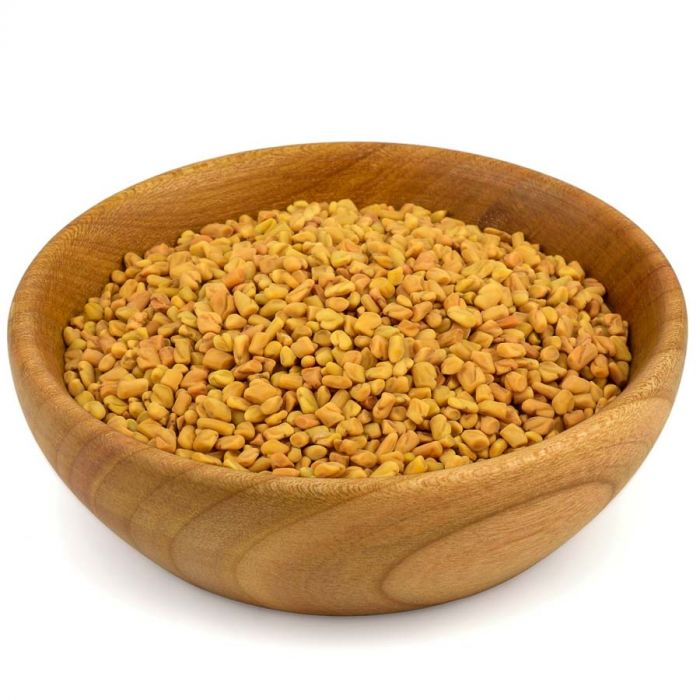
Akhi means whole. These are intact seeds — small, hard, angular, mustard-yellow to light brown, with the characteristic groove down one face. Whole seed keeps much better than ground: fenugreek powder loses its aroma quickly and picks up moisture, while the whole seed will sit in a jar for a long time without complaint. It is also the form you can actually look at before you use it.
The classical placement is straightforward. The Bhavaprakasha Nighantu verse gives the synonyms — Methika, Methini, Methi, Deepani, Bahupatrika, Bodhini, Bahubija, Jatigandhaphala — and Deepani in that list is the clue to how the texts thought about it: a Deepaniya drug, one that kindles Agni. Terms are given as the texts give them, and no claim about any modern condition is made on this page.
The part is the seed, and that is not merely custom: the Ayurvedic Pharmacopoeia of India, Volume II, monograph 48 specifies it.
A word we removed from this page
The previous version of this listing described the herb as “Methi (Medhika)”. That is very likely wrong, and it is the kind of error that spreads because it sounds plausible.
The classical word is Methika, which appears in the Bhavaprakasha Nighantu verse quoted above. Medhika appears on wellness sites, usually glossed as “the memory herb” from medha, intellect. But a Sanskrit lexicon gives मेधिक as an unrelated word, and no nighantu source we could reach lists it as a synonym for fenugreek. The likeliest explanation is a slip from Methika — which classical commentators do gloss as benefiting medha, so the meaning is not invented, only the spelling.
One letter, and it changes the word. We would rather correct it quietly than repeat it.
Key Features
- Whole seed, not powder: Akhi means whole. These are intact fenugreek seeds — hard, angular, mustard-yellow to light brown — which keep far better than a ground churna and can be inspected before use.
- The seed is the official part: the Ayurvedic Pharmacopoeia of India, Volume II, monograph 48 gives Methika as the seed. That is what is in this pack.
- Methika, not Medhika: the classical synonym set from Bhavaprakasha Nighantu is Methika, Methini, Methi, Deepani, Bahupatrika, Bodhini, Bahubija and Jatigandhaphala. We corrected this page, which previously used a word that does not appear in the nighantus.
- A kitchen spice that is also a classical dravya: which is unusual, and means most households already own it. Classical texts record it as Deepaniya.
- One verified human reference, and one honest gap: the fenugreek research most people have heard about concerns blood glucose and lipids, and Indian law does not permit us to discuss it. We say so rather than hinting.
- Genuine, doctor-guided sourcing: bill provided with every pack; a store trusted since 2015, with pan-India delivery.
Research on the Constituents
◆ The one place fenugreek has real human evidence that we are allowed to discuss. Khan, Wu and Dolzhenko conducted a network meta-analysis comparing fenugreek against other herbal and pharmaceutical galactagogues in breastfeeding mothers, evaluating measures of breast milk output — (Khan TM, Wu DB, Dolzhenko AV, 2018 — Phytotherapy Research 32(3):402–412). PMID 29193352. We mention it because it is the honest answer to “has this been studied”, not as advice: anyone breastfeeding should raise it with their own doctor first.
◆ An allergen finding, and the reason for the note in our safety block. A 2024 laboratory study in Journal of Allergy and Clinical Immunology: Global examined whether fenugreek proteins show molecular cross-reactivity with peanut allergens. We have not printed a PMID for this one. One is listed for it, but NCBI served a bot-check on every attempt to load the record while we prepared this page, and we do not print identifiers we have not seen ourselves. The article is indexed in DOAJ under that journal and date. Note also that this was in-vitro work, not a clinical trial.
◆ What is deliberately missing from this page. The largest body of fenugreek clinical research concerns blood glucose and blood lipids. Indian advertising law does not permit an Ayurvedic product page to make claims in those areas, so we did not collect that literature and we do not gesture at it. If it is why you are here, it is a conversation for you and your doctor, not for a shop listing. Google Scholar — Trigonella foenum-graecum. Individual results may vary.
Results were observed under study conditions. Individual results may vary. This is shared for general educational interest and is not a medical claim. Consult your Ayurvedic physician before use.
Composition (label-verified)
| Ingredient | Botanical | Part | Quantity |
|---|---|---|---|
| Methi Akhi — whole dried seed | Trigonella foenum-graecum L., family Fabaceae | Seed — the part specified in the Ayurvedic Pharmacopoeia of India, Vol. II, monograph 48 | Single raw material, 100 g net; whole, unground |
A single raw material: whole dried fenugreek seed, 100 g net, with nothing added. Harvest year and geographic origin are not stated on the pack, as is usual for a kitchen-grade seed in this market, and neither is assumed here. No extract ratio and no standardisation percentage are claimed, because this is not an extract. Fenugreek is a legume — see the allergen note in the safety section.
How to Use
This is a food material as much as a classical one, so it is used in both ways. In cooking, whole seeds are tempered in hot oil or ghee, or ground into masalas and pickles; a very little goes a long way, because fenugreek turns bitter in quantity and scorches quickly. As a hair preparation, the seeds are traditionally soaked overnight, ground to a paste and applied to the scalp. Soaked-seed water is another common household practice. For any use beyond the culinary, ask your Ayurvedic physician for the quantity and the duration rather than taking a figure from a web page — ours included.
Who Can Use It
Suitable for most adults as an ordinary kitchen ingredient. Anyone with a peanut or legume allergy should take advice before using it — fenugreek is a legume and laboratory work documents molecular cross-reactivity between its proteins and peanut allergens. Larger-than-culinary quantities are traditionally avoided during pregnancy; the reasoning is set out honestly in the safety section. If you are breastfeeding, fenugreek has a long folk association with milk supply and there is published work on it, but that is a conversation for your own doctor rather than something to start on your own. Children can have it in food as any household does; for anything beyond that, ask a physician.
Safety Information
Methi Akhi is a food material with a classical Ayurvedic record. It is not a substitute for professional medical care, and nothing on this page is a claim about any illness. If you have a peanut or legume allergy, take advice before using this, and be aware that fenugreek can appear in processed foods under the generic label term “spice”. We could not confirm a chickpea-specific cross-reactivity study and so do not claim one. On pregnancy, here is the honest position. The traditional caution against larger-than-culinary quantities is sensible, but the human evidence behind it is weak rather than settled: a 2025 review in the Journal of Reproductive Healthcare and Medicine collects mostly rodent studies reporting reduced fetal size and increased pup mortality at high doses, attributed to the estrogenic activity of diosgenin, together with eight congenital-malformation case reports from the Moroccan pharmacovigilance centre. Case reports are a signal, not proof of cause. We take the precautionary line — keep to culinary amounts in pregnancy, and ask your doctor about anything more — while telling you what that line actually rests on. Fenugreek is bitter and warming in quantity and can upset the stomach if overdone. Discontinue and consult a physician if any discomfort occurs. Keep out of reach of children. Results may vary from person to person.
Storage
Store in a cool, dry place away from direct sunlight, in a tightly closed airtight container. Whole fenugreek seed is one of the better keepers in a kitchen — hard, low in moisture, and slow to go stale — which is the practical argument for buying it whole and grinding only what you need. Keep damp spoons out of the jar, and if the seeds ever smell musty rather than sharply aromatic, do not use them.
Frequently Asked Questions
What is Methi Akhi?
It is whole dried fenugreek seed, Trigonella foenum-graecum L., in a 100 g pack. Akhi means whole, so these are intact seeds rather than a powder. The seed is the official part in the Ayurvedic Pharmacopoeia of India, Vol. II, monograph 48.
Is this the same as kitchen methi?
Yes, and we would rather say so than dress it up. Fenugreek is one of the few substances that is both an everyday kitchen spice and a classical Ayurvedic dravya. What you are buying is the seed, sourced and packed by us, not a different or upgraded material.
Why did the name on this page change from Medhika to Methika?
Because Methika is the classical word and Medhika very likely is not. The Bhavaprakasha Nighantu verse gives Methika, Methini, Methi, Deepani, Bahupatrika, Bodhini, Bahubija and Jatigandhaphala. Medhika appears mostly on wellness sites, glossed as the memory herb; a Sanskrit lexicon gives मेधिक as an unrelated word. It reads as a slip from Methika, which classical commentators do gloss as benefiting medha. One letter, different word.
I have a peanut allergy. Can I use it?
Ask your doctor first. Fenugreek is a legume, and a 2024 laboratory study examined molecular cross-reactivity between fenugreek proteins and peanut allergens. This is a real documented finding rather than a precaution we invented, and it is the reason the note is on this page at all. We could not confirm a chickpea-specific study and do not claim one.
Can I use it during pregnancy?
Keep to culinary amounts, and ask your doctor about anything more. The honest picture: the evidence behind the traditional caution is mostly rodent studies reporting reduced fetal size and higher pup mortality at high doses, plus eight congenital-malformation case reports from a national pharmacovigilance centre. That is a signal worth respecting, not settled proof, and we would rather tell you which it is.
Does it help with breast milk?
There is published human work on that question — a 2018 network meta-analysis in Phytotherapy Research (PMID 29193352) compared fenugreek with other galactagogues. We are citing it because it exists and because it is the honest answer to whether this seed has been studied. We are not offering it as advice: if you are breastfeeding, raise it with your own doctor before starting anything.
What does Ayurveda classically say about it?
The Bhavaprakasha Nighantu verse names it and the synonym Deepani in that verse is the clue — it is recorded among the Deepaniya drugs, those that kindle Agni. Those are classical categories, given as the texts give them, and not claims about any modern condition.
How do I use it?
In cooking, tempered whole in hot oil or ghee, or ground into masalas and pickles — sparingly, because it turns bitter in quantity and scorches fast. As a hair preparation, soaked overnight and ground to a paste. Soaked-seed water is another common household practice. For anything beyond culinary use, ask your Ayurvedic physician for the amount.
Why does this page not give a dose?
Because as a kitchen spice it does not need one, and as anything more it should come from a physician rather than from us. We would rather leave the number to the person who knows your constitution.
What are the alternate names?
In Sanskrit मेथिका (Methika); in Gujarat and across much of North India simply મેથી / मेथी (Methi), with मेथी दाना (methi dana) for the seed; in Tamil வெந்தயம் (Vendhayam); in Telugu మెంతులు (Menthulu); in Kannada ಮೆಂತ್ಯ (Menthya); in Malayalam ഉലുവ (Uluva); in Bengali মেথি (Methi). In English, fenugreek. The full table is further down this page.
How should I store it?
In a cool, dry place away from sunlight, in a tightly closed airtight container. Whole seed keeps well — that is the argument for buying it whole and grinding as you go. If it ever smells musty rather than sharply aromatic, do not use it.
Is it available at Riddhish Herbals?
Yes — Methi Akhi is in stock at riddhishherbals.com and at our Gujarat retail stores, with pan-India delivery and a proper bill, doctor-guided selection since 2015.
Regional Names & Spelling Variants
| Language | Name |
|---|---|
| Local / common name — મેથી / मेथी (Methi) | Unusually for this range, the local name and the pan-Indian trade name are the same word. Methi is Methi in Gujarati, Hindi, Marathi, Bengali, Punjabi and Odia alike — there is no separate regional token to hunt for. |
| Sanskrit | मेथिका (Methikā) · मेथिनी (Methinī) · मेथी (Methī) · दीपनी (Dīpanī) · बहुपत्रिका (Bahupatrikā) · बोधिनी (Bodhinī) · बहुबीजा (Bahubījā) · जातिगन्धफला (Jātigandhaphalā) — the Bhavaprakasha Nighantu verse |
| Hindi | मेथी (Methi) · मेथी दाना (Methi dana — the seed specifically) |
| Gujarati | મેથી (Methi) |
| Marathi | मेथी (Methi) |
| Bengali | মেথি (Methi) |
| Tamil | வெந்தயம் (Vendhayam) |
| Telugu | మెంతులు (Menthulu) · మెంతి (Menthi) |
| Kannada | ಮೆಂತ್ಯ (Menthya) · ಮೆಂತೆ (Menthe) |
| Malayalam | ഉലുവ (Uluva) |
| Punjabi · Assamese | ਮੇਥੀ (Methi) · মেথি (Methi) |
| English · Botanical · Part used | Fenugreek · Trigonella foenum-graecum L., family Fabaceae · Seed — the part given in the Ayurvedic Pharmacopoeia of India, Vol. II, monograph 48 |
| Romanised search variants | Methi · Methi dana · Methi akhi · Methika · Fenugreek seeds · Vendhayam · Menthulu · Uluva |
| Common misspellings | Fenugreak · Fenugreek seeeds · Methy · Methi danna · Methi seed |
Related at Riddhish Herbals
Ajmo Churna — another kitchen spice with a classical record · Sunth Yavkut 100gm — coarse-cut dried ginger, another Deepaniya material · Vavding Akha 100gm — a classical single herb sold whole · Wheat Grass Powder 100gm — another food-type material in this range · Ayurvedic Raw Herbs & Materials
Share