
Riddhish Herbals
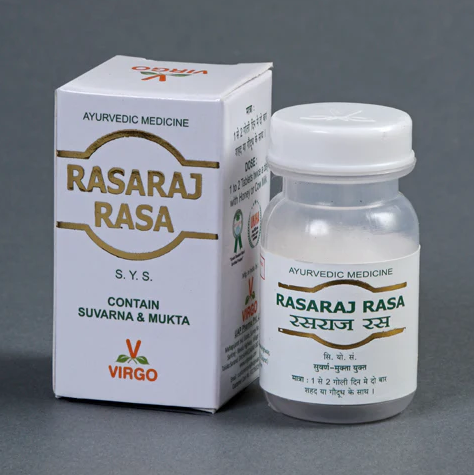
Rasaraj Rasa (Suvarna-Mukta Yukta) – AYUSH Standard Mark Rasaushadhi – Virgo UAP Pharma – 10 Tab
Rasaraj Rasa (Suvarna-Mukta Yukta) – AYUSH Standard Mark Rasaushadhi – Virgo UAP Pharma – 10 Tab
Couldn't load pickup availability
Rasaraj Rasa by Virgo UAP Pharma Pvt. Ltd. is a classical Suvarna-Mukta Yukta Rasaushadhi — a gold- and pearl-bearing herbo-mineral tablet prepared to the formulation recorded in the Siddha Yoga Sangraha, the reference printed on the pack. Its principal dravya is Rasa Sindura at 58.825 mg of a 125 mg uncoated tablet, with Abhraka Bhasma 14.706 mg, Suvarna Bhasma (gold) 7.352 mg, Mukta Pishti (pearl) 7.352 mg, Praval Pishti 7.352 mg, and Loha, Raupya and Vanga Bhasma with five botanicals at 3.676 mg each — levigated in Kuvarpatha Rasa (aloe leaf juice) and Makoy Kwath. This pack carries the AYUSH Standard Mark and is made under Mfg. Lic. No. GA/1696. Riddhish Herbals supplies it with doctor-guided selection at no cost, genuine brand-sealed stock, and a bill on every purchase.
Rasaraj — King of the Rasas
The classical authors did not hand out that name lightly. Rasaraj Rasa is recorded in the Siddha Yoga Sangraha — the S.Y.S. printed on the carton — and it sits among the most concentrated preparations in the entire Rasashastra repertoire.
Rasa Sindura — The Principal Dravya of This Yoga
Rasa Sindura is 58.825 mg of the 125 mg tablet. In most Rasaushadhi it is a supporting ingredient. In Rasaraj it is the principal one, and that is the formulation's whole design — the reason the classical authors called it the king.
In Rasashastra, Rasa Sindura is described as a Yogavahi: a carrier that directs and amplifies whatever is formulated alongside it. A yoga built around a Yogavahi is built to carry its Suvarna, its Mukta and its Abhraka further and faster than they would travel alone. The quantity is not incidental. It is the point.
And Rasa Sindura is not Parada. It is Kajjali — Shuddha Parada triturated with Shuddha Gandhaka — taken through Kupipakwa, graded heating in a sealed Kupi within the Valuka Yantra. X-ray diffraction identifies what emerges as α-mercuric sulphide, cinnabar: a distinct nanocrystalline compound, and one of the most insoluble substances known to chemistry. The insert names its standard, Bharat Bhaishajya Ratnakar formula 6096. To describe the finished preparation by naming the metal it began as is to describe the contents of a furnace and call it steel.
The Rest of the Formulation
Suvarna Bhasma (gold) 7.352 mg and Mukta Pishti (pearl) 7.352 mg — the two dravyas that make this a Suvarna-Mukta Yukta preparation, as the carton states. The Suvarna Bhasma follows the Rasamritam standard; the Mukta is supplied as a Pishti (levigated rather than calcined), classically described as Sheeta and Pitta-pacifying.
Abhraka Bhasma 14.706 mg — mica, the second-largest mineral component and among the most laboriously processed Bhasma in classical Rasashastra. Praval Pishti 7.352 mg (coral), with Loha (iron), Raupya (silver) and Vanga (Bang, tin) Bhasma at 3.676 mg each, all to the Rasa Tantra Sar standard.
The botanical group, 3.676 mg each, all to Ayurvedic Pharmacopoeia of India standard: Jatiphala (Myristica fragrans, seed), Javantri (Myristica fragrans, aerial part), Lavanga (Syzygium aromaticum, flower bud), Ashwagandha (Withania somnifera, root) and Kakoli (Lilium polyphyllum, root). Small quantities, classical to the yoga — and note that Virgo UAP Pharma names the exact plant part for each, which most manufacturers do not. The thirteen actives total 124.995 mg in a 125 mg uncoated tablet.
The Bhavana — and a Detail Worth Noticing
Before the tablet is formed, the mineral powders are levigated (Bhavana) in two plant preparations, both printed on the insert with their plant parts and references: Kuvarpatha Rasa (aloe, Aloe barbadensis, leaf juice — A.P.I.) and Makoy Kwath (Solanum nigrum, whole-plant decoction — A.P.I.).
One small thing is worth pointing out, because it tells you where this medicine comes from. The insert does not call the aloe Kumari, the Sanskrit name you would expect in a classical text. It calls it Kuvarpatha — the Gujarati name, the one people here actually use in the kitchen and the courtyard. Kunvar Pathu. A Gujarat pharmacy, writing for Gujarat, in the language Gujarat speaks. We are keeping their word, not correcting it.
The Classical Record
The Siddha Yoga Sangraha describes Rasaraj Rasa within the context of Vatavyadhi — the classical Ayurvedic category of Vata disorders — and presents it as a preparation for states of profound depletion, where the body and the indriyas have grown weak and neither Ushna nor Sheeta measures are being accepted. That is a statement of what a classical text records, with the text named.
An earlier version of this listing enumerated a specific list of conditions. We removed it. Several of those terms correspond directly to diseases named in the Schedule to the Drugs and Magic Remedies (Objectionable Advertisements) Act, 1954 — and writing a scheduled disease in Sanskrit does not make it a different disease. What this preparation is appropriate for, in a specific person, is a clinical judgement belonging to a qualified Vaidya who has examined them. It does not belong on a product page.
Research on the Constituents
◆ A Central Council for Research in Ayurvedic Sciences study that ran X-ray diffraction on Vasant Kusumakar Rasa — a different classical preparation, which we also stock — identified its mercurial component as cinnabar, the mercuric sulphide arising from that formula's Rasa Sindura, confirming that Shodhana and Marana convert the raw minerals into distinct compounds. Cinnabar is the finding that bears on this formulation, through its own Rasa Sindura 58.825 mg — Ota S, Singh A, Srikanth N, Sreedhar B, Ruknuddin G, Dhiman KS (2017), Ancient Science of Life 36(4):207–214, CCRAS — PMID 29269973.
◆ X-ray diffraction analysis has confirmed that classical Swarna Bhasma consists principally of gold at the nanoscale — Nanostructured gold in the Ayurvedic calcined drug swarnabhasma, Journal of Ayurveda and Integrative Medicine (2021) — PMID 34690042.
◆ A physicochemical and blood-compatibility study characterised Swarna Bhasma as crystalline gold in the 28–35 nm range — Paul & Sharma (2011), International Journal of Ayurveda Research 2(1):14–22 — PMID 21897638.
Results were observed under study conditions. Individual results may vary. This is shared for general educational interest and is not a medical claim. Consult your Ayurvedic physician before use.
Composition — each uncoated 125 mg tablet (label-verified)
| Ingredient | Form / plant part | Reference | Qty |
|---|---|---|---|
| Rasa Sindura | Kupipakwa Rasaushadhi — α-HgS (cinnabar) | B.B.R. 6096 | 58.825 mg |
| Abhraka Bhasma | Mica — Shodhana + Marana | R.T.S.-1 | 14.706 mg |
| Suvarna Bhasma | Gold — Shodhana + Marana | Rasamritam | 7.352 mg |
| Mukta Pishti | Pearl — levigated Pishti | R.T.S.-1 | 7.352 mg |
| Praval Pishti | Coral — levigated Pishti | R.T.S.-1 | 7.352 mg |
| Loha Bhasma | Iron — Shodhana + Marana | R.T.S.-1 | 3.676 mg |
| Raupya Bhasma | Silver — Shodhana + Marana | R.T.S.-1 | 3.676 mg |
| Vanga Bhasma | Tin — Shodhana + Marana | R.T.S.-1 | 3.676 mg |
| Jatiphala | Myristica fragrans — seed | A.P.I. | 3.676 mg |
| Javantri | Myristica fragrans — aerial part (per label) | A.P.I. | 3.676 mg |
| Lavanga | Syzygium aromaticum — flower bud | A.P.I. | 3.676 mg |
| Ashwagandha | Withania somnifera — root | A.P.I. | 3.676 mg |
| Kakoli | Lilium polyphyllum — root | A.P.I. | 3.676 mg |
| TOTAL ACTIVES | 13 ingredients | — | 124.995 mg |
| Excipients | Base | — | Q.S. |
Label-verified against the Virgo UAP Pharma pack insert. Every quantity is transcribed from the printed insert. Bhavana: Kuvarpatha Rasa (aloe leaf juice) and Makoy Kwath. Reference key — B.B.R. = Bharat Bhaishajya Ratnakar (the Rasa Sindura follows formula 6096); R.T.S.-1 = Rasa Tantra Sar; Rasamritam for the Suvarna Bhasma; A.P.I. = Ayurvedic Pharmacopoeia of India for the botanicals. Classical reference: Siddha Yoga Sangraha. Manufacturer: Virgo UAP Pharma Pvt. Ltd., Village Moriya, Ta. Sanand, Ahmedabad 382 213 — Mfg. Lic. No. GA/1696. This pack carries the AYUSH Standard Mark, verified on the physical carton.
How to Use
As prescribed by your Ayurvedic physician. The insert states 1 to 2 tablets twice daily with Madhu (honey) or Gau Dugdha (cow's milk), or as the physician advises. In Rasashastra the anupan actively directs the preparation, and for a yoga built around a Yogavahi the choice is a clinical one. Your Vaidya sets the dose, the anupan and the duration.
Who Can Use It
Adults, on the prescription of a registered Ayurvedic practitioner. Not for pregnancy or lactation. Not for children — we print no paediatric dose for this preparation, and none should be inferred. If you take any other medicine, or are under care for any condition, mention it to your physician first.
Safety Information
Bhasma and Bhasma-based Ayurvedic medicines are to be used under strict medical supervision only. That is the standard practice for this class of medicine, and the instruction the manufacturer prints on the pack. Your Vaidya matches the preparation, the dose and the duration to you — to your Prakriti, your Agni and your condition — which is something no pack and no web page can do.
Use strictly under the guidance of a qualified Ayurvedic physician. Consult your physician before use, especially if you are pregnant, lactating, taking any medication, or managing any medical condition. Keep out of reach of children. Results may vary from person to person.
CAUTION — TO BE TAKEN UNDER MEDICAL SUPERVISION. सावधानी — चिकित्सक की देखरेख में ही लें।
This preparation contains a dravya listed in Schedule E(1) of the Drugs and Cosmetics Rules, 1945. Rule 161 of those Rules requires the caution above on a medicine of this class intended for internal use. Consult a qualified Ayurvedic physician before usage. Take it only at the dose and for the duration your physician directs, never above the dose printed on the pack, and not as self-medication. Keep out of reach of children. Results may vary from person to person.
Storage
Store in a cool, dry place away from direct sunlight and moisture. Keep the container tightly closed after every use. Do not refrigerate. Keep out of reach of children.
Frequently Asked Questions
What is Rasaraj Rasa?
Rasaraj Rasa — king of the Rasas — is a classical Suvarna-Mukta Yukta Rasaushadhi recorded in the Siddha Yoga Sangraha, the reference printed on the Virgo UAP Pharma carton. Each 125 mg uncoated tablet carries thirteen actives built around Rasa Sindura, with Suvarna Bhasma (gold) and Mukta Pishti (pearl).
Why is there so much Rasa Sindura in it?
Because that is the design of the yoga. Rasa Sindura is the principal dravya of Rasaraj at 58.825 mg, and in Rasashastra it is described as a Yogavahi — a carrier that directs and amplifies whatever is formulated alongside it. A yoga built around a Yogavahi carries its Suvarna, Mukta and Abhraka further than they would travel alone. The classical authors called it the king of the Rasas for exactly this reason.
What is Rasa Sindura, chemically?
α-mercuric sulphide — cinnabar. Rasa Sindura begins as Kajjali (Shuddha Parada triturated with Shuddha Gandhaka) and is taken through Kupipakwa, graded heating in a sealed Kupi within the Valuka Yantra. X-ray diffraction identifies the result as a distinct nanocrystalline compound, one of the most insoluble known to chemistry — confirmed by the Central Council for Research in Ayurvedic Sciences on Vasant Kusumakar Rasa, a different classical preparation which we also stock, for that formula's own Rasa Sindura (PMID 29269973). Rasashastra said so first; the diffractometer agreed.
What else is in each tablet?
Abhraka Bhasma 14.706 mg; Suvarna Bhasma (gold), Mukta Pishti (pearl) and Praval Pishti (coral) at 7.352 mg each; Loha (iron), Raupya (silver) and Vanga (tin) Bhasma at 3.676 mg each; and Jatiphala, Javantri, Lavanga, Ashwagandha and Kakoli at 3.676 mg each, plus excipients. Levigated in Kuvarpatha Rasa (aloe leaf juice) and Makoy Kwath. Full table above, with the pharmacopoeial standard and plant part for each.
Is it AYUSH Standard Mark certified?
Yes. The Virgo UAP Pharma carton carries the AYUSH Standard Mark with the printed statement “Ayush Standard Mark Certified Product,” verified on the physical pack. Manufactured under Mfg. Lic. No. GA/1696.
What are B.B.R., R.T.S. and A.P.I. on the composition table?
The pharmacopoeial standards each ingredient is prepared to, printed by Virgo UAP Pharma on the insert. B.B.R. is the Bharat Bhaishajya Ratnakar — the Rasa Sindura follows its formula 6096. R.T.S.-1 is the Rasa Tantra Sar, the standard for the Bhasma and Pishti. The Suvarna Bhasma follows Rasamritam. A.P.I. is the Ayurvedic Pharmacopoeia of India, governing the five botanicals. We do, because it is the clearest evidence of how the medicine was actually made.
Why does the insert call the aloe ‘Kuvarpatha’?
Because that is what it is called here. The insert does not use Kumari, the Sanskrit name you would expect in a classical text — it uses Kuvarpatha, the Gujarati name, Kunvar Pathu. A Gujarat pharmacy writing for Gujarat, in the language Gujarat speaks. We keep their word rather than correcting it.
What does the classical text record about it?
The Siddha Yoga Sangraha describes Rasaraj Rasa in the context of Vatavyadhi — the classical category of Vata disorders — and presents it as a preparation for states of profound depletion. That is classical record, with the text named. What is appropriate in your case is a question for your physician.
Why does this page not list specific indications?
Because an earlier version did, and several of those terms correspond directly to diseases named in the Schedule to the Drugs and Magic Remedies (Objectionable Advertisements) Act, 1954. Writing a scheduled disease in Sanskrit does not make it a different disease. We forgo the search traffic.
What is the correct anupan?
The insert specifies Madhu (honey) or Gau Dugdha (cow's milk), 1 to 2 tablets twice daily, or as the physician advises. In Rasashastra the anupan directs the preparation, so the choice is clinical; your Vaidya makes it.
Has Suvarna Bhasma been studied scientifically?
Yes. X-ray diffraction work confirmed classical Swarna Bhasma consists principally of gold at the nanoscale (PMID 34690042), and a blood-compatibility study characterised it as crystalline gold at 28–35 nm (PMID 21897638). These are characterisation studies of the ingredient.
How should I store it?
In a cool, dry place away from direct sunlight and moisture, tightly closed after every use. Do not refrigerate. Keep out of reach of children.
Related at Riddhish Herbals
Vasant Kusumakar Rasa — Virgo UAP Pharma · Brihat Vat Chintamani Ras — Virgo UAP Pharma · Yogendra Rasa — Virgo UAP Pharma · Madhurantak Vati (Mukta Yukta) · Suvarna Vasant Malati Rasa 10 Tab — Virgo UAP Pharma
Riddhish Herbals is an authorised online seller for Virgo UAP Pharma.