

Riddhish Herbals
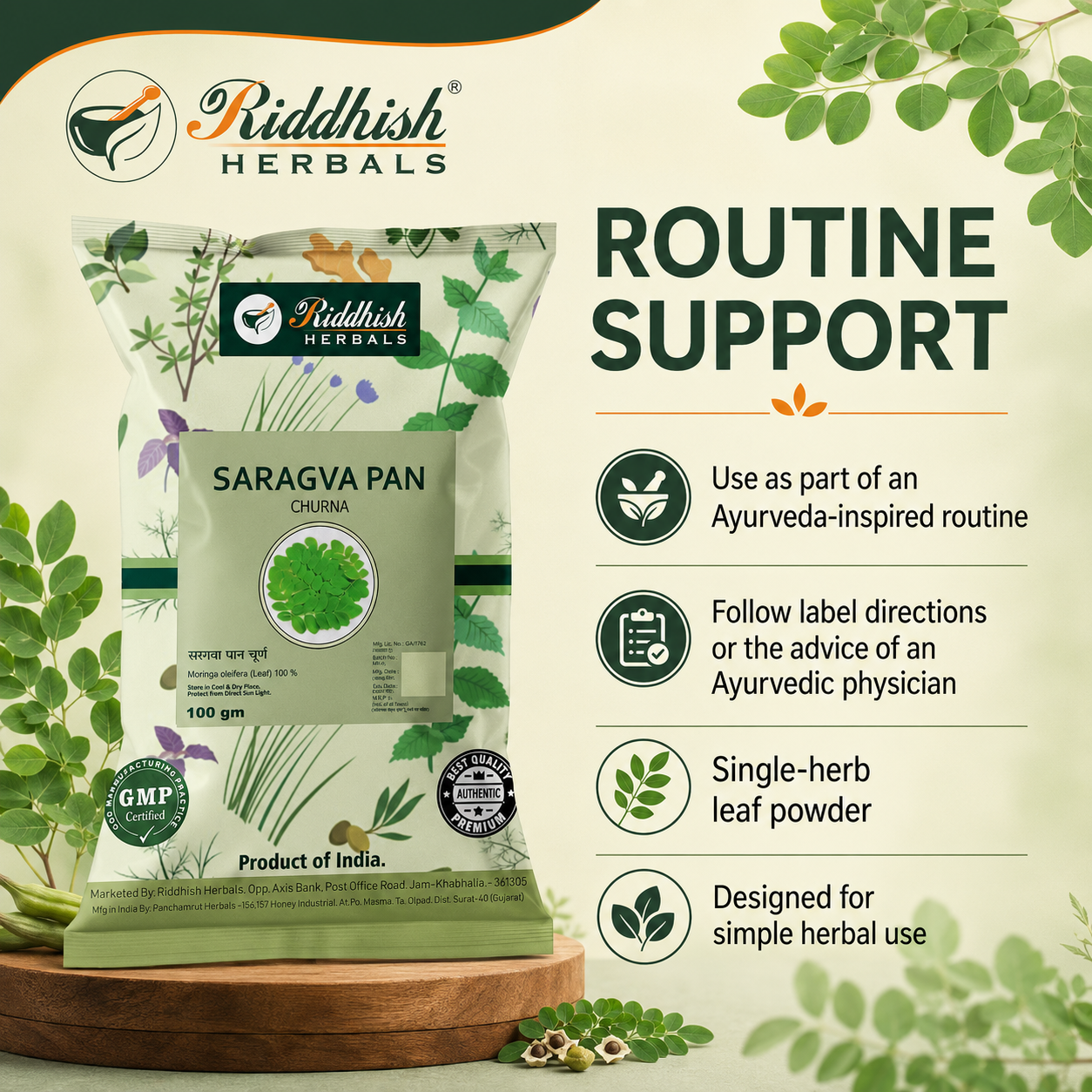
Shigru Pan Churna | Saragva Pan | Moringa Leaf Powder | Riddhish Herbals | 100gm
Shigru Pan Churna | Saragva Pan | Moringa Leaf Powder | Riddhish Herbals | 100gm
Couldn't load pickup availability
Quick answer: Shigru Pan Churna (also called Saragva Pan Churna or Moringa leaf powder) is a single-ingredient powder of shade-dried Moringa oleifera leaf. In Ayurveda, Shigru is a classical Deepana-Pachana (digestive) and Tridosha-balancing herb; nutritionally, dried Moringa leaf is a genuinely nutrient-dense green — a natural source of plant protein, calcium, iron, potassium, and vitamins A, C and E. It is a nourishing daily dietary herb, not a medicine, and makes no claim to diagnose, prevent or treat any disease. Net weight 100 g. Mfg. Lic. GA/1762.
Key facts — Botanical: Moringa oleifera Lam. (family Moringaceae) · Part used: leaf (Shigru Parna / Saragva Pan) · Form: 100% single-herb churna (powder), no fillers · Net weight: 100 g · Mfg. Lic.: GA/1762 · Ayurvedic class: Deepana-Pachana & Tridosha-balancing dietary herb · Suggested use: ½–1 tsp (1–3 g) once or twice daily.
About Shigru Pan Churna (Saragva Pan / Moringa Leaf Powder)
Shigru — known in Gujarat as Saragvo or Shevgo, across India as Sahijan or Drumstick, and botanically as Moringa oleifera — is one of the most valued daily nutritive herbs in both classical Ayurveda and modern nutrition science. Riddhish Herbals Shigru Pan Churna is made from pure Moringa leaf, shade-dried to protect its natural colour, aroma and nutrients, with no fillers, binders or synthetic preservatives.
Moringa is booming worldwide as a “superfood” — and with that has come a great deal of exaggeration. Our approach is different: we give you the verified, sourced facts below, including where the popular claims are overstated. Honest nutrition you can trust is worth more than hype.
Verified Nutrient Profile
Representative values for dried Moringa leaf powder, with the amount in a realistic daily serving. We show the per-spoon column because that is what actually reaches your body — not the per-100g figure used to make dramatic comparisons. One regular kitchen spoon holds about 5 g of our Shigru Pan Churna (we weighed it on the 100 g pouch); a level 5 ml measuring teaspoon holds about 2 g. See how much a spoon of moringa powder weighs.
| Nutrient | Per 100 g (dried leaf) | Per 1 kitchen spoon (≈5 g, measured on our pack) |
|---|---|---|
| Energy | ~350 kcal | ~18 kcal |
| Protein | ~25 g | ~1.25 g |
| Dietary fibre | ~12 g | ~0.6 g |
| Calcium | ~1,500 mg | ~75 mg |
| Iron | ~28 mg | ~1.4 mg |
| Potassium | ~1,350 mg | ~68 mg |
| Magnesium | ~350 mg | ~18 mg |
| Vitamin A (as beta-carotene) | ~16 mg | ~0.8 mg |
| Vitamin C | ~17 mg | ~0.85 mg |
| Vitamin E | ~110 mg | ~5.5 mg |
The honest takeaway: dried Moringa leaf is truly nutrient-dense for a plant — around a quarter protein by weight, with useful calcium, iron and vitamins A, C and E. But a real half-spoon to one-spoon serving delivers a modest, helpful top-up alongside a balanced diet — not a multivitamin in a spoon. Used daily and consistently, that steady nourishment is exactly where Moringa earns its reputation.
Myths vs Facts
Three claims travel with almost every Moringa listing online. Here is what the science actually says.
Myth: “Moringa has 90+ / 92 nutrients.”
Fact: This specific number appears in marketing material, not in peer-reviewed research. Moringa is rich in protein, vitamins A, C, B-group, minerals such as calcium, iron and potassium, and plant antioxidants — but there is no scientific basis for the exact “92” figure.
Myth: “7 times the vitamin C of oranges.”
Fact: Fresh Moringa leaf holds roughly 50–52 mg vitamin C per 100 g — about the same as an orange (~53 mg), not seven times more. The inflated ratios usually compare concentrated dried Moringa against fresh or liquid foods, which is not a like-for-like comparison.
Myth: “Moringa works for every health condition.”
Fact: Human research on Moringa is still preliminary and limited. Moringa leaf is a nourishing food herb — not a treatment for, or a substitute for medical care of, any disease. We make no such claims for this product.
Traditional Ayurvedic Importance
Charaka Samhita (Sutra Sthana 27) places Shigru among the Deepaniya (digestive-fire-kindling) and Pachana (digestive) group of herbs — within the classical tradition of dietary herbs used to support daily nourishment and comfortable digestion. Its Laghu (light), Ushna (warming) and Katu-Tikta (pungent-bitter) qualities make it classically suited to Kapha-related digestive sluggishness.
Ashtanga Hridayam describes Shigru as Tridosha Shamaka — supportive of balance across Vata, Pitta and Kapha in appropriate amounts. Bhavaprakasha Nighantu lists Shigru (Shobhanjana) among well-regarded culinary-medicinal shaka (leafy) dravyas, and Sushruta Samhita notes it among herbs classically described as Shothahara (traditionally associated with supporting normal fluid balance). The leaf (Parna / Pan) is the part specifically favoured in Charaka for everyday dietary use — distinct from the root and bark, which have separate classical applications and call for greater caution. This single-ingredient leaf powder stays within that gentle dietary tradition.
Key Features
- Classical Deepana-Pachana herb: traditionally valued for supporting digestive fire (Agni) and digestive ease in daily routines.
- Tridosha Shamaka: described in Ashtanga Hridayam as balancing for Vata, Pitta and Kapha in appropriate amounts.
- Genuinely nutrient-dense leaf: a natural whole-food source of plant protein, calcium, iron, potassium and vitamins A, C and E — see the verified table above.
- Saragvo — Gujarat's everyday herb: the concentrated form of a drumstick-leaf tradition woven into Gujarat's kitchens and daily wellness.
- pure shade-dried leaf: single ingredient, minimally processed, no fillers, no synthetic preservatives, vegan and gluten-free.
- Licensed manufacture: manufactured by Panchamrut Herbals under Ayurvedic manufacturing licence GA/1762; marketed by Riddhish Herbals — genuine products, bill provided, since 2015.
- GMP-, ISO 9001:2015- and HACCP-certified manufacturer: made by Panchamrut Herbals, certified to GMP, ISO 9001:2015 and HACCP standards, Mfg. Lic. GA/1762.
Ingredients
- Shigru Parna / Saragva Pan — Moringa oleifera Lam. — shade-dried leaf — 100%
- No excipients, no fillers, no preservatives. Vegan. Gluten-free.
How to Use
½ to 1 teaspoon (1–3 g) once or twice daily. Stir into warm water, buttermilk, lassi, soup, dal or a smoothie. Best taken after meals, or as directed by an Ayurvedic practitioner. A mild, earthy, slightly green flavour is natural. If you are new to Moringa, start with a smaller amount and build up gradually — consistency over time matters more than a large dose.
Who Can Use It
Suitable as a daily nutritive herb for most adults. Pregnant or lactating women should consult a qualified healthcare provider before use — traditional guidance advises particular caution with Shigru root and bark in pregnancy; leaf in dietary amounts is generally considered separately, but please check with your physician. Not recommended for children under 5 without guidance. Anyone managing a health condition or taking regular medication should speak to their doctor before adding any new herb.
Safety Information
A daily dietary herb, generally very well tolerated in recommended amounts. Excessive intake may cause mild digestive sensitivity in some people — begin with a smaller dose. Results may vary from person to person. This product is not intended to diagnose, treat, cure or prevent any disease. Keep out of reach of children.
Storage
Store in a cool, dry place away from direct sunlight and moisture, as printed on the label. Keep tightly sealed after each use — light and air slowly reduce the vitamin content of any dried green powder.
Regional Names Across India
Moringa leaf is one of India's most widely used kitchen-and-wellness herbs, so it travels under many names. If you searched any of these, you are looking at the same herb.
| Language / Region | Name (native script) | Romanised |
|---|---|---|
| Sanskrit | शिग्रु · शोभांजन | Shigru · Shobhanjana |
| Hindi | सहजन · मुनगा | Sahijan · Munaga |
| Gujarati | સરગવો · સરગવા પાન | Saragvo · Saragva Pan |
| Marathi | शेवगा · शेवग्याची पाने | Shevga · Shevgyachi pane |
| Bengali | সজনে · সজনে পাতা | Sajne · Sajne pata |
| Tamil | முருங்கை · முருங்கைக் கீரை | Murungai · Murungai keerai |
| Telugu | మునగ · మునగాకు | Munaga · Munagaku |
| Kannada | ನುಗ್ಗೆ · ನುಗ್ಗೆ ಸೊಪ್ಪು | Nugge · Nugge soppu |
| Malayalam | മുരിങ്ങ · മുരിങ്ങയില | Muringa · Muringa ila |
| Punjabi (Gurmukhi) | ਸੁਹਾਂਜਨਾ | Suhanjana |
| Odia | ସଜନା | Sajana |
| Urdu | سہانجنا · مونگا | Suhanjna · Munga |
| English | Drumstick / Moringa / Horseradish tree leaf | — |
| Botanical | Moringa oleifera Lam. (Moringaceae) | — |
Research & References
Moringa oleifera is among the most-studied nutritive plants in recent literature. The nutrient figures and context on this page draw on peer-reviewed reviews, including:
- Leone A, Spada A, Battezzati A, Schiraldi A, Aristil J, Bertoli S. Cultivation, Genetic, Ethnopharmacology, Phytochemistry and Pharmacology of Moringa oleifera Leaves: An Overview. Int J Mol Sci. 2015;16(6):12791–12835. doi:10.3390/ijms160612791. PMID: 26057747.
- Leone A, Fiorillo G, Criscuoli F, et al. Nutritional Characterization and Phenolic Profiling of Moringa oleifera Leaves Grown in Chad, Sahrawi Refugee Camps, and Haiti. Int J Mol Sci. 2015;16(8):18923–18937. doi:10.3390/ijms160818923. PMID: 26274956.
- Gopalakrishnan L, Doriya K, Kumar DS. Moringa oleifera: A review on nutritive importance and its medicinal application. Food Science and Human Wellness. 2016;5(2):49–56.
- Fahey JW. Moringa oleifera: A Review of the Medical Evidence for Its Nutritional, Therapeutic, and Prophylactic Properties. Part 1. Trees for Life Journal. 2005;1:5.
Figures reflect study conditions and representative samples; individual products and responses vary. Presented for nutritional and educational context only — not as a medicinal claim.
Frequently Asked Questions
What is Shigru Pan Churna / Saragva Pan Churna?
It is a single-ingredient powder of shade-dried Moringa oleifera leaf. “Shigru” is the Sanskrit name, “Saragva Pan” the Gujarati name, and “Moringa leaf powder” or “drumstick leaf powder” the common English names — all the same herb. In Ayurveda it is classed as a Deepana-Pachana (digestive) and Tridosha-balancing dietary herb.
What is Moringa leaf powder actually rich in?
Dried Moringa leaf is genuinely nutrient-dense: around 25% plant protein by weight, with meaningful calcium, iron, potassium and magnesium, plus vitamins A (as beta-carotene), C and E and plant antioxidants such as quercetin and chlorogenic acid. See the verified nutrient table above for representative per-100g and per-spoon amounts.
Is Moringa really ‘92 nutrients’ and ‘7× the vitamin C of oranges’?
No — both are marketing myths. The “92 nutrients” figure does not appear in peer-reviewed research. And fresh Moringa leaf has roughly the same vitamin C as an orange (about 50–53 mg per 100 g), not seven times more. Moringa is impressive on its real merits; it does not need the exaggeration.
How much protein is in Moringa leaf powder?
Dried Moringa leaf is about 25% protein by weight, so 100 g holds roughly 25 g of plant protein. One regular kitchen spoon (about 5 g, as measured on our 100 g pack) provides around 1.25 g — a useful top-up, not a primary protein source.
How much should I take each day?
½ to 1 teaspoon (1–3 g), once or twice daily, is a typical daily amount. Start low and increase gradually. Consistency over weeks matters more than a single large dose.
Fresh vs dried Moringa — which is more nutritious?
Drying concentrates minerals and protein by weight, so gram-for-gram dried powder shows higher numbers — but you also eat far less of it. Fresh leaves are richer in vitamin C (some is lost in drying). Both are valuable; the powder simply makes year-round daily use convenient.
When is the best time to take it?
Most people take it after a meal, in warm water, buttermilk or a smoothie. There is no single “correct” time — daily consistency is what counts.
Is Shigru Pan Churna a medicine or a food?
It is a traditional dietary herb. Charaka places Shigru in the dietary-herb tradition, used as a daily nutritive addition alongside meals. It is not intended to diagnose, prevent or manage any disease.
Is it safe during pregnancy or breastfeeding?
Moringa leaf in small dietary amounts is generally considered separately from Moringa root and bark, which are traditionally avoided in pregnancy. We strongly recommend consulting a qualified Ayurvedic physician or healthcare provider before use during pregnancy or lactation.
What are the alternate names for Shigru?
Shigru / Shobhanjana (Sanskrit), Saragvo / Saragva Pan (Gujarati), Sahijan / Munagga (Hindi), Drumstick or Horseradish Tree leaf (English), Murungai Ilai (Tamil), Munagaku (Telugu), Nugge soppu (Kannada), Muringa ila (Malayalam), Shevga (Marathi), Sajne Pata (Bengali). Botanical: Moringa oleifera Lam. Also searched as Shevga Paan Churna and Moringa powder. See the full Regional Names table above.
Why choose Riddhish Herbals Shigru Pan Churna?
pure shade-dried leaf, manufactured under Ayurvedic licence GA/1762, with honest sourced information rather than hype. From a doctor-guided Ayurvedic store trusted since 2015, with a bill provided and pan-India delivery.
Is this product GMP certified?
Panchamrut Herbals, the manufacturer of this product, holds GMP, ISO 9001:2015 and HACCP certification. Good manufacturing practice (GMP) relates to how the product is made; these are not claims about any medical outcome.
How should it be stored?
In a cool, dry place away from direct sunlight and moisture, tightly sealed after each use. Keep out of reach of children.
Related from Riddhish Herbals
Shigru Pan Churna pairs naturally with other daily-nutrition and digestive herbs from Riddhish Herbals:
- Triphala Churna 100g — the classic Amla, Haritaki & Baheda blend for digestive wellness.
- Amla Powder (Amalaki) 100g — a vitamin-C-rich single-herb churna traditionally valued for skin, hair and daily nourishment.
- Rasayan Churna (Amrutadi) — a Giloy, Gokshura & Amla classical Rasayana blend for everyday wellness.
New to Moringa? Read our complete, honest Moringa (Shigru / Saragva) guide — verified nutrition, myths vs facts, classical Ayurvedic uses, dosage and safety in one place.
Browse more: Digestive Wellness · Millets, Seeds & Superfoods
રીધ્ધીશ હર્બલ્સ — ગુજરાતનો વિશ્વાસપાત્ર આયુર્વેદિક સ્ટોર, જ્યાં સાચી સલાહ અને genuine Ayurvedic products એક જ જગ્યાએ મળે છે.