Skip to product information
1 of 1

Riddhish Herbals

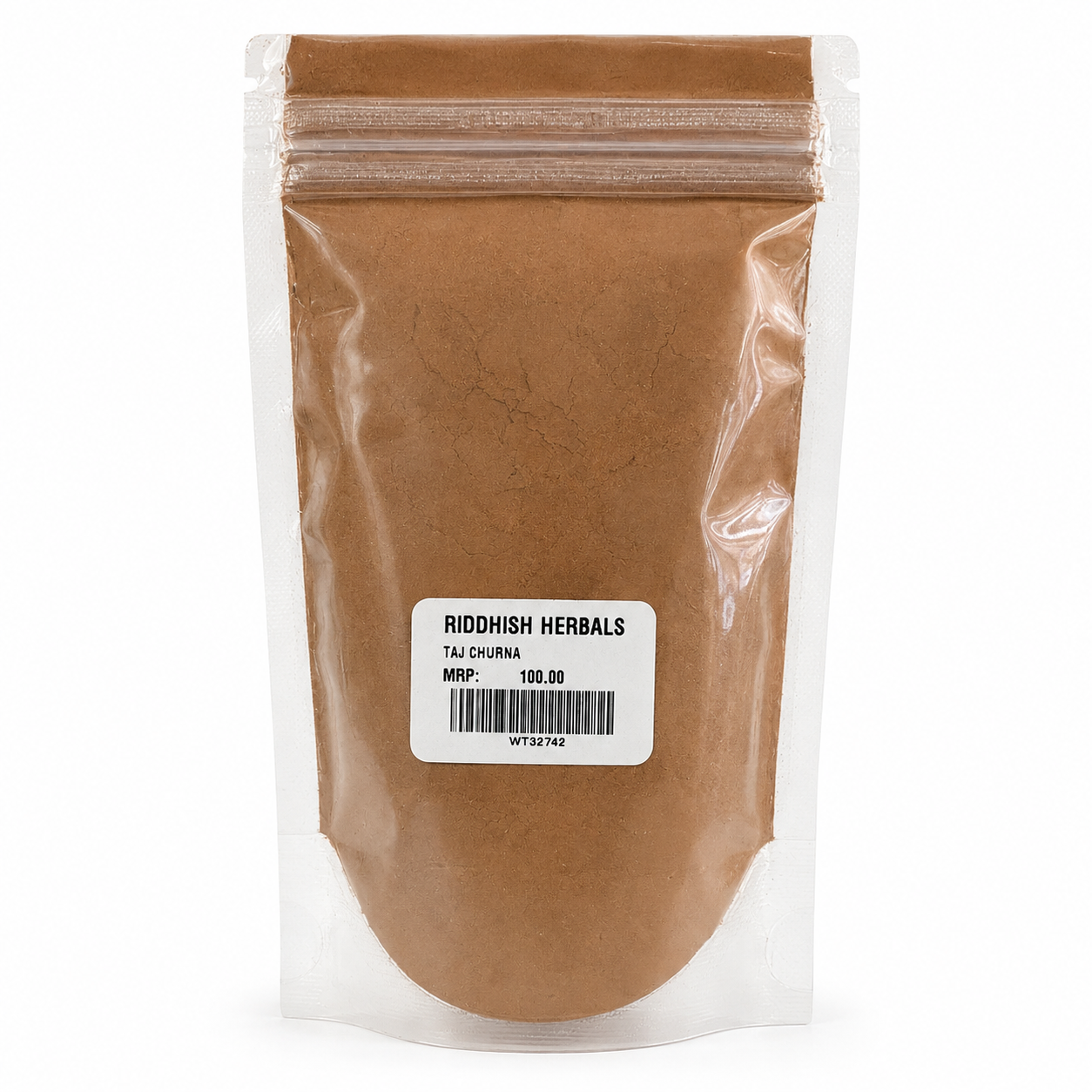
Taj Churna (Dalchini) – Cinnamon Bark Powder – Riddhish Herbals – 100g

Taj Churna (Dalchini) – Cinnamon Bark Powder – Riddhish Herbals – 100g

Regular price Rs. 70.00
Regular price Rs. 70.00 Sale price Rs. 70.00
Sale Sold out

Taj Churna from Riddhish Herbals is pure cinnamon bark powder — the dried inner bark of Cinnamomum zeylanicum, known in Sanskrit as Twak, in Hindi as Dalchini and in Gujarati as Taj — supplied in a 100g pack. In classical Ayurveda, Twak is grouped among the warm, aromatic dravyas traditionally used in small quantities as an appetiser (Deepana) and carminative, and it remains one of the most widely used culinary spices in Indian kitchens. This is traditional-use and culinary information, not a medical claim for any condition; consult a qualified Ayurvedic physician before medicinal use. Each pack is genuine, bill-provided material from a doctor-guided store operating since 2015.

About Taj Churna (Dalchini / Cinnamon Bark Powder)

Taj — Dalchini in Hindi, Twak in Sanskrit — is the dried inner bark of the cinnamon tree, dried into the familiar quills and then milled to a fine, warm-scented powder.

This Churna is a single-ingredient bark powder. Nothing is added to it: no colour, no starch bulking agent, no preservative. Its aroma comes from the volatile oil naturally held in the bark, which is also why it should be kept airtight.

Traditional Ayurvedic Importance

Classical Dravyaguna literature (Bhavaprakasha Nighantu, Haritakyadi Varga, and the parallel Nighantu texts) places Twak among the Katu-Tikta-Madhura Rasa dravyas with Ushna Virya — a warming, aromatic character. It appears in the classical Trijataka and Chaturjataka groupings alongside Ela and Patra, and is described as Deepana (appetising) and Pachana (digestive), which is the standard and lawful classical description of its traditional pharmacological action.

In practical classical usage Twak is a small-quantity dravya — a pinch in a Kwath, a supporting spice in a churna blend, a warming note in a Kadha — rather than something taken in large amounts. That restraint is itself part of the traditional instruction, and it is the reason the dose guidance below is deliberately modest.

This classical description is shared as textual record. It is not a claim that Taj Churna is intended for any diagnosed condition, and it is not a substitute for professional medical care.

Key Features

  • Classical Twak (Taj / Dalchini): the dried inner bark of the cinnamon tree, classically named Twak in Ayurvedic Nighantu literature and grouped among the warming, aromatic Deepana-Pachana dravyas.
  • Single-ingredient powder: pure cinnamon bark powder — no added colour, starch, preservative or filler.
  • Traditional carminative and digestive spice: classically used in small quantities as an appetiser and carminative, and in everyday Indian kitchens as a warming spice.
  • Kitchen and Kadha use: a standard component of garam masala, chai masala and household Kwath/Kadha preparations.
  • Species declared honestly: declared as Cinnamomum zeylanicum per the current product data; because Indian trade cinnamon is frequently C. cassia, we do not market this as premium 'Ceylon' or 'true' cinnamon without pack-level species verification — see the FAQ below.
  • Quality-certified facility: manufactured for Riddhish Herbals in a GMP-, ISO 9001:2015- and HACCP-certified facility (our contract-manufacturing partner, Mfg. Lic. GA/1762).
  • Genuine, doctor-guided sourcing: bill provided with every pack; a store trusted since 2015.

Research on the Constituents

A peer-reviewed systematic review surveyed the published literature on true cinnamon (Cinnamomum zeylanicum), documenting the bark's principal aromatic constituents — cinnamaldehyde, cinnamyl acetate and eugenol among them — and the breadth of traditional uses recorded for it — (Ranasinghe P, Pigera S, Premakumara GAS, Galappaththy P, Constantine GR & Katulanda P, 2013 — BMC Complementary and Alternative Medicine, 13:275). Shared as published-literature information only, not as a medical claim. PubMed PMID: 24148965

A published review article examined cinnamon's phytochemistry and its long documented history of culinary and traditional use across Asia, noting that the volatile oil of the inner bark is the source of its characteristic warm aroma — (Rao PV & Gan SH, 2014 — Evidence-Based Complementary and Alternative Medicine, 2014:642942). This is a narrative review of existing literature, not a clinical finding about this product. PubMed PMID: 24817901

Results were observed under study conditions. Individual results may vary. This is shared for general educational interest and is not a medical claim. Consult your Ayurvedic physician before use.

Ingredients

Ingredient (Sanskrit / Botanical) Plant Part Form Quantity
Twak / Taj / Dalchini (Cinnamomum zeylanicum) Dried inner bark Fine powder (Churna) 100% — single ingredient

Single-ingredient composition; no other ingredients, excipients or additives. Species is stated as per the current product data and has not been verified against a physical printed pack this session — Indian trade cinnamon is commonly C. cassia rather than C. zeylanicum, so the botanical name is flagged for pack-level confirmation and is not used here to support any premium 'Ceylon' or 'true cinnamon' positioning.

How to Use

As directed by your Ayurvedic physician. Traditionally a small-quantity dravya: about 250–500 mg (a small pinch, roughly ¼ teaspoon at most) once or twice daily, or simply as a culinary spice in cooking, chai and Kadha. Anupan (vehicle): warm water, honey or warm milk are the traditional choices. Larger or prolonged medicinal doses should only be taken on a physician's advice.

Who Can Use It

Suitable for most adults in ordinary culinary quantities as a kitchen spice. For medicinal-quantity or prolonged use, consult a qualified Ayurvedic physician first. Pregnant and lactating women should keep to normal culinary amounts and seek an Ayurvedic doctor's advice before any medicinal use. Children may have it in ordinary food, but should not be given medicinal doses without professional advice. Anyone with a known spice allergy, anyone with a Pitta-aggravated or bleeding tendency, and anyone on regular medication should seek advice before medicinal use.

Safety Information

Taj Churna is a culinary and traditional-use spice powder, not intended for any diagnosed condition — please seek qualified medical care directly for any health concern. Cinnamon is a warming, Ushna Virya dravya: excessive or prolonged medicinal use can aggravate Pitta and is best avoided. Coumarin occurs naturally in cinnamon bark and is present at higher levels in C. cassia than in C. zeylanicum, which is a further reason large daily medicinal quantities are not advisable without professional advice. Discontinue and consult a physician if any sensitivity or discomfort occurs. Use under the guidance of a qualified Ayurvedic physician if you are pregnant, lactating, taking any medication, or managing any health condition. Keep out of reach of children. Results may vary from person to person.

Storage

Store in a cool, dry place away from direct sunlight, in a tightly closed airtight container. Cinnamon powder loses aroma quickly once exposed to air, so close the pack firmly after each use and avoid damp spoons.

Frequently Asked Questions

What is Taj Churna?

Taj Churna is pure cinnamon bark powder — the dried inner bark of Cinnamomum zeylanicum, milled to a fine powder. It is known in Sanskrit as Twak, in Hindi as Dalchini and in Gujarati as Taj. This pack contains 100g of single-ingredient bark powder with nothing added.

Are Taj, Dalchini and cinnamon the same thing?

Yes. Taj is the Gujarati name, Dalchini the Hindi name, Twak the Sanskrit name, and cinnamon the English name for the same aromatic tree bark. All four refer to this product.

Is this Cinnamomum zeylanicum or Cinnamomum cassia? Does the difference matter?

The product data states Cinnamomum zeylanicum, and that is what we declare. We want to be plain about a real trade fact: a large share of the cinnamon sold in India is Cinnamomum cassia, which looks similar, is thicker-barked and carries naturally higher coumarin. We have not verified the species against a physical printed pack this session, so we have deliberately avoided marketing this as premium 'Ceylon' or 'true' cinnamon, and this listing is flagged internally for pack-level species confirmation. If exact species matters for your use, please ask us before ordering.

Is this product AYUSH or GMP certified?

It is manufactured for Riddhish Herbals in a GMP-, ISO 9001:2015- and HACCP-certified facility (Mfg. Lic. GA/1762). These are facility quality certifications, not product health claims.

How is Taj Churna traditionally used?

In two ways. As a kitchen spice it goes into garam masala, chai masala, pulao, Kadha and sweets. In classical Ayurvedic use it is a small-quantity dravya described as Deepana and Pachana, taken as a pinch with warm water or honey. Classical texts group it with Ela and Patra in the Trijataka and Chaturjataka combinations.

Does it have any cautions I should know about?

Yes, and we would rather state them than claim there are none. Cinnamon is a warming, Ushna Virya dravya, so excessive or prolonged medicinal use can aggravate Pitta. Coumarin occurs naturally in cinnamon bark, at higher levels in C. cassia than in C. zeylanicum, which is why large daily medicinal quantities are not advisable without professional advice. Spice allergy is uncommon but real. Ordinary culinary use suits most people; medicinal-quantity use should be discussed with a qualified Ayurvedic physician.

Can children take Taj Churna?

Children can have cinnamon in ordinary food and chai as they normally would. Medicinal doses should not be given to children without the advice of a qualified Ayurvedic physician. We do not print a paediatric dose here for that reason.

What are the other names for Taj?

Twak, Dalchini, Daruchini, Chakke, Karuvapatta, Ilavangapattai, Dalchina Chekka, Varanga and Darusita, among others. The full Regional Names table above lists them by language.

Has cinnamon been studied scientifically?

Yes — cinnamon has a substantial published literature. A 2013 systematic review in BMC Complementary and Alternative Medicine surveyed the recorded properties of true cinnamon, and a 2014 review in Evidence-Based Complementary and Alternative Medicine examined its phytochemistry and traditional use. These are shared for general educational interest, not as medical claims; results may vary from person to person.

How should I store it?

In a cool, dry place away from sunlight, in a tightly closed airtight container. Cinnamon powder loses its aroma quickly once exposed to air, so close the pack firmly and keep damp spoons out.

Is it available at Riddhish Herbals?

Yes — in stock at riddhishherbals.com and at our Gujarat retail stores, with pan-India delivery and a proper bill, doctor-guided selection since 2015.

Regional Names & Spelling Variants

Language Name
Local / common name Taj / Dalchini (highlighted — the names Indian buyers actually use)
Sanskrit त्वक् — Twak (also Darusita, Varanga, Utkata)
Hindi दालचीनी — Dalchini
Gujarati તજ — Taj
Marathi दालचिनी — Dalchini
Bengali দারুচিনি — Daruchini
Tamil இலவங்கப்பட்டை — Ilavangapattai
Telugu దాల్చిన చెక్క — Dalchina Chekka
Kannada ಚಕ್ಕೆ — Chakke (also Dalchinni)
Malayalam കറുവപ്പട്ട — Karuvapatta
English + Botanical + part Cinnamon Bark Powder — Cinnamomum zeylanicum — dried inner bark
Romanised search variants Taj Churna, Dalchini powder, Dalchini churna, Twak churna, Cinnamon powder, Daruchini, Ilavangapattai podi
Common misspellings Dalchini/Dalcheeni, Talchini, Daalchini, Cinamon powder, Cinnamom, Taj Churan

Related at Riddhish Herbals

Since 2015Genuine ProductsBill ProvidedDoctor-Guided Selection4000+ Ayurvedic Products130+ Trusted BrandsPan-India Delivery
રીધ્ધીશ હર્બલ્સ — ગુજરાતનો વિશ્વાસપાત્ર આયુર્વેદિક સ્ટોર, જ્યાં સાચી સલાહ અને genuine Ayurvedic products એક જ જગ્યાએ મળે છે.
View full details
%}