Riddhish Herbals
Tulasi Churna (Tulsi / Holy Basil Powder) – Single Herb – Riddhish Herbals – 100g
Couldn't load pickup availability
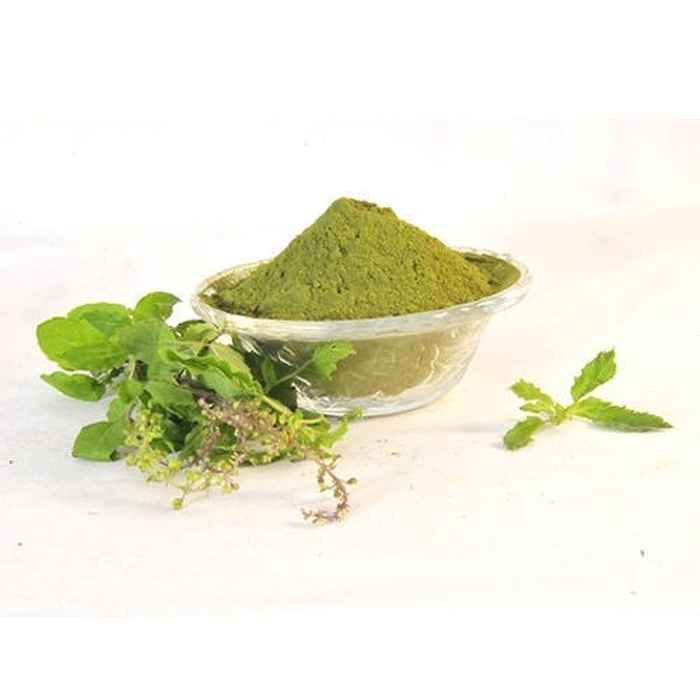
Tulasi Churna from Riddhish Herbals is a single-herb Ayurvedic powder made from the dried leaf of Tulasi (Ocimum tenuiflorum, syn. Ocimum sanctum), commonly called Holy Basil, supplied in a 100 g pack. Tulasi is recorded in Bhavaprakasha Nighantu, Pushpavarga, under the classical name Surasa, where it is described in the Kaphahara and Deepana context and is valued in the Rasayana tradition. This churna is the leaf only — not the seed and not an extract. This is classical textual and compositional information, not a medical claim; consult a qualified Ayurvedic physician before use.
Reviewed by Dr. Riddhish Padiya — B.Pharm (Ayurveda), M.Pharm (Pharmacognosy), Ph.D. (Dravyaguna), ITRA Jamnagar. Publications under “Padiya RH”.
About Tulasi Churna
Tulasi is the one Ayurvedic herb almost every Indian household already knows. It grows in the courtyard, it is offered in the morning, and its leaves are chewed or steeped without anyone thinking of it as medicine. A churna is simply the same leaf, dried and powdered, so that it is available in a consistent quantity through the year rather than only when the plant is in good leaf.
This powder is made from the leaf alone. That distinction matters more than it sounds: Tulasi seed and Tulasi root appear in classical practice with their own separate indications, and a churna that quietly includes stem or seed is not the same material. Ours is Patra — leaf — and nothing else.
Tulasi's character comes largely from volatile aromatic constituents, the same ones you smell when you crush a fresh leaf between your fingers. Those fade with time, heat and light, which is why a Tulasi churna is judged first by its smell. If the powder in your hand still smells unmistakably of Tulasi, it is fresh. If it smells of dry hay, it has been sitting somewhere warm for too long, and that is worth knowing before you buy any brand's version.
Traditional Ayurvedic Importance
Bhavaprakasha Nighantu records Tulasi in its Pushpavarga under the Sanskrit name Surasa. The classical description places it in the Kaphahara context — that is, as a herb whose qualities counter Kapha — and as Deepana, kindling to Agni, the digestive fire.
Its classical Rasa is Katu (pungent) and Tikta (bitter), its Virya is Ushna (heating), and its Vipaka is Katu. That combination is why Tulasi is traditionally taken warm and in small quantity rather than in large doses: it is a heating herb by classical character, not a neutral one.
Tulasi also sits within the Rasayana tradition of Ayurveda, the body of practice concerned with sustaining vitality over the long term rather than acting on a complaint of the moment. That is the context in which it is classically taken daily and in modest amounts.
These are classical Dravyaguna categories quoted from their source. They describe how the texts classify the herb; they are not statements about any diagnosed condition.
Choosing and judging a Tulasi churna
Because Tulasi is so widely sold, quality varies more than for most single herbs. Three things are worth checking in any brand's powder, including ours.
- Smell it. Fresh Tulasi churna has a clear, sharp, faintly clove-like aroma. Weak smell means old or over-dried stock.
- Look at the colour. Properly shade-dried leaf gives a green powder. A dull brown-grey suggests sun-scorching or long storage.
- Ask what part it is. Leaf-only churna and leaf-plus-stem churna are not the same product, and stem is cheaper to include.
We state the plant part on this page for exactly that reason. It is the single most useful piece of information on a raw-herb listing and the one most often left out.
Key Features
- One plant, nothing else: dried Tulasi leaf (Ocimum tenuiflorum, syn. O. sanctum) ground to a churna. No blend, no filler, no extract — a single-material raw herb.
- Leaf, specifically: the classical Patra (leaf) is what this churna is made from. Tulasi seed (Tukmaria) and root have their own separate classical uses and are not interchangeable with the leaf.
- Classically Surasa: Bhavaprakasha Nighantu, Pushpavarga, records Tulasi under the name Surasa and places it in the Kaphahara and Deepana context. We give those terms as the text gives them, anchored to their source.
- The household herb, in measurable form: most Indian homes have a Tulasi plant; a churna simply makes the dried leaf available year-round and in a consistent quantity, outside the growing season.
- Aroma is the freshness test: Tulasi leaf owes its character to volatile aromatic constituents, which fade with age and heat. A good churna still smells distinctly of Tulasi; a flat, hay-like smell means old stock.
- Studied in a human trial: a double-blinded randomised controlled trial in healthy volunteers has been published on a Tulsi leaf extract, cited in full on this page.
- Genuine, doctor-guided sourcing: bill provided with every pack; a store trusted since 2015, with pan-India delivery.
Research on the Constituents
◆ A double-blinded, randomised, placebo-controlled trial in the Journal of Ethnopharmacology gave a Tulsi (Ocimum sanctum) leaf extract to healthy adult volunteers and measured a panel of immunological markers before and after, reporting changes in several of those measures under study conditions — (Mondal S et al., 2011 — Journal of Ethnopharmacology). The study used a prepared leaf extract in healthy volunteers; it is not evidence that this churna does anything for any diagnosed condition. Results observed in study conditions. Individual results may vary. Consult your Ayurvedic physician before use. PubMed PMID: 21619917
Results were observed under study conditions. Individual results may vary. This is shared for general educational interest and is not a medical claim. Consult your Ayurvedic physician before use.
Composition (label-verified)
| Ingredient | Botanical | Part | Quantity |
|---|---|---|---|
| Tulasi / Holy Basil (Ocimum tenuiflorum, syn. O. sanctum) | Dried leaf (Patra) | Single herb | 100 g |
A single-material raw herb: this pack contains dried Tulasi leaf and nothing else — no blend, no excipient, no extract, and no standardisation percentage is claimed. Sold as a loose raw material under Riddhish Herbals' own pack, so there are no per-ingredient quantities to transcribe beyond the net weight. Botanical identity is given as Ocimum tenuiflorum, the currently accepted name; Ocimum sanctum is the older synonym still printed on much of the trade's packaging and used in most of the published literature.
How to Use
As directed by your Ayurvedic physician. The quantity commonly dispensed for adults is 1 to 3 grams of the churna, roughly a quarter to a half teaspoon, once or twice a day. The traditional Anupana is warm water; honey added once the water has cooled to lukewarm is also common in classical practice. Tulasi is Ushna (heating) in classical character, so it is taken in small quantity rather than by the spoonful. It can also be steeped in hot water and strained as a simple household infusion. Children should be given this only on the direction of a qualified Ayurvedic physician.
Who Can Use It
Suitable for most adults as part of a daily routine, in the quantity advised by a qualified Ayurvedic physician. Because Tulasi is Ushna in classical character, people of markedly Pitta constitution may find a smaller quantity suits them better. Not to be taken during pregnancy or lactation except under the direction of a qualified Ayurvedic physician. Anyone taking regular medication or managing a health condition should consult their physician before starting, particularly if they are on blood-thinning medication or are scheduled for surgery.
Safety Information
Tulasi Churna is a traditional Ayurvedic raw herb, not a substitute for professional medical care — please seek qualified medical attention directly for any health concern. Tulasi is Ushna (heating) by classical character, so an excessive quantity may not suit everyone; keep to the quantity your physician advises. Classical practice advises caution during pregnancy, and anyone on blood-thinning medication or awaiting surgery should speak to their physician before taking it. Discontinue and consult a physician if any discomfort occurs. Keep out of reach of children. Results may vary from person to person.
Storage
Store in a cool, dry place away from direct sunlight, in a tightly closed airtight container. Tulasi's aromatic constituents are volatile, so an open or half-empty pack kept in a warm kitchen will lose its smell within weeks. Keep the pack firmly closed, keep damp spoons out, and buy a size you will finish rather than a large pack that will sit.
Frequently Asked Questions
What is Tulasi Churna?
It is a single-herb Ayurvedic powder made from the dried leaf of Tulasi (Ocimum tenuiflorum, syn. O. sanctum), the plant known in English as Holy Basil. Bhavaprakasha Nighantu records it in the Pushpavarga under the classical name Surasa.
Which part of the plant is this?
The leaf, and only the leaf. Tulasi seed (often sold as Tukmaria) and Tulasi root have their own separate classical uses and are different materials. We state the plant part because on a raw-herb listing it is the single most useful fact and the one most often omitted.
Is Ocimum sanctum the same as Ocimum tenuiflorum?
Yes — the same plant under two names. Ocimum tenuiflorum is the currently accepted botanical name and Ocimum sanctum is the older synonym, still printed on much of the trade's packaging and used throughout the published research. Both refer to Tulasi / Holy Basil.
What are the alternate names and spellings?
Tulsi, Tulasi, Thulasi, Tulas and Surasa are all the same herb. Common misspellings include Tulsee, Thulsi and Tulsi Churan. The full regional-name table is set out above.
How much should I take?
That is for your Ayurvedic physician to decide for you. The quantity commonly dispensed for adults is 1 to 3 grams — a quarter to a half teaspoon — once or twice daily. Tulasi is a heating herb by classical character, so it is taken in small amounts rather than by the spoonful.
Can I take this without a doctor?
Tulasi is a household herb and is widely taken as a daily infusion, but for regular or long-term use in churna form we would rather you asked a qualified Ayurvedic physician. That is particularly true if you are pregnant, on blood-thinning medication, or awaiting surgery.
Can I just make tea with it?
Yes — steeping a small quantity in hot water and straining it is the simplest and most traditional household use. Add honey only after the water has cooled to lukewarm, as classical practice directs.
Is this AYUSH or GMP certified?
This is a loose raw herb supplied under Riddhish Herbals' own pack. Any AYUSH Standard Mark or GMP mark would appear on the physical pack, and we state such marks only where they are verified on the pack itself. We do not add Organic or ISO product claims unless they are documented on the label.
Has Tulasi been studied scientifically?
Yes — a double-blinded, randomised, placebo-controlled trial published in the Journal of Ethnopharmacology (Mondal S et al., 2011) gave a Tulsi leaf extract to healthy adult volunteers and measured a panel of immunological markers before and after. It is shared here as published research literature, not as a medical claim about this churna, and results may vary from person to person.
How do I tell if a Tulasi churna is fresh?
Smell it. Fresh Tulasi churna has a clear, sharp, faintly clove-like aroma from its volatile constituents. A flat or hay-like smell means the powder is old or has been stored warm. Colour helps too — properly shade-dried leaf gives a green powder rather than a dull brown.
What is the recommended Anupana?
Warm water is the usual vehicle. Honey added once the water has cooled to lukewarm is also common in classical practice. Your physician may direct something different depending on the individual.
How should I store it?
In a cool, dry place away from sunlight, in a tightly closed airtight container. Tulasi loses its aroma quickly in warmth, so keep the pack closed and keep damp spoons out of it.
Is it available at Riddhish Herbals?
Yes — Tulasi Churna is in stock at riddhishherbals.com and at our Gujarat retail stores, with pan-India delivery and a proper bill, doctor-guided selection since 2015.
Regional Names & Spelling Variants
| Language | Name |
|---|---|
| Local / common name (Gujarat) | તુલસી (Tulsi) — the name buyers actually use |
| Sanskrit | तुलसी (Tulasi); also सुरसा (Surasa), the name used in Bhavaprakasha Nighantu |
| Hindi | तुलसी (Tulsi) |
| Gujarati | તુલસી (Tulsi) |
| Marathi | तुळस (Tulas) |
| Bengali | তুলসী (Tulsi) |
| Tamil | துளசி (Thulasi) |
| Telugu | తులసి (Tulasi) |
| Kannada | ತುಳಸಿ (Tulasi) |
| Malayalam | തുളസി (Thulasi) |
| English + Botanical + part | Holy Basil / Sacred Basil — Ocimum tenuiflorum L. (syn. O. sanctum), Family Lamiaceae — dried leaf |
| Romanised search variants | Tulsi · Tulasi · Thulasi · Tulas · Tulsi powder · Tulsi churna · holy basil powder |
| Common misspellings | Tulsee · Tulsi Churan · Thulsi · Tulasee |
Related at Riddhish Herbals
Vasa Patra 100gm — another classical single-leaf raw herb · Sudarshan Churna 100gm — classical bitter compound in which Tulasi-class herbs sit · Triphala Churna 100gm — the classical daily three-fruit churna · Amla Powder (Amalaki Churna) — classical Rasayana single herb · Shadangpaniya Kwath 100g — classical six-herb decoction · Ayurvedic Raw Herbs & Materials
Share