

Riddhish Herbals
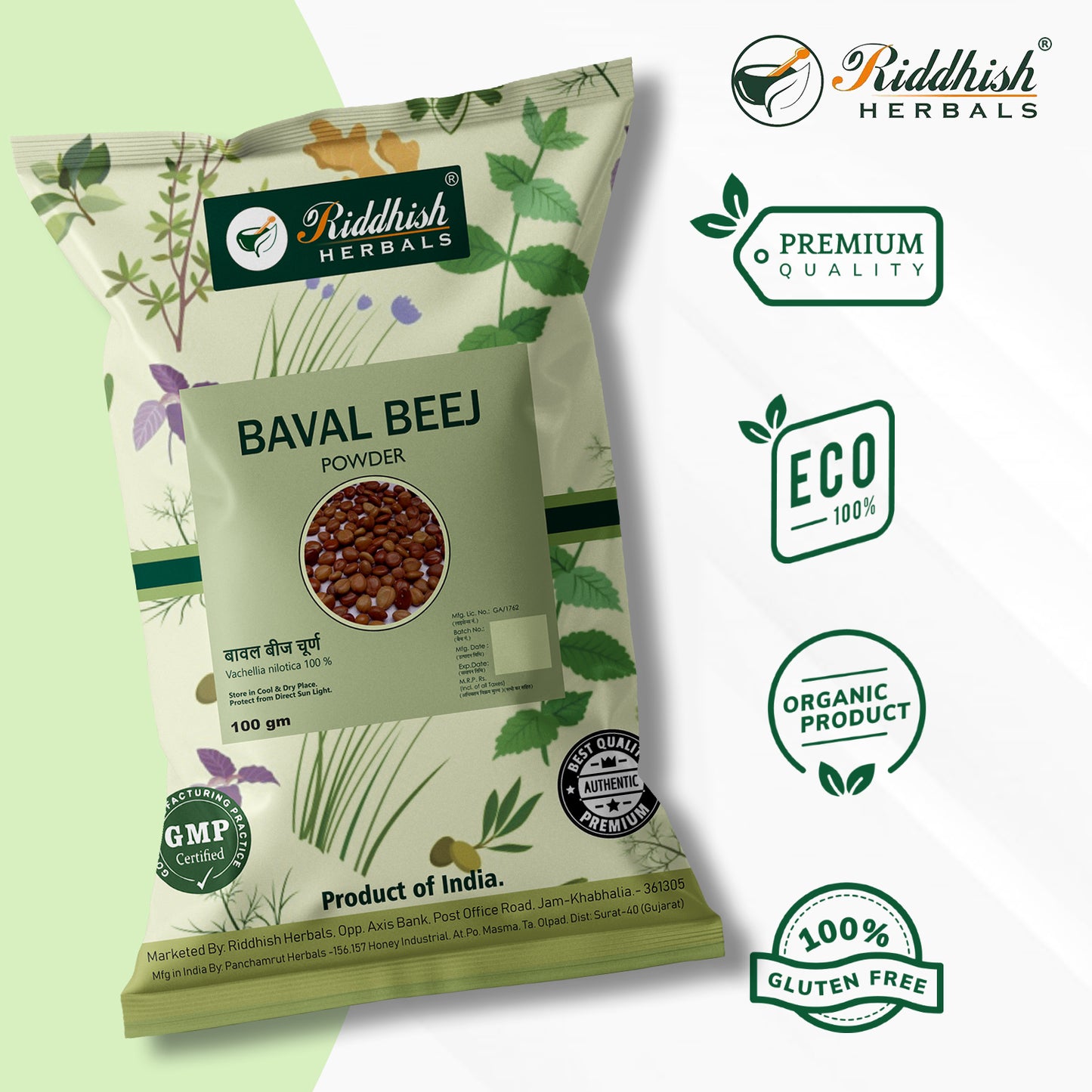
Baval Beej Powder (Babul Seed) | Acacia nilotica | Riddhish Herbals | 100gm
Baval Beej Powder (Babul Seed) | Acacia nilotica | Riddhish Herbals | 100gm
Couldn't load pickup availability
Baval Beej Powder (Babul Seed) is a single-herb powder of Acacia nilotica seed — the classical Kashaya (astringent) herb Babbula, traditionally valued for its Sandhaniya (tissue-uniting) and Grahi (astringent-binding) qualities.
Baval Beej Powder is made from the seeds of Acacia nilotica (syn. Vachellia nilotica) — the tree known as Baval in Gujarati, Babul or Kikar in Hindi, and Babbula in Sanskrit. Riddhish Herbals offers it as pure Baval seed powder, with no fillers or additives. Note that true Babul (Acacia nilotica) is a distinct plant from Subabul (Leucaena leucocephala), with which it is sometimes confused online.
About Baval Beej Powder (Babul Seed)
Almost every part of the Babul tree — bark, pods, gum and seeds — carries long-standing traditional use. This product focuses specifically on the seed (beej). Riddhish Herbals has supplied genuine Ayurvedic products across India since 2015, with a bill on every order.
Traditional Ayurvedic Importance
Classical Ayurvedic literature describes Babbula (Acacia nilotica) as a herb of Kashaya rasa (astringent taste) that traditionally pacifies Kapha and Pitta. It is documented in the Bhavaprakasha Nighantu and listed in the Ayurvedic Pharmacopoeia of India. Babbula is classically valued for its Sandhaniya (tissue-uniting) and Grahi (astringent-binding) qualities, the traditional basis for its association with tissue strength and with steady oral and digestive routines. Its astringent character is also why the Babul tree has been linked for generations to traditional dental care. Within this framework, Baval Beej is classically taken with warm water, milk or honey as the anupan, under guidance.
Key Features
- Single-herb purity: 100% Baval (Babul) seed powder — Acacia nilotica — no blends or fillers.
- Astringent (Kashaya) herb: classically valued for Kapha–Pitta balance.
- Sandhaniya tradition: classically described as tissue-uniting and strengthening.
- Oral-care heritage: the astringent Babul tree has a long traditional link to dental routines.
- Digestive routine support: a Grahi (astringent) herb in traditional daily use.
- Clean & natural: no synthetic colours, preservatives or additives.
- Facility quality: made for Riddhish Herbals in a GMP-, ISO 9001:2015- and HACCP-certified facility.
Composition
- Baval Beej / Babbula (Acacia nilotica, syn. Vachellia nilotica) — seed — 100%
No excipients or additives. Label-verified composition.
Research & Scientific References
Babul (Acacia nilotica) has been the subject of published phytochemical research documenting its tannins, flavonoids and polyphenols and reviewing its traditionally recognised antioxidant constituents. (Hafez et al., 2024 — Nutrients, MDPI; PMID 39770900)
Findings are observed under research conditions and do not constitute medical claims. Individual results may vary. Use under the guidance of a qualified Ayurvedic physician.
How to Use & Anupan
As directed by your Ayurvedic physician. Traditionally, about 3–5 g (½–1 teaspoon) once or twice daily with warm water, milk or honey.
Who Can Use It
Generally suited to adults seeking traditional support as part of a daily routine. Not recommended during pregnancy or lactation without advice. Because the seed is astringent, those prone to constipation should use it cautiously and under advice. Consult a qualified Ayurvedic physician if on medication or managing any health condition. Keep out of reach of children.
Safety Information
For wellness use under guidance. Because the seed is astringent, those prone to constipation should use it cautiously and under advice. Keep out of reach of children. Results may vary from person to person. This product is not intended to diagnose, treat, or replace professional medical care.
Storage
Store in a cool, dry place away from direct sunlight, in a tightly closed airtight container.
Frequently Asked Questions
Is this product AYUSH or GMP certified?
This Riddhish Herbals own-brand powder is manufactured in a facility holding GMP, ISO 9001:2015 and HACCP certifications. These are manufacturing-quality certifications for the facility. Riddhish Herbals provides a genuine bill with every order; ask us for the documentation that applies to your pack.
Can I take Baval Beej Powder without consulting a doctor?
It is a single herb, but for regular use — especially alongside other medicines — it is best taken under the guidance of an Ayurvedic physician.
What is Baval Beej Powder?
It is a single-herb powder of Babul seeds (Acacia nilotica), classically described as an astringent (Kashaya) herb with Sandhaniya (tissue-uniting) and Grahi (astringent) qualities.
What are the other names for Baval?
Baval (Gujarati), Babul / Kikar (Hindi), Babbula (Sanskrit), Karuvel (Tamil), Nallatumma (Telugu), Babhul (Marathi), Babul / gum arabic tree (English). Botanical Acacia nilotica. It is not the same as Subabul (Leucaena leucocephala).
Which part of the tree is this?
This powder is made only from the seed (beej) — not the bark, gum or pods, which are separate products with their own traditional uses.
How is this different from other brands?
It is a true single-herb seed powder with honest, classically-grounded traditional-use language, clear sourcing, and facility-level quality certification.
Is it available at Riddhish Herbals?
Yes, with genuine sourcing, a bill provided, and pan-India delivery.
What is the recommended anupan?
Warm water, milk or honey, as advised by your physician.
Has Babul been studied scientifically?
Yes. A peer-reviewed review (Hafez et al., 2024, Nutrients; PMID 39770900) documents its polyphenols and traditionally recognised antioxidant constituents. Such findings are observed under research conditions and individual results may vary.
Regional Names Across India
| Language | Script | Romanised |
|---|---|---|
| Sanskrit | बब्बूल, कण्टकी | Babbula, Kantaki |
| Hindi | बबूल, कीकर | Babul, Kikar |
| Gujarati | બાવળ | Baval |
| Marathi | बाभूळ | Babhul |
| Bengali | বাবলা | Babla |
| Tamil | கருவேலம் | Karuvelam |
| Telugu | నల్లతుమ్మ | Nallatumma |
| Kannada | ಕರಿಜಾಲಿ | Karijali |
| Malayalam | കരിവേലം | Karivelam |
| Punjabi | ਕਿੱਕਰ | Kikkar |
| Odia | ବବୁଳ | Babula |
| Urdu | کیکر, ببول | Kikar, Babool |
| English | — | Babul, Gum Arabic tree |
| Botanical | — | Acacia nilotica (L.) Delile (syn. Vachellia nilotica) (Family: Fabaceae) |
Plant part used: Seed (beej). Not to be confused with Subabul (Leucaena leucocephala).
Related from Riddhish Herbals
- Baheda Powder (Bibhitaki) — another classical Kashaya (astringent) single-herb churna
- Arjun Chaal Powder — astringent (Kashaya) bark churna, classically Hridya
- Browse all Wellness Products · Ayurvedic Medicines
About Riddhish Herbals
Since 2015 · Genuine Products · Bill Provided · Doctor-Guided Selection · 4000+ Ayurvedic Products · 130+ Trusted Brands · Pan-India Delivery