Riddhish Herbals
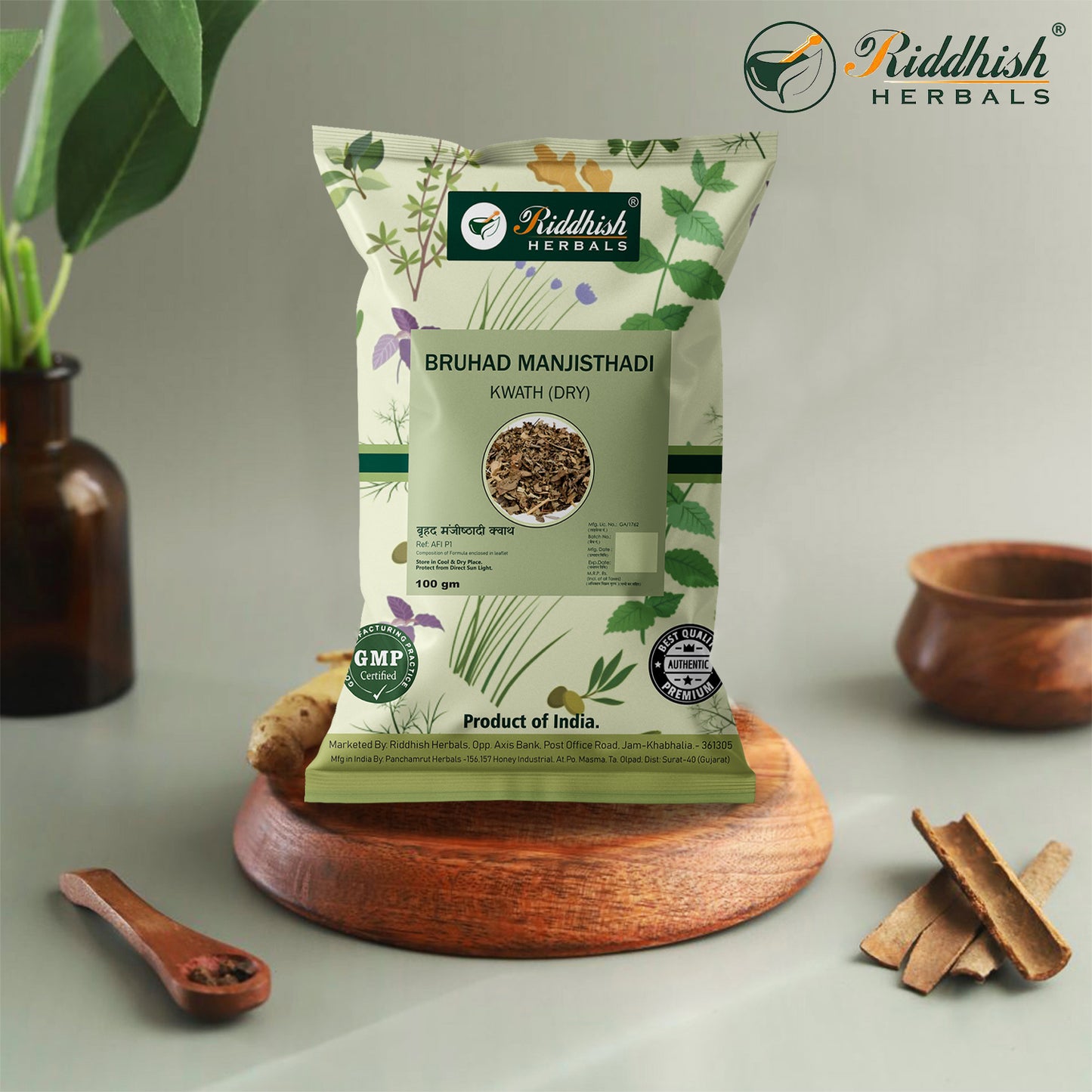
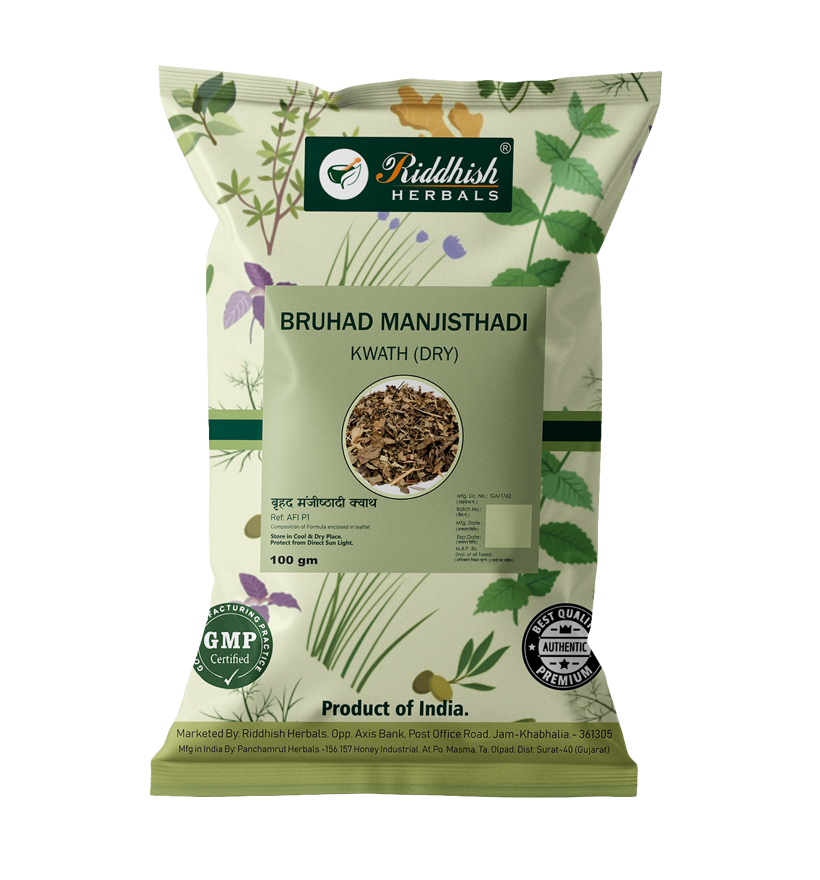
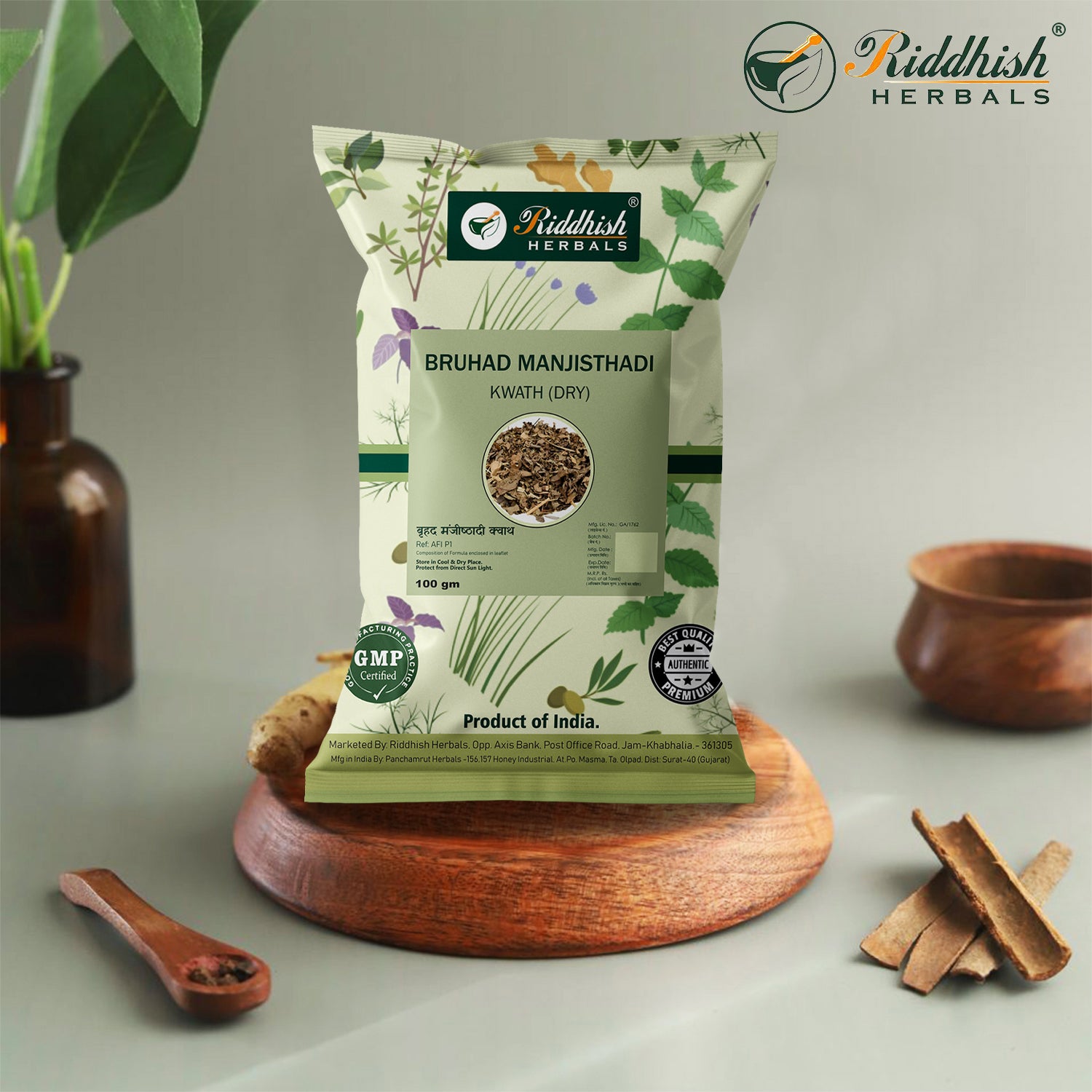
Bruhad Manjisthadi Kwath (Dry) 100gm
Bruhad Manjisthadi Kwath (Dry) 100gm
Couldn't load pickup availability
Bruhad Manjisthadi Kwath (Dry) — also written Maha Manjishthadi or Brihat Manjishtadi Kwath — is a classical Ayurvedic decoction (kwath / kashayam) of around 45 herbs, led by Manjistha (Rubia cordifolia) and prepared as described in the Ayurvedic Formulary of India, Part I.
It is not a single-herb powder — it is a large multi-herb formulation supported by a wide group of Twachya and Raktashodhak herbs. Riddhish Herbals offers it as a dry coarse-powder (yavakuta) decoction in a 100 g pack for traditional home preparation.
About Bruhad Manjisthadi Kwath (Dry)
Manjistha is one of Ayurveda's most respected Rakta-prasadana herbs, classically described for supporting clean blood and a clear complexion. The "Manjisthadi" group of formulas is recorded in classical literature including Bhaishajya Ratnavali (Kushtha Rogadhikara) and standardised in the Ayurvedic Formulary of India.
Traditional Ayurvedic Importance
The Manjisthadi group is described in the texts under Kushtha — the classical Ayurvedic category of skin conditions. The accompanying herbs — Triphala, Nimba, Haridra, Daruharidra and Guduchi among them — are traditionally grouped as Kushtaghna and Kandughna dravyas, carrying Kaphapitta-shamaka and Shothahara qualities as recorded in the texts. Together they form a balanced multi-herb decoction for skin and blood wellness as understood in classical Ayurveda.
Key Features
- Classical 45-herb formula: built on the Manjisthadi group described in the Ayurvedic Formulary of India, Part I.
- Manjistha-led blend: Rubia cordifolia is the principal (pradhana) herb, traditionally valued as a Raktashodhak.
- Skin-and-blood focus: classically described herbs for Twak (skin) and Rakta (blood) wellness.
- Authentic dry-decoction format: coarse Kwath churna for traditional home preparation.
- Pitta-balancing herbs: traditionally used to support balanced Pitta as part of a routine.
- Made in a quality facility: produced in a GMP-certified manufacturing unit.
- Convenient 100 g pack: suitable for regular, supervised use.
Composition (Classical Manjisthadi Formula — AFI Part I)
Composition follows the classical Manjisthadi formula of the Ayurvedic Formulary of India, Part I, traditionally prepared in equal parts (sama bhaga). Full composition is as per the enclosed leaflet.
| # | Herb (Sanskrit) | Botanical | Per 100 g |
|---|---|---|---|
| 1 | Manjistha | Rubia cordifolia | 2.22 g |
| 2 | Musta / Nagarmotha | Cyperus rotundus | 2.22 g |
| 3 | Kutaja | Holarrhena antidysenterica | 2.22 g |
| 4 | Guduchi | Tinospora cordifolia | 2.22 g |
| 5 | Kushtha | Saussurea lappa | 2.22 g |
| 6 | Nagara / Shunthi | Zingiber officinale | 2.22 g |
| 7 | Bharangi | Clerodendrum serratum | 2.22 g |
| 8 | Kantakari | Solanum xanthocarpum | 2.22 g |
| 9 | Vacha | Acorus calamus | 2.22 g |
| 10 | Nimba | Azadirachta indica | 2.22 g |
| 11 | Haridra | Curcuma longa | 2.22 g |
| 12 | Daruharidra | Berberis aristata | 2.22 g |
| 13 | Haritaki | Terminalia chebula | 2.22 g |
| 14 | Bibhitaki | Terminalia bellirica | 2.22 g |
| 15 | Amalaki | Emblica officinalis | 2.22 g |
| 16 | Patola | Trichosanthes dioica | 2.22 g |
| 17 | Katuki | Picrorhiza kurroa | 2.22 g |
| 18 | Murva | Marsdenia tenacissima | 2.22 g |
| 19 | Vidanga | Embelia ribes | 2.22 g |
| 20 | Asana | Pterocarpus marsupium | 2.22 g |
| 21 | Chitraka | Plumbago zeylanica | 2.22 g |
| 22 | Shatavari | Asparagus racemosus | 2.22 g |
| 23 | Trayamana | Gentiana kurroo | 2.22 g |
| 24 | Pippali (Krishna) | Piper longum | 2.22 g |
| 25 | Indrayava | Holarrhena antidysenterica (seed) | 2.22 g |
| 26 | Vasa | Adhatoda vasica | 2.22 g |
| 27 | Bhringaraja | Eclipta alba | 2.22 g |
| 28 | Devadaru | Cedrus deodara | 2.22 g |
| 29 | Patha | Cissampelos pareira | 2.22 g |
| 30 | Khadira | Acacia catechu | 2.22 g |
| 31 | Chandana | Santalum album | 2.22 g |
| 32 | Trivrit | Operculina turpethum | 2.22 g |
| 33 | Varuna | Crataeva nurvala | 2.22 g |
| 34 | Kiratatikta | Swertia chirata | 2.22 g |
| 35 | Bakuchi | Psoralea corylifolia | 2.22 g |
| 36 | Aragvadha | Cassia fistula | 2.22 g |
| 37 | Shakhotaka | Streblus asper | 2.22 g |
| 38 | Mahanimba | Melia azedarach | 2.22 g |
| 39 | Karanja | Pongamia pinnata | 2.22 g |
| 40 | Ativisha | Aconitum heterophyllum | 2.22 g |
| 41 | Hrivera | Pavonia odorata | 2.22 g |
| 42 | Indravaruni | Citrullus colocynthis | 2.22 g |
| 43 | Ananta | Hemidesmus indicus | 2.22 g |
| 44 | Sariva | Hemidesmus indicus (Sariva group) | 2.22 g |
| 45 | Parpata | Fumaria indica | 2.22 g |
Total: 45 herbs in equal parts (2.222 g each per 100 g). Coarse powder / yavakuta for decoction. Label-verified composition.
Rows 43 and 44 read Ananta and Sariva, and both carry the same binomial, Hemidesmus indicus. In classical pharmacognosy Ananta is a Sanskrit synonym of Sariva rather than a separate drug; the genuine two-variety split is Shweta Sariva (Hemidesmus indicus) against Krishna Sariva (Cryptolepis buchananii). The physical pack label is the reference for which variety this pack contains.
Research & Scientific References
A published review of the lead herb. Wen and colleagues reviewed the traditional uses, chemical constituents — anthraquinones and cyclic hexapeptides among them — and the range of pharmacological activity reported for Rubia cordifolia root across the published literature — (Wen M et al., 2022 — Frontiers in Pharmacology 13, article 965390). Read the article.
An animal study, labelled as such. Lodi and colleagues examined whether a Rubia cordifolia extract could counter immune-response impairment and kidney oxidative stress induced by lead exposure in mice — (Lodi S, Sharma V, Kansal L, 2011 — Indian Journal of Pharmacology 43(4):441–444). PMID 21845002. This was work in animals, not in people, and we will not extrapolate it to human use.
What exists sits in non-indexed regional journals. Research on Manjistha the single herb is not evidence about a forty-five-herb decoction, and we are not going to present it as though it were.
Results observed in study conditions. Individual results may vary. Consult your Ayurvedic physician before use.
How to Use & Anupan
This is a dry decoction (Kwath churna), not an instant mix. Classical method: take 1 part of the coarse powder to about 8 parts water, boil gently and reduce to roughly one-fourth, then strain and take the warm decoction — generally twice daily, or exactly as directed by your Ayurvedic physician. Warm water is the usual anupan.
Who Can Use It
Generally suited to adults seeking traditional skin-and-blood wellness support, under guidance. Not recommended during pregnancy or lactation without advice. Consult a qualified Ayurvedic physician if on medication or managing any health condition.
Safety Information
This is a forty-five-herb formulation and it deserves more than a generic caution, so here is the specific one. Bruhad Manjisthadi Kwath is a traditional Ayurvedic preparation and is not a substitute for professional medical care — please seek qualified medical attention directly for any health concern. Use only under the direction of a qualified Ayurvedic physician, and do not exceed the quantity they specify.
Four of the constituents are the reason we say that.
- Indravaruni (Citrullus colocynthis) is classically recorded as purgative and abortifacient. A 2025 human case report documents hemorrhagic colitis, raised liver enzymes, acute kidney injury and hypotension after colocynth ingestion, resolving over five days with supportive care (Alemseged NM et al., Journal of Medical Case Reports 19:506, 2025). That is real-world evidence of multi-organ risk at uncontrolled quantity, and it is the single strongest reason not to self-dose this formula.
- Trivrit (Operculina turpethum) is a classical Virechaka — a purgative — and its action is dose-dependent. It is not appropriate in pregnancy, in young children, in the frail elderly, or for anyone with diarrhoea, rectal bleeding or bowel incontinence.
- Bakuchi (Psoralea corylifolia) contains psoralen, a furanocoumarin long associated with photosensitivity — the skin becoming more reactive to sunlight. A 2023 study also identified psoralen as an immunogenic hepatotoxic component that produced liver injury in immune-stressed mice but not in normal ones, suggesting the risk tracks individual susceptibility rather than being universal (Zhang M-L et al., Frontiers in Chemistry 11, article 1259569). PMID 37867998. If you have any liver condition, raise this formula with your doctor before starting it.
- Ativisha (Aconitum heterophyllum) needs care in how it is described. It is the mild member of a genus whose other well-known species are handled with far greater caution: its root yields atisine rather than the aconitine and pseudaconitine of Vatsanabha (Aconitum ferox), and classical practice has long treated it as the safe one. But the modern literature is not unanimous on that point, and misidentification between Aconitum species in the raw-drug trade is a documented problem. We note the distinction; we do not rest a safety claim on it.
Not for use in pregnancy or lactation. Two of the constituents above carry specific pregnancy cautions of their own. Not for children except on the direction of a qualified Ayurvedic physician. If you are taking any medication, tell your doctor you are taking this, because a decoction of forty-five herbs is not something anyone can screen against your prescriptions from a web page. Discontinue and consult a physician if any discomfort, unusual sun sensitivity or digestive upset occurs. Keep out of reach of children. Results may vary from person to person.
Storage
Store in a cool, dry place away from direct sunlight. Reseal the pack tightly after each use.
Also searched as: bruhad manjisthadi kwath, maha manjisthadi kwath, brihat manjishtadi kwath, manjisthadi kashayam, manjistha kwath powder.
Frequently Asked Questions
What is Bruhad Manjisthadi Kwath?
It is a classical Ayurvedic decoction of about forty-five herbs, led by Manjistha (Rubia cordifolia), supplied as a dry coarse powder (yavakuta) in a 100 g pack for home preparation. It is also written Maha Manjishthadi and Brihat Manjishtadi. It is not a single-herb powder and should not be used like one.
How do I prepare it?
The classical method takes one part of the coarse powder to about eight parts water, simmered gently until reduced to roughly a quarter, then strained and taken warm — generally twice daily, or exactly as your Ayurvedic physician directs. Warm water is the usual anupan. Prepare it fresh; a decoction is not meant to be kept.
Why does this page insist so much on physician guidance?
Because of what is in it. Four of the forty-five constituents — Indravaruni, Trivrit, Bakuchi and Ativisha — carry specific documented cautions, set out in the safety section above. A forty-five-herb decoction is also not something anyone can screen against your other medicines from a web page. This is a formula to take on direction, not on impulse.
Can I take it during pregnancy or while breastfeeding?
No. Two of the constituents carry specific pregnancy cautions of their own — Indravaruni is classically recorded as abortifacient, and Trivrit is a purgative that classical practice keeps away from pregnancy. Not during lactation either, except on the direction of a qualified Ayurvedic physician.
What does Ayurveda classically say about this formula?
The Manjisthadi group is described in classical literature including Bhaishajya Ratnavali under Kushtha Rogadhikara, and is standardised in the Ayurvedic Formulary of India, Part I. Manjistha is recorded as a Rakta-prasadana drug and the supporting herbs are traditionally grouped as Kushtaghna and Kandughna. Kushtha is a classical Ayurvedic category with its own long literature; it is not a modern diagnosis, and this page does not present it as one.
Has this formula been studied scientifically?
Not as a formula, no. There is no PubMed-indexed human study of Bruhad Manjisthadi Kwath; what exists sits in non-indexed regional journals. The two references on this page concern Manjistha, the lead herb, and one of them is an animal study which we have labelled as such. Work on a single herb is not evidence about a forty-five-herb decoction. Individual results may vary.
Is the composition on this page complete?
It lists all forty-five herbs in equal parts, as the Ayurvedic Formulary of India describes the classical formula, and the full composition is also in the leaflet enclosed with the pack. Rows 43 and 44 both resolve to Hemidesmus indicus; see the note under the composition table.
Can I take it alongside my regular medicines?
Ask your doctor, and tell them what is in it. Forty-five herbs is a great many interactions to consider, and several of the constituents here have real pharmacological action rather than being merely mild. We would rather you had that conversation than not.
Is this AYUSH or GMP certified?
It is produced in a GMP-certified manufacturing unit. Any AYUSH Standard Mark would appear on the physical pack, and we state such marks only where they are verified on the pack itself. We do not add Organic or ISO product claims unless they are documented on the label.
How should I store it?
In a cool, dry place away from direct sunlight, resealed tightly after each use. A coarse yavakuta grade takes up moisture faster than whole material and will clump if the pack is left open in humidity. Do not store the prepared decoction.
Is it available at Riddhish Herbals?
Yes — Bruhad Manjisthadi Kwath (Dry) is in stock at riddhishherbals.com and at our Gujarat retail stores, with pan-India delivery and a proper bill, doctor-guided selection since 2015.
Related from Riddhish Herbals: Panchvalkal Kwath (Dry) · Manjishthadi Kashayam Tablet · Ayurvedic Medicines
About Riddhish Herbals
Since 2015 · Genuine Products · Bill Provided · Doctor-Guided Selection · 4000+ Ayurvedic Products · 130+ Trusted Brands · Pan-India Delivery