
Riddhish Herbals
Panchvalkal Kwath Dry 100g | Classical Five-Bark Ayurvedic Decoction (Panchavalkala) | Riddhish Herbals
Panchvalkal Kwath Dry 100g | Classical Five-Bark Ayurvedic Decoction (Panchavalkala) | Riddhish Herbals
Couldn't load pickup availability
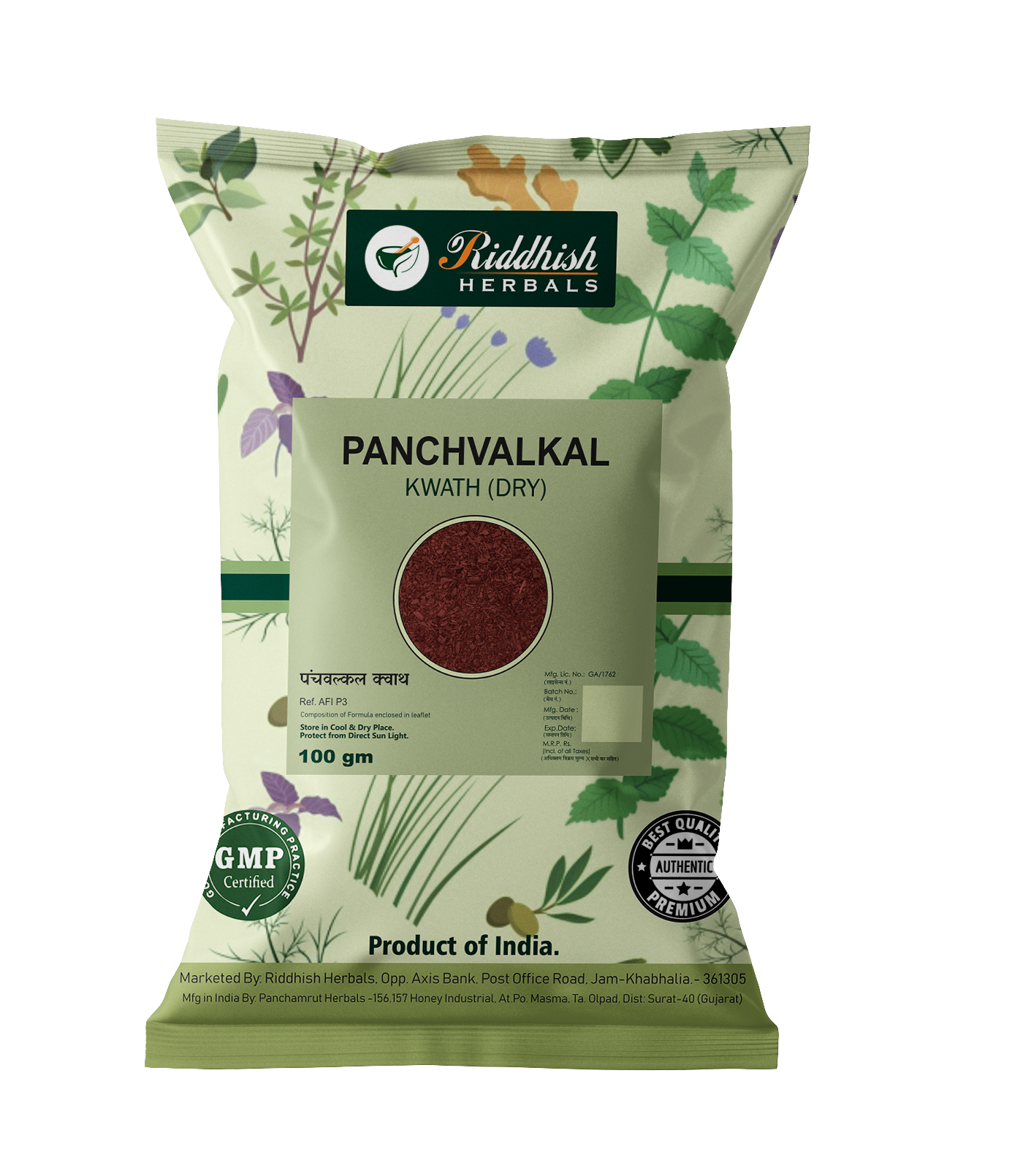
Panchvalkal Kwath (Panchavalkala Kwatha) is a classical Ayurvedic decoction mix prepared from the dried bark of five sacred trees — Vata, Udumbara, Ashvattha, Plaksha and Parisha. Standardised in the Ayurvedic Formulary of India, Part III (AFI P3), this five-bark blend is traditionally valued in classical surgical literature for vrana shodhana (wound cleansing) and vrana ropana (natural healing of the skin), and is used as an external wash, gargle or sitz preparation — and as an internal decoction under the guidance of a qualified Ayurvedic physician.
About Panchvalkal Kwath (Dry)
Some Ayurvedic formulas are admired for a single rare herb. Panchavalkala is admired for the opposite reason — it is the careful pairing of five tree barks that work in the same direction. The Sanskrit name says it plainly: pancha means five, valkala means bark. Together these barks share a strong kashaya (astringent) character, the quality classical texts associate with cleansing, firming and soothing.
This pack is the dry kwath (decoction) form — the shredded, sun-protected stem-bark mix that you simmer in water to prepare a fresh decoction at home. It is a single, time-honoured preparation that has served Ayurvedic households and vaidyas for generations, equally at home as a skin wash, a mouth gargle or an internal kashaya.
Traditional Ayurvedic Importance
Panchavalkala belongs to the surgical heart of Ayurveda. Acharya Sushruta, the father of Ayurvedic surgery, grouped these five barks within the Nyagrodhadi gana and placed them among his measures for wound care — part of the Shashti Upakrama (sixty classical measures for managing vrana) described in the Sushruta Samhita. Their shared role there is twofold: shodhana (to cleanse) and ropana (to help the skin knit and settle).
The method of turning these barks into a decoction follows the kwatha kalpana (decoction pharmaceutics) laid out by Acharya Sharangdhara in the Sharangdhara Samhita (Madhyama Khanda). The Bhavaprakasha Nighantu further records the five Ficus-group barks as kashaya in taste, sheeta (cooling) in potency and kapha-pitta pacifying — the classical reason they are reached for when skin runs hot, moist or irritated.
Across regions the same blend found many traditional roles: a daily kavala/gandusha (gargle) for mukha roga (mouth comfort and gum care), an external parisheka or sitz wash described in classical surgical contexts for arsha (ano-rectal) comfort, and a gentle intimate yoni-prakshalana (external wash) in women's traditional care. In every case the framing is the same — supportive, cleansing, soothing — never a promise.
Key Features
- Authentic five-bark formula — Vata, Udumbara, Ashvattha, Plaksha and Parisha stem bark in equal classical proportion, exactly as compiled in the Ayurvedic Formulary of India, Part III (AFI P3).
- Astringent by nature — every bark carries dominant kashaya rasa, the quality classical texts link with cleansing and firming of skin and mucosa.
- Truly versatile — one preparation that traditionally serves as a skin wash, a mouth gargle, a sitz/compress and an internal kashaya.
- Cooling and soothing — sheeta virya framing makes it a classic choice for skin and tissue that feels hot or irritated.
- Backed by published research — Panchavalkala formulations have been the subject of peer-reviewed clinical study (see References below).
- Manufactured by Panchamrut Herbals — produced for Riddhish Herbals under Mfg. Lic. No. GA/1762.
- GMP-, ISO 9001:2015- and HACCP-certified manufacturer: made by Panchamrut Herbals, certified to GMP, ISO 9001:2015 and HACCP standards, Mfg. Lic. No. GA/1762.
- Doctor-guided, genuine, billed — selected and supplied by Riddhish Herbals, Gujarat's trusted Ayurvedic store since 2015, with a proper bill every time.
Composition
The five barks are combined in equal parts (one part each), exactly as set out in the Ayurvedic Formulary of India, Part III (AFI P3) — confirmed against the manufacturer's enclosed leaflet.
| Ayurvedic Name | Botanical Source | Part Used | Proportion |
|---|---|---|---|
| Nyagrodha / Vata | Ficus benghalensis (syn. F. bengalensis) | Stem Bark (Twak) | 1 part |
| Udumbara | Ficus racemosa (syn. F. glomerata) | Stem Bark (Twak) | 1 part |
| Ashvattha / Pipal | Ficus religiosa | Stem Bark (Twak) | 1 part |
| Parisha / Parish | Thespesia populnea | Stem Bark (Twak) | 1 part |
| Plaksha | Ficus lacor | Stem Bark (Twak) | 1 part |
Net weight: 100 g · Form: Dry Kwath (decoction mix) · Reference: Ayurvedic Formulary of India, Part III (AFI P3).
Research & Scientific References
The traditional standing of Panchavalkala in wound and skin care has drawn modern research interest, particularly around its astringent and antimicrobial character.
A peer-reviewed clinical study published in AYU (2014) by Bhat and colleagues at SDM College of Ayurveda and the Institute of Medical Sciences, Banaras Hindu University, observed a progressive reduction in wound microbial load among subjects with chronic non-healing wounds when a Panchavalkala formulation was applied, under study conditions. — (Bhat KS, Vishwesh BN, Sahu M, Shukla VK, 2014 — AYU 35(2):135–140 — PMID: 25558157)
A laboratory investigation in the Journal of Natural Remedies examined the antimicrobial activity of Panchavalkala Kwatha and noted a tannin-, flavonoid- and phytosterol-rich profile consistent with its classical shodhana (cleansing) role, under study conditions. — (Prajeesh Nath et al. — J. Natural Remedies, Amrita School of Ayurveda)
Findings above were observed under study conditions and relate to the herbs studied, not to this specific pack. Individual results may vary. This information is educational and is not a promise of any clinical outcome. Please consult a qualified Ayurvedic physician before use.
How to Use & Anupan
As directed by your Ayurvedic physician. A traditional way to prepare the decoction:
- Make the decoction: soak about 10–15 g (roughly 2–3 teaspoons) of the bark mix in 200–400 ml water for a few hours, then simmer gently until it reduces to about one-quarter. Strain.
- External skin wash / face wash: let the strained decoction cool and use it to rinse the affected skin.
- Gargle (gandusha): use the lukewarm decoction as a mouth rinse for everyday gum and mouth comfort.
- Sitz / compress (parisheka): use the lukewarm decoction externally as a soak or compress.
- Internal use: only under a physician's direction — typically 30–50 ml of fresh decoction, with warm water as anupana.
Who Can Use It
Suitable for adults seeking a traditional Ayurvedic bark decoction for external skin, mouth and intimate-wash routines, or as an internal kashaya under guidance. Pregnant or lactating women, children, the elderly, and anyone on regular medication or managing a health condition should use it only after consulting a qualified Ayurvedic physician. For internal use, professional guidance is always recommended.
Safety Information
Panchavalkala is a plant-bark preparation and is generally well tolerated when used as traditionally described. For first-time external use, a small patch test is sensible. Use under the guidance of a qualified Ayurvedic physician, especially for internal use or prolonged application. Consult your physician before use if you are pregnant, lactating, on any medication, or managing any health condition. Keep out of reach of children. Results may vary from person to person.
Storage
Store in a cool, dry place, away from direct sunlight. Keep the pack tightly closed and protected from moisture to preserve the bark's freshness and astringent quality.
Regional Names Across India
The formulation name is a Sanskrit compound carried, with transliteration, across India's languages:
| Language | Script | Romanised |
|---|---|---|
| Sanskrit / Hindi | पञ्चवल्कल क्वाथ / पंचवल्कल क्वाथ | Panchavalkala Kwatha |
| Gujarati | પંચવલ્કલ ક્વાથ | Panchvalkal Kvath |
| Marathi | पंचवल्कल काढा | Panchavalkal Kadha |
| Bengali | পঞ্চবল্কল ক্বাথ | Panchabalkal Kbath |
| Tamil | பஞ்சவல்கல கஷாயம் | Panchavalkala Kashayam |
| Telugu | పంచవల్కల కషాయం | Panchavalkala Kashayam |
| Kannada | ಪಂಚವಲ್ಕಲ ಕಷಾಯ | Panchavalkala Kashaya |
| Malayalam | പഞ്ചവല്കല കഷായം | Panchavalkala Kashayam |
| Punjabi | ਪੰਚਵਲਕਲ ਕਵਾਥ | Panchvalkal Kvath |
| Odia | ପଞ୍ଚବଲ୍କଳ କ୍ାଥ | Panchabalkala Kwatha |
The five barks themselves are familiar village trees, known by these common names:
| Sanskrit | Hindi | Gujarati | English | Botanical |
|---|---|---|---|---|
| Vata / Nyagrodha | बरगद (Bargad) | વડ (Vad) | Banyan | Ficus benghalensis |
| Udumbara | गूलर (Gular) | ઉમરો (Umaro) | Cluster fig | Ficus racemosa |
| Ashvattha | पीपल (Peepal) | પીપળો (Pipalo) | Sacred fig | Ficus religiosa |
| Plaksha | पाकड़ (Pakar) | પ્લક્ષ (Plaksha) | Java fig | Ficus lacor |
| Parisha | पारस पीपल (Paras Peepal) | પારસ પીપળો (Paras Pipalo) | Portia tree | Thespesia populnea |
Also searched as: Panchvalkal Kwath, Panchvalkal Kwatha, Panchavalkal Kwath, Panchvalkal Kadha, Five Bark Decoction, Panchvalkal churna, Panchvalkal kashayam.
Frequently Asked Questions
What is Panchvalkal Kwath?
It is a classical Ayurvedic decoction mix made from the dried stem bark of five trees — Vata, Udumbara, Ashvattha, Plaksha and Parisha. Standardised in the Ayurvedic Formulary of India, Part III (AFI P3), it is traditionally valued for skin and wound care and used as an external wash, gargle or internal kashaya.
Who manufactures this Panchvalkal Kwath?
It is manufactured by Panchamrut Herbals (Mfg. Lic. No. GA/1762) and marketed by Riddhish Herbals. Panchamrut Herbals holds GMP, ISO 9001:2015 and HACCP certification. Good manufacturing practice (GMP) relates to how the product is made; these are not claims about any medical outcome.
Can I take Panchvalkal Kwath without a doctor?
For external uses — a skin wash, gargle or sitz preparation — it is gentle and widely used. For internal use as a decoction, please take it only under the guidance of a qualified Ayurvedic physician, who can advise the right dose for you.
What are the five barks in Panchavalkala?
Vata (Ficus benghalensis), Udumbara (Ficus racemosa), Ashvattha (Ficus religiosa), Plaksha (Ficus lacor) and Parisha (Thespesia populnea) — the stem bark of each, combined in equal parts.
What are the alternate names and spellings?
Also written as Panchavalkala Kwatha, Panchavalkal Kwath, Panchvalkal Kadha, and described in English as a five-bark Ayurvedic decoction. In classical texts it appears within the Nyagrodhadi gana.
How do I prepare the decoction from this dry pack?
Soak about 10–15 g of the bark mix in 200–400 ml water for a few hours, simmer until reduced to roughly a quarter, then strain. Use externally once cooled, or internally under physician guidance.
Has Panchavalkala been studied scientifically?
Yes. A peer-reviewed clinical study in AYU (Bhat et al., 2014, PMID 25558157) observed a reduction in wound microbial load in chronic-wound subjects using a Panchavalkala formulation under study conditions. Such findings are educational and not a promise of any outcome.
How should I store it, and what is the shelf reference?
Store in a cool, dry place away from direct sunlight, tightly closed. The pack is a 100 g dry kwath; refer to the printed manufacturing and expiry dates on the pouch.
What is the recommended anupan?
For internal decoction, warm water is the usual anupana. External uses need no anupan. Your physician may suggest a specific vehicle based on your constitution.
Is it available at Riddhish Herbals?
Yes — Panchvalkal Kwath (Dry) 100g is genuine, in stock and supplied with a proper bill by Riddhish Herbals, with pan-India delivery and doctor-guided selection.
Related Products & Reading
Manufactured by Panchamrut Herbals. Marketed by Riddhish Herbals. Opp. Axis Bank, Post Office Road, Jam-Khambhalia 361305, Gujarat. Manufacturing unit: Masma, Olpad, Surat, Mfg. Lic. GA/1762. Reference: Ayurvedic Formulary of India, Part III (AFI P3). This is a traditional Ayurvedic product; information provided is educational and not a substitute for professional medical advice.
Since 2015 · Genuine Products · Bill Provided · Doctor-Guided Selection · 4000+ Ayurvedic Products · 130+ Trusted Brands · Pan-India Delivery
રીધ્ધીશ હર્બલ્સ — ગુજરાતનો વિશ્વાસપાત્ર આયુર્વેદિક સ્ટોર, જ્યાં સાચી સલાહ અને genuine Ayurvedic products એક જ જગ્યાએ મળે છે.