Riddhish Herbals
Hira Bhasma (Hirak / Vajra Bhasma) – Classical Rasaushadhi – Virgo UAP Pharma – 100mg
Couldn't load pickup availability
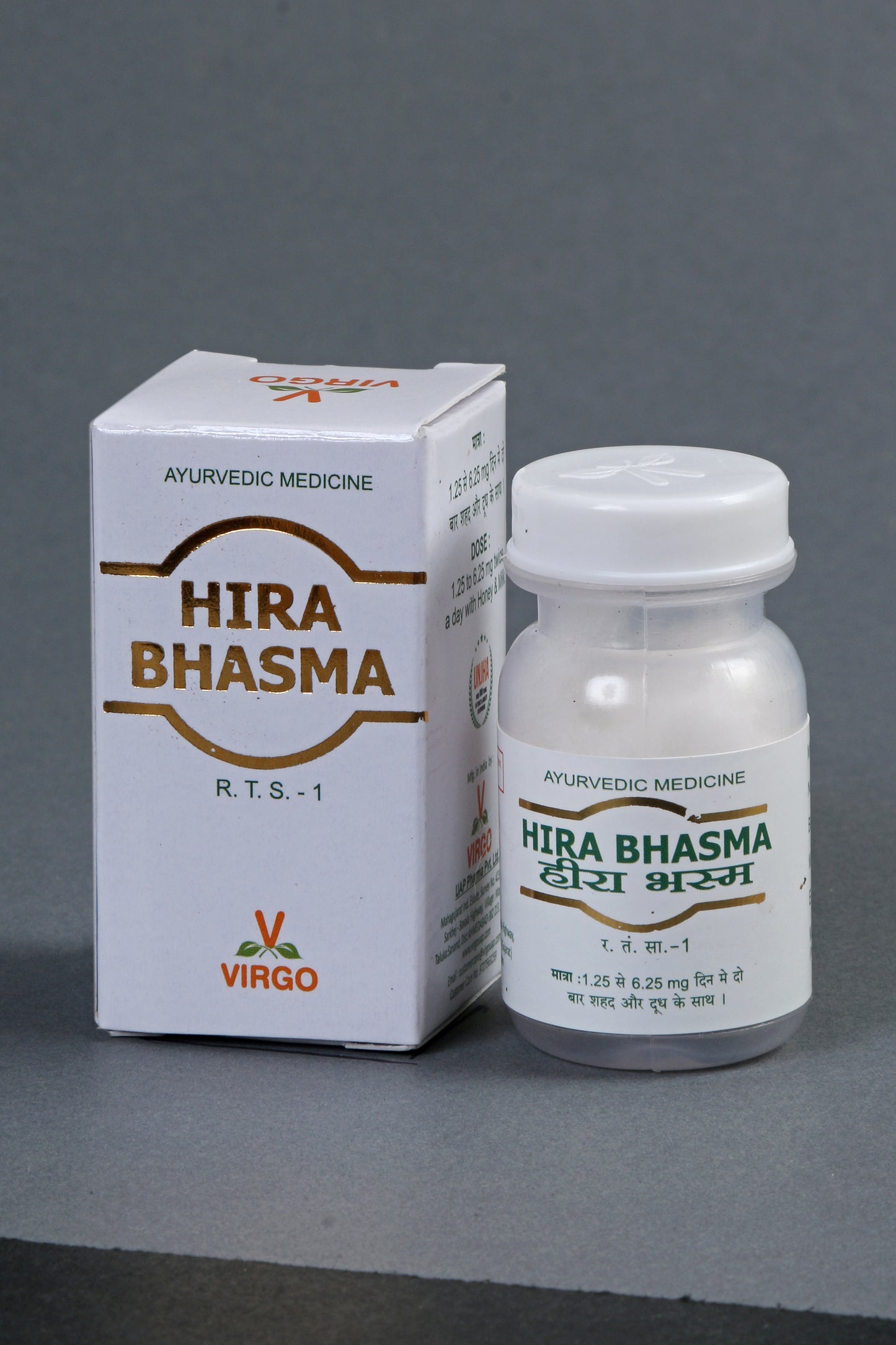
Hira Bhasma 100 mg by Virgo UAP Pharma is a classical Ayurvedic rasaushadhi of Rasatantra Sara va Siddhaprayoga Samgraha (R.T.S.-1), prepared from Shuddha Hirak — purified diamond, stated on the label as 99.99% pure — processed with Shuddha Haratal, Shuddha Gandhak, Shuddha Hingul and Suvarna Makshik Bhasma, with bhavana in Bor and Pipal Tvak Kwath. Two of those processing materials are named on Schedule E(1) of the Drugs and Cosmetics Rules, 1945 — Haratala (arsenic trisulphide) and Hingula (cinnabar) — so this is a prescription-class medicine, and the pack itself prints the statutory caution in English and Hindi. The label dose is 1.25 to 6.25 mg twice a day with honey and milk. Made under Mfg. Lic. No. GA/1696 by Virgo UAP Pharma Pvt. Ltd., a GMP, ISO-9001 and ISO-22000 certified company at Moraiya, Ahmedabad. Sold by Riddhish Herbals, Gujarat's trusted Ayurvedic store since 2015, with a bill on every pack.
Reviewed by Dr. Riddhish Padiya — B.Pharm (Ayurveda), M.Pharm (Pharmacognosy), Ph.D. (Dravyaguna), ITRA Jamnagar. Publications under “Padiya RH”.
About Hira Bhasma
Hira is the diamond, Vajra in Sanskrit, and a bhasma is what remains after a mineral has been put through classical shodhana and marana until it can be triturated to an impalpable ash. Hira Bhasma sits at the top of the rasaushadhi hierarchy for exactly that reason: it is the hardest substance the tradition works with, and reducing it is the longest and most demanding process in the whole of Rasashastra. The Virgo pack prints the reference R.T.S.-1 — Rasatantra Sara va Siddhaprayoga Samgraha, part one — so the recension can be checked.
The label is unusually specific for this category. It states the purity of the starting material, 99.99%, and it names every processing companion rather than describing a proprietary method: Shuddha Haratal, Shuddha Gandhak, Shuddha Hingul and Suvarna Makshik Bhasma, finished with bhavana in Bor and Pipal Tvak Kwath. Most sellers of this dravya publish none of that.
And here is the part the rest of the shelf leaves out. We read the competing Hira Bhasma listings on 18 August 2026 — PARAM, Unjha Pharmacy, Zandu, Heerak and Dhootapapeshwar among them, plus the product libraries at 1mg and Netmeds — and not one of them names the two Schedule E1 minerals this preparation is processed with. Two of those companions — Haratala and Hingula — are named substances on Schedule E(1) of the Drugs and Cosmetics Rules, 1945. Virgo know it and print the statutory caution on the carton, in a red box, in English and Hindi. This page reproduces it rather than quietly dropping it, because a customer choosing between brands deserves to know which of them is telling them the truth about what they are buying.
Traditional Ayurvedic Importance
Classical Rasashastra places Hirak first among the Maharatna — the great gems — and the texts are candid that the difficulty is the point. An unreduced diamond is inert and useless as medicine; the entire classical apparatus of shodhana and marana exists to convert it into something the body can receive. Where the classical literature describes it, it is a Rasayana dravya, spoken of in terms of Ojas, Bala and the strength of the tissues, and it is given in milligram quantities inside a physician's protocol rather than as a general tonic.
The processing companions are not incidental and they are not filler. Gandhaka, sulphur, is the classical partner in the kajjali tradition and the reducing agent for hard minerals. Haratala and Hingula are Upavisha-class materials whose role here is pharmaceutical — they participate in reducing an intractable mineral — which is precisely why the finished preparation is restricted and not sold as a wellness supplement. Suvarna Makshika, chalcopyrite, adds the copper-iron element the classical method calls for.
The bhavana closes the process. The pack names Bor and Pipal Tvak Kwath — the ber fruit and a decoction of the bark of Ficus religiosa. Bhavana is the stage where a mineral ash is triturated with a plant liquid, repeatedly, and classical authors regard it as what makes a bhasma fit to give. That the manufacturer prints it at all is a mark of a real classical process rather than a nominal one.
Key Features
- Schedule E(1) declared, not buried: Haratala (arsenic trisulphide) and Hingula (cinnabar) are both named on Schedule E(1) of the Drugs and Cosmetics Rules, 1945. We state it because it decides how this medicine may lawfully be used.
- The pack carries the statutory caution already: Virgo print the Rule 161 caution in English and Hindi, in a red box on the carton. This page reproduces it rather than dropping it.
- Starting purity stated on the label: Shuddha Hirak at 99.99% purity, a precision figure almost no competing pack prints.
- The two Schedule E1 minerals named, which no competitor names: shelf checked 18 August 2026 across PARAM, Unjha Pharmacy, Zandu, Heerak and Dhootapapeshwar — Virgo UAP Pharma print the Rule 161 caution on the carton and every reseller we found drops it. We put it back.
- Classical reference R.T.S.-1: Rasatantra Sara va Siddhaprayoga Samgraha part one, printed on the pack, so the recension is checkable rather than asserted.
- Every processing companion named: Shuddha Haratal, Shuddha Gandhak, Shuddha Hingul and Suvarna Makshik Bhasma — a declared method, not a proprietary one.
- Bhavana printed: Bor and Pipal Tvak Kwath, the trituration stage classical authors regard as what makes a bhasma fit to administer.
- Licence and certifications from the pack: Mfg. Lic. No. GA/1696; Virgo UAP Pharma Pvt. Ltd. marked on the leaflet as a GMP, ISO-9001 and ISO-22000 certified company, Moraiya, Ahmedabad.
Research on the Constituents
◆ No PMID is asserted on this page, and we want to explain why rather than leave a gap. We searched PubMed this session for published work on hiraka bhasma. There is indexed research, and it is a nanomaterial characterisation study — but its therapeutic subject is a condition Indian law does not permit us to discuss in product copy under any framing. Reporting it while omitting its subject would be a euphemism, and rewording it to sound harmless would be worse. So we cite nothing here. The classical record for this dravya is in Rasatantra Sara va Siddhaprayoga Samgraha, which the pack itself references, and that is the authority this page rests on. If you want the pharmacological literature, ask your Ayurvedic physician, who can read it in its proper context.
Results were observed under study conditions. Individual results may vary. This is shared for general educational interest and is not a medical claim. Consult your Ayurvedic physician before use.
Composition (label-verified, per 100 mg pack)
| Dravya / role | Identity | Quantity |
|---|---|---|
| Shuddha Hirak (Vajra) — principal dravya | purified diamond — label states 99.99% pure | — |
| Shuddha Haratal — processed with | arsenic trisulphide (orpiment) — Schedule E(1) | — |
| Shuddha Gandhak — processed with | purified sulphur | — |
| Shuddha Hingul — processed with | cinnabar, mercuric sulphide — Schedule E(1) | — |
| Suvarna Makshik Bhasma — processed with | calcined chalcopyrite (copper-iron sulphide) | — |
| Bhavana — Bor | ber fruit (Ziziphus sp.) — the pack prints only “Bor” | — |
| Bhavana — Pipal Tvak Kwath | decoction of Ficus religiosa bark | — |
| Net weight | — | 100 mg |
Reproduced from the Virgo UAP Pharma leaflet and carton, which state: “COMPOSITION: It is prepared from: Shuddha Hirak (99.99% Pure), processed with Shuddha Haratal, Shuddha Gandhak, Shuddha Hingul, Suvarna Makshik Bhasma. BHAVANA: Bor, Pipal Tvak Kwath.” Declared an Ayurvedic Medicine against R.T.S.-1 (Rasatantra Sara va Siddhaprayoga Samgraha), Mfg. Lic. No. GA/1696, Virgo UAP Pharma Pvt. Ltd., marked on the leaflet as a GMP, ISO-9001 and ISO-22000 certified company, Mahagujarat Ind. Estate, Village Moraiya, Ta. Sanand, Dist. Ahmedabad 382213, Gujarat. The carton carries the Unjha emblem above the manufacturer's name. The label gives no individual quantities for the processing companions, so none are invented here. Batch number, manufacturing date, expiry and printed price are on your pack and are deliberately not reproduced in this description.
How to Use
Strictly as your Ayurvedic physician directs. The Virgo pack states 1.25 to 6.25 mg twice a day with honey and milk, and its Hindi dose line reads the same. That is milligrams, not grams: the whole pack is 100 mg, so a single maximum dose is roughly one sixteenth of it. There is no household measure that divides this accurately, which is the practical reason it is dispensed rather than self-administered. Honey and milk are the anupan the label names; your Vaidya may specify otherwise for your constitution. Never exceed the printed dose.
Who Can Use It
Adults for whom a registered Ayurvedic physician has prescribed it, and no one else. This is not a product for self-selection at any dose: the preparation contains two Schedule E(1) substances, Haratala and Hingula, and the carton itself instructs medical supervision. Not for use in pregnancy or lactation. Not for children. Not for anyone on regular medication without their physician's knowledge. Riddhish Herbals stocks it for patients already under a Vaidya's care and offers doctor-guided selection to anyone unsure whether this is the preparation they were actually told to buy.
Safety Information
This preparation contains two Schedule E(1) dravyas — Haratala and Hingula — and the Virgo carton prints the statutory caution in a red box in English and Hindi. Take it only on a registered Ayurvedic physician's direction, at the dose and for the duration they set, and stop and contact them if anything changes. Never exceed 6.25 mg per dose or the frequency printed on the pack, and do not increase it because a dose feels small. Avoid in pregnancy and lactation. Not for children. Keep it in its labelled pack, out of reach of children and away from food. Results may vary from person to person.
CAUTION — TO BE TAKEN UNDER MEDICAL SUPERVISION. सावधानी — चिकित्सक की देखरेख में ही लें।
This preparation contains a dravya listed in Schedule E(1) of the Drugs and Cosmetics Rules, 1945. Rule 161 of those Rules requires the caution above on a medicine of this class intended for internal use. Consult a qualified Ayurvedic physician before usage. Take it only at the dose and for the duration your physician directs, never above the dose printed on the pack, and not as self-medication. Keep out of reach of children. Results may vary from person to person.
Use strictly under the guidance of a qualified Ayurvedic physician. Consult your physician before use, especially if you are pregnant, lactating, taking any medication, or managing any medical condition. Keep out of reach of children. Results may vary from person to person.
Storage
Store in a cool, dry place away from direct sunlight and moisture, with the container tightly closed. Keep it in its original labelled carton — a 100 mg bhasma pack should never be decanted into an unlabelled container. Keep out of the reach and sight of children. Use within the expiry printed on your pack.
Frequently Asked Questions
What is Hira Bhasma?
Hira Bhasma — also called Hirak Bhasma, Heerak Bhasma or Vajra Bhasma — is a classical Ayurvedic rasaushadhi prepared from Shuddha Hirak, purified diamond, which the Virgo label states at 99.99% purity. It is processed with Shuddha Haratal, Shuddha Gandhak, Shuddha Hingul and Suvarna Makshik Bhasma, with bhavana in Bor and Pipal Tvak Kwath, against the classical reference R.T.S.-1. The pack size is 100 mg and the label dose is 1.25 to 6.25 mg twice a day.
Does this contain a Schedule E(1) substance?
Yes — two of them. The label names Shuddha Haratal (arsenic trisulphide, orpiment) and Shuddha Hingul (cinnabar, mercuric sulphide) among the materials it is processed with, and both are named substances on Schedule E(1) of the Drugs and Cosmetics Rules, 1945. That is why it is a prescription-class medicine rather than a supplement. Virgo print the statutory caution on the carton themselves, in English and Hindi. No other listing of this product that we checked mentions it at all.
What does the caution on the carton say?
In a red box: “CAUTION: To be taken under Medical Supervision”, and beneath it the same in Hindi. That is the caution Rule 161 of the Drugs and Cosmetics Rules, 1945 requires on an internal-use medicine containing a Schedule E(1) substance, in English and Hindi. The leaflet repeats it. Please read it as the instruction it is.
What exactly does the label declare?
“COMPOSITION: It is prepared from: Shuddha Hirak (99.99% Pure), processed with Shuddha Haratal, Shuddha Gandhak, Shuddha Hingul, Suvarna Makshik Bhasma. BHAVANA: Bor, Pipal Tvak Kwath. DOSE: 1.25 to 6.25 mg twice a day with Honey and Milk. CAUTION: To be taken under Medical Supervision.” Reference R.T.S.-1; Mfg. Lic. No. GA/1696; net weight 100 mg. The label gives no individual quantities for the processing companions and we have not invented any.
How much should I take?
The pack states 1.25 to 6.25 mg twice a day with honey and milk — and please note those are milligrams. The entire pack is 100 mg, so one maximum dose is about a sixteenth of the whole container. No spoon and no kitchen scale measures accurately at that scale, which is exactly why this is a dispensed medicine. Your physician sets the dose, the anupan and the duration.
Can I buy this without seeing a doctor?
We would rather you did not, and the pack agrees with us. A preparation containing two Schedule E(1) substances, dosed in single-digit milligrams, is prescribed inside a protocol. Riddhish Herbals offers doctor-guided selection — tell us what your Vaidya specified and we will match the exact preparation, dravya and pack size rather than the nearest-sounding one.
Is Virgo UAP Pharma certified?
The leaflet marks Virgo UAP Pharma Pvt. Ltd. as a GMP, ISO-9001 and ISO-22000 certified company, with Mfg. Lic. No. GA/1696, at Mahagujarat Ind. Estate, Village Moraiya, Ta. Sanand, Dist. Ahmedabad 382213, Gujarat. Those are the certifications printed on the pack in front of us and they are the only ones we will state. The carton also carries the Unjha emblem above the manufacturer's name.
What is Shuddha Hirak, and why can't raw diamond be used?
Shuddha Hirak is diamond that has been through classical shodhana and marana. Raw diamond is inert and pharmacologically useless — the entire classical process exists to reduce the hardest material the tradition handles into an impalpable ash. That reduction is why the process needs Gandhaka and the Upavisha-class companions, and it is the single hardest operation in Rasashastra.
What is Bhavana, and what was used here?
Bhavana is the stage at which a mineral ash is triturated with a plant liquid, repeatedly, until it takes on the properties of that liquid. Classical authors regard it as what makes a bhasma fit to give. This pack names Bor — the ber fruit — and Pipal Tvak Kwath, a decoction of Ficus religiosa bark. The label prints only “Bor”, so we do not specify whether a juice or a decoction was used.
Has Hira Bhasma been studied scientifically? I want a straight answer.
Here is the straight answer. There is PubMed-indexed research involving hiraka bhasma as a nanomaterial, and we opened it. Its therapeutic subject is a condition Indian advertising law forbids us to discuss in product copy in any framing, so we will not cite it — not even reworded, because rewording it to sound harmless is the dishonest version. We therefore assert no PMID on this page. The classical authority is R.T.S.-1, which the pack references. Your Ayurvedic physician can read the pharmacological literature in the context it belongs in.
What are the alternate names and spellings?
Hira Bhasma, Hirak Bhasma, Heerak Bhasma, Heera Bhasma, Vajra Bhasma, Hiraka Bhasma and Diamond Bhasma. Sanskrit Vajra; Hindi हीरा भस्म; the pack's Hindi face reads हीरा भस्म with the reference र.तं.सा.-१. Buyers also search it as diamond ash Ayurvedic, and misspell it as Hira Bhasm, Hirak Bhashma or Heerakh Bhasma.
How should I store it, and is it available at Riddhish Herbals?
Keep it in its original labelled carton in a cool, dry place away from sunlight and moisture, tightly closed, out of the reach and sight of children and away from food; use within the expiry printed on your pack. It is stocked at our Khambhalia, Gujarat store and online at riddhishherbals.com with Pan-India delivery, on your physician's direction. Since 2015, genuine products, bill provided, doctor-guided selection.
Related at Riddhish Herbals
Suvarna Bhasma (Swarna Bhasma) 100 mg — Virgo UAP Pharma · Raupya Bhasma (Chandi) 500 mg — Virgo UAP Pharma · Suvarna Bhupati Rasa — Virgo UAP Pharma · Trailokya Chintamani Ras — Virgo UAP Pharma · Bhasma, Pishti & Rasa Aushadhi collection · Classical Medicines — Rasa & Rasayan · Virgo UAP Pharma collection
Share