Riddhish Herbals
Triphala Kwath (Trifala Kadha) – Classical Ayurvedic Decoction – Riddhish Herbals – 100g
Couldn't load pickup availability
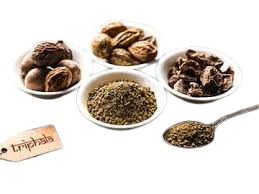
Triphala Kwath from Riddhish Herbals is a classical Ayurvedic Kwath (decoction) grade of Triphala — Haritaki (Terminalia chebula), Bibhitaki (Terminalia bellirica) and Amalaki (Emblica officinalis) in equal classical parts — supplied as a coarse powder in a 100 g pack. Triphala is recorded in the Haritakyadi Varga of Bhavaprakasha Nighantu, where it is described as Tridoshahara, Deepana, Anulomana, Rasayana and Chakshushya; the Kwatha method itself is set out in Sharangdhara Samhita, Madhyama Khanda 2. Unlike Triphala Churna, this grade is simmered in water and strained before use. This is classical textual and compositional information, not a medical claim; consult a qualified Ayurvedic physician before use.
Reviewed by Dr. Riddhish Padiya — B.Pharm (Ayurveda), M.Pharm (Pharmacognosy), Ph.D. (Dravyaguna), ITRA Jamnagar. Publications under “Padiya RH”.
About Triphala Kwath
Triphala is the best known of all Ayurvedic combinations, and Kwath is the oldest way of taking it. Three dried fruits — Haritaki, Bibhitaki and Amalaki — are broken to a coarse grade, simmered in water, and the strained liquid is drunk warm. The coarse cut is the whole point: a fine churna would turn the decoction to sludge, while a Yavakut grade lets water draw the water-soluble fraction out and leaves the marc behind in the strainer.
The three fruits are not interchangeable and the texts are specific about why they sit together. Haritaki is directed against Vata, Bibhitaki against Kapha and Amalaki against Pitta. Put in one vessel they cover all three Doshas, which is what earns Triphala the description Tridoshahara in the Haritakyadi Varga of Bhavaprakasha Nighantu. The same passage places it in the Rasayana context and calls it Chakshushya.
Because a Kwath is made fresh, it is a preparation that asks something of the user. It cannot be carried in a pocket like a tablet. What it offers in return is the classical form: the proportions, the vehicle and the strength are all in the hands of the person preparing it, which is exactly why the texts leave those decisions to the attending Vaidya.
Traditional Ayurvedic Importance
Haritaki (Terminalia chebula) is described in Bhavaprakasha Nighantu, Haritakyadi Varga, as Deepana and Anulomana — kindling to Agni and regulating to the downward movement of Vata. Classical practice regards it as the leading fruit of the three.
Bibhitaki (Terminalia bellirica) is recorded in the same Varga in the Kaphahara context and is classically associated with the throat and the respiratory passages. Its Kashaya (astringent) Rasa is the dominant character it brings to the combination.
Amalaki (Emblica officinalis) is the Pitta-pacifying member and is described as Rasayana in its own right. It is the only one of the three with Amla (sour) as its principal Rasa, which is why the finished decoction tastes sour-astringent rather than merely bitter.
Taken together, the classical record for the combination is Tridoshahara, Deepana, Anulomana, Rasayana and Chakshushya, as stated in Bhavaprakasha Nighantu, Haritakyadi Varga. These are classical Dravyaguna categories quoted from their source, not statements about any diagnosed condition.
Kwath, Churna and Ghanvati — which is which
Riddhish Herbals stocks Triphala in several classical Kalpanas and they are genuinely different preparations, so it is worth being clear about the distinction before choosing.
- Kwath (this product): coarse grade, simmered in water and strained. Prepared fresh, taken warm.
- Churna: fine powder, taken directly with a suitable Anupana. Convenient, and the whole drug including the insoluble fraction is consumed.
- Tablet / Ghanvati: a measured, portable form. Easiest to carry, least adjustable in quantity.
None of the three is a better version of the others. The Kwath is chosen when the classical decoction form is wanted; the churna and the tablet are chosen for convenience. Your physician will pick the Kalpana that suits the person in front of them.
Key Features
- A Kwath, not a churna: this is the coarse decoction grade of Triphala, meant to be simmered in water and strained. It is a different preparation from Triphala Churna, which is a fine powder swallowed directly — same three fruits, different Kalpana.
- The classical three fruits: Haritaki (Terminalia chebula), Bibhitaki (Terminalia bellirica) and Amalaki (Emblica officinalis) — the Triphala of the Haritakyadi Varga of Bhavaprakasha Nighantu.
- Tridoshahara by classical design: the texts place Haritaki against Vata, Bibhitaki against Kapha and Amalaki against Pitta, which is why the three together are described as balancing to all three Doshas rather than to one.
- Classically Rasayana and Chakshushya: Bhavaprakasha Nighantu records Triphala in the Rasayana (rejuvenative) context and describes it as Chakshushya. We give those terms as the classical texts give them, anchored to their source, rather than translating them into modern medical promises.
- Prepared the classical way: Kwatha Kalpana is set out in Sharangdhara Samhita, Madhyama Khanda 2 — the coarse drug is simmered in water and reduced, so the decoction is made fresh each time rather than stored.
- Composition stated honestly: the pack does not print per-ingredient quantities, so we state the classical equal-part proportion and flag it for pack-level confirmation instead of inventing figures.
- Genuine, doctor-guided sourcing: bill provided with every pack; a store trusted since 2015, with pan-India delivery.
Research on the Constituents
◆ A review in the Chinese Journal of Integrative Medicine surveyed the published ethnomedicinal and laboratory literature reported for Triphala — the three-fruit combination of Haritaki, Bibhitaki and Amalaki that makes up this Kwath — and collated what had been published on it up to that point — (Baliga MS et al., 2012 — Chinese Journal of Integrative Medicine). This is a survey of published research literature, not evidence that this particular product does anything for any diagnosed condition. Results observed in study conditions. Individual results may vary. Consult your Ayurvedic physician before use. PubMed PMID: 23239004
Results were observed under study conditions. Individual results may vary. This is shared for general educational interest and is not a medical claim. Consult your Ayurvedic physician before use.
Composition (label-verified)
| Ingredient | Botanical | Part | Quantity |
|---|---|---|---|
| Haritaki (Terminalia chebula) | Dried fruit rind (pericarp) | 1 | 33.33 g |
| Bibhitaki (Terminalia bellirica) | Dried fruit rind (pericarp) | 1 | 33.33 g |
| Amalaki (Emblica officinalis) | Dried fruit | 1 | 33.33 g |
Three classical parts in the equal 1:1:1 proportion recorded for Triphala in Bhavaprakasha Nighantu, Haritakyadi Varga. The 'Approx. per 100 g' column is derived arithmetically from that classical ratio, not transcribed from a printed pack — no physical label was verified this session, so quantities are flagged for pack-level confirmation and no standardisation percentage or extract ratio is asserted. Some classical authorities give Triphala in a 1:2:4 proportion instead of 1:1:1; where a pack does not print its ratio we state the equal-part convention and say so plainly rather than assume.
How to Use
As directed by your Ayurvedic physician. The classical Kwatha method in Sharangdhara Samhita, Madhyama Khanda 2, takes one part of the coarse drug to sixteen parts of water, simmered gently until reduced to about one quarter, then strained. In household terms that is roughly one to two teaspoons of the Kwath powder in two cups of water, reduced by simmering, strained and taken warm. Prepare it fresh each time; a decoction is not meant to be kept. The traditional Anupana is simply the warm strained decoction itself, taken on an empty stomach or as your physician directs. Children should be given this only on the direction of a qualified Ayurvedic physician.
Who Can Use It
Suitable for most adults when prepared in the classical way on professional advice. Because Triphala is Anulomana in classical character, the quantity that suits one person may be too much for another, and that judgement belongs with your physician. Not to be taken during pregnancy or lactation except under the direction of a qualified Ayurvedic physician. Anyone taking regular medication or managing a health condition should consult their physician before starting.
Safety Information
Triphala Kwath is a classical Ayurvedic preparation, not a substitute for professional medical care — please seek qualified medical attention directly for any health concern. Triphala is Anulomana in classical character, so an excessive quantity or prolonged unsupervised use may cause loose motions or abdominal discomfort in susceptible individuals. Discontinue and consult a physician if any discomfort occurs. Use under the guidance of a qualified Ayurvedic physician if you are pregnant, lactating, taking any medication, or managing any health condition. Any use of a decoction as an external eye wash must be done only on the direct instruction of a qualified physician, with appropriately prepared and filtered material. Keep out of reach of children. Results may vary from person to person.
Storage
Store in a cool, dry place away from direct sunlight, in a tightly closed airtight container. A coarse Kwath grade takes up moisture more readily than a fine churna and will clump if the pack is left open in humidity, so close it firmly and keep damp spoons out of it. Prepare the decoction fresh; do not store the strained liquid.
Frequently Asked Questions
What is Triphala Kwath?
It is the decoction grade of Triphala — Haritaki, Bibhitaki and Amalaki broken to a coarse cut so the material can be simmered in water and strained. Bhavaprakasha Nighantu records the three-fruit combination in its Haritakyadi Varga; Sharangdhara Samhita, Madhyama Khanda 2, sets out the Kwatha method itself.
How is Triphala Kwath different from Triphala Churna?
Grade and method. The Kwath is a coarse cut meant to be boiled in water and strained, so you drink the decoction and discard the marc. The Churna is a fine powder swallowed directly with a suitable Anupana, so the whole drug is consumed. Same three fruits, two different classical Kalpanas — your physician will choose between them.
What are the alternate names and spellings?
Also written Triphala Kwatha, Triphala Kadha, Trifala Kwath, Triphla Kwath and Trifla Kadha. The three fruits appear as Harde or Harad (Haritaki), Baheda or Bahera (Bibhitaki) and Amla or Amalaki. In Gujarati the combination is commonly written ત્રિફલા and in Hindi त्रिफला. Kwath itself is also called Kashayam in south Indian practice.
How do I prepare it?
Classically one part of the coarse drug to sixteen parts water, simmered until reduced to about a quarter, then strained. In practice that is roughly one to two teaspoons in two cups of water. Take it warm, freshly made, on an empty stomach or as your physician directs.
Can I take this without a doctor?
It is better not to. Triphala Kwath is a classical Ayurvedic preparation and both the quantity and the timing are matters a qualified Ayurvedic physician should decide for the individual. Self-medicating with a decoction is not advisable.
Can children take it?
Only on the direction of a qualified Ayurvedic physician. We do not print a paediatric quantity — that judgement belongs with the attending physician, not with a product page.
Is this AYUSH or GMP certified?
This pack is supplied under Riddhish Herbals' own label. Any AYUSH Standard Mark or GMP mark would appear on the physical pack, and we state such marks only where they are verified on the pack itself. We do not add Organic or ISO product claims unless they are documented on the label.
Has Triphala been studied scientifically?
Yes — a review in the Chinese Journal of Integrative Medicine (Baliga MS et al., 2012) surveyed the published ethnomedicinal and laboratory literature reported for Triphala and collated what had appeared up to that point. It is shared here as published research literature, not as a medical claim about this product, and results may vary from person to person.
What is the recommended Anupana?
For a Kwath the decoction is itself the vehicle — it is taken warm as strained. Classical practice sometimes adds honey once the liquid has cooled to lukewarm, or a little Ghrita, depending on the individual, so follow your physician's direction rather than a general rule.
How should I store it?
In a cool, dry place away from sunlight, in a tightly closed airtight container. A coarse grade picks up humidity faster than a fine powder, so keep the pack firmly closed and keep damp spoons out. Do not store the prepared decoction — make it fresh.
Is it available at Riddhish Herbals?
Yes — Triphala Kwath is in stock at riddhishherbals.com and at our Gujarat retail stores, with pan-India delivery and a proper bill, doctor-guided selection since 2015.
Related at Riddhish Herbals
Triphala Churna 100gm — the same three fruits as a fine powder · Triphala Tablets 100gm — the same combination in tablet form · Triphala Guggulu 100g — the classical Guggulu yoga built on Triphala · Haritaki Churna (Harde) — shared ingredient · Baheda Powder (Bibhitaki) — shared ingredient · Amla Powder (Amalaki Churna) — shared ingredient · Ayurvedic Raw Herbs & Materials
Share