Riddhish Herbals
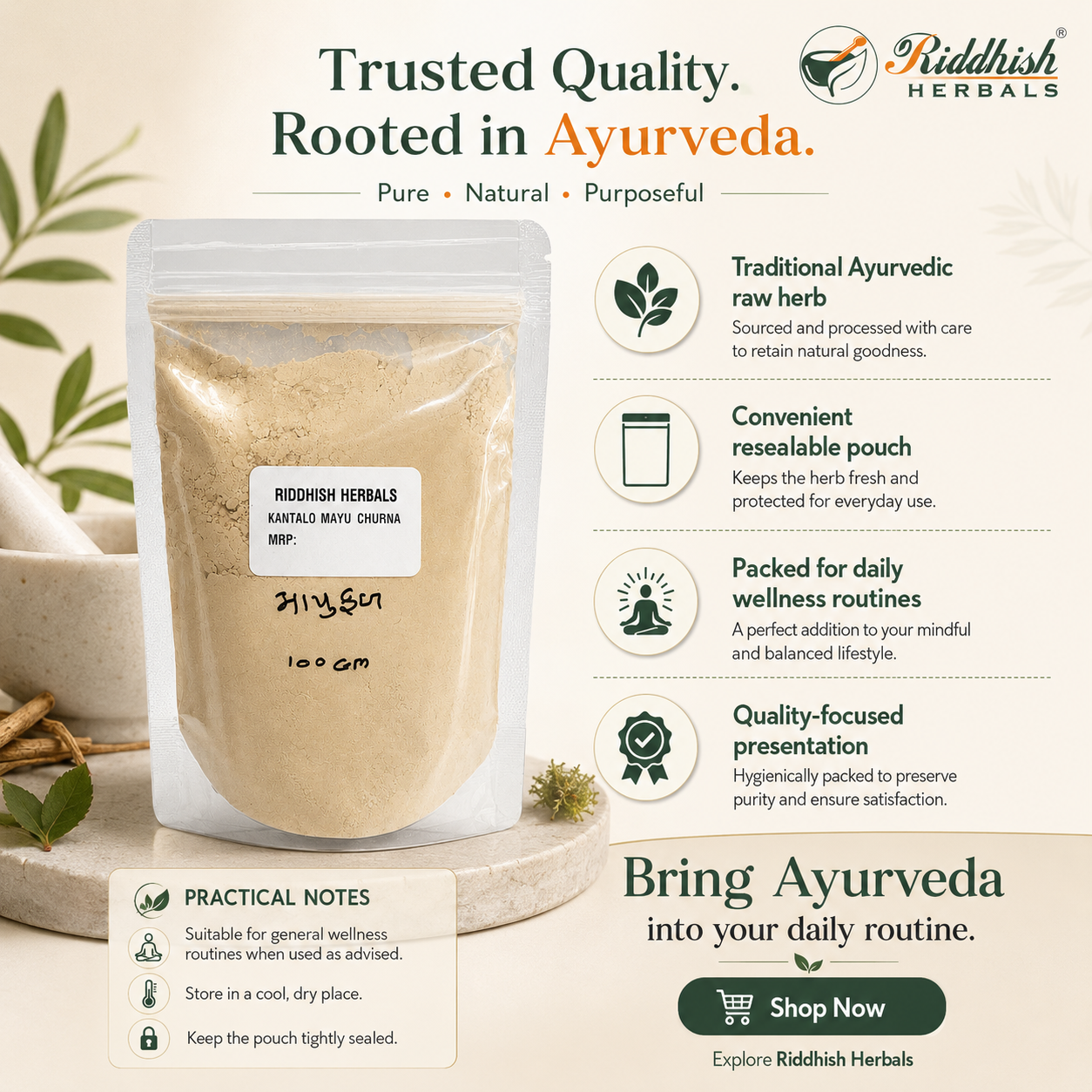
Katalu Mayu Churna (Majuphal / Mayaphala) – Oak Gall Powder – Riddhish Herbals – 100g
Couldn't load pickup availability
Katalu Mayu Churna from Riddhish Herbals is milled oak gall — the drug Ayurveda calls Mayaphala or Majjaphala, Hindi calls Majuphal and Unani calls Mazu — from Quercus infectoria Olivier, family Fagaceae, supplied in a 100 g pack. The part used is the gall: a hard, warty growth that a gall wasp induces on the tree's young twigs. It is not a root, a fruit or a seed, and an earlier version of this page described it as a root powder throughout, which was wrong. Katalu Mayu is a genuine Gujarati trade name for the same material, most likely from કાંટાળું માયુ — “thorny mayu” — after the gall's rough surface. The drug is exceptionally high in gallotannins and is classically valued for that astringency, which is also why traditional practice keeps it to short courses and why excess is noted to cause constipation and to interfere with the absorption of nutrients including iron. Use under the guidance of a qualified Ayurvedic physician.
Reviewed by Dr. Riddhish Padiya — B.Pharm (Ayurveda), M.Pharm (Pharmacognosy), Ph.D. (Dravyaguna), ITRA Jamnagar. Publications under “Padiya RH”.
About Katalu Mayu Churna
This is one of the more interesting materials in the range, and one of the most misunderstood. It is not a root, a bark or a seed. It is a gall — a hard, round, warty growth that forms on the young twigs of the oak Quercus infectoria when a gall wasp lays its egg in the tissue and the tree responds by walling it off. The wasp leaves; the growth stays; it is collected, dried and ground. That is the whole of what is in this pack.
Because the tree responds by concentrating tannins into that tissue, the gall is extraordinarily astringent — among the richest natural sources of gallotannins known, which is why the same material has been used historically for tanning leather and for making iron-gall ink as well as in medicine. Ayurveda calls it Mayaphala or Majjaphala; Hindi calls it Majuphal; Unani calls it Mazu; across South India it is Machikai. In Gujarat, and on this pack, it is Katalu Mayu.
The classical use follows directly from the chemistry. An intensely astringent drug is used where astringency is wanted, in small amounts and for a short time. It is not a nourishing or building substance and was never treated as one.
A correction: this page used to call it a root
We would rather show the correction than make it silently, because it went to the identity of the material.
The previous version of this listing described Katalu Mayu as a root or rhizome powder — in the bullet list, in the description, and in its own FAQ. Its ingredients line read “Katalu Mayu Root Powder — (Botanical name to be confirmed)”, while the product title and web address both said Quercus infectoria. So the page carried a botanical name it declined to stand behind, and described the wrong organ of the plant besides.
The title was right. Quercus infectoria is correct, and the drug is the gall. The page also carried a line beginning “Trending SEO keywords:” followed by a list of search phrases, visible to anyone reading it. That is gone too. So is a Regional Names table whose seven rows were the product name written out in seven different alphabets.
None of that was true, and some of it was embarrassing. It is worth a paragraph to say so.
Key Features
- It is a gall, not a root: the drug is the hard, warty growth a gall wasp induces on the twigs of Quercus infectoria. This page previously called it a root powder throughout, which was simply wrong, and we have said so rather than quietly editing it.
- One material, milled: oak gall, ground to a churna. Nothing blended in.
- Katalu Mayu is a real Gujarati trade name: most likely from કાંટાળું માયુ — kantalu, thorny or rough, for the gall's warty surface — and the same drug the rest of India calls Majuphal or Mayaphala, and Unani calls Mazu.
- Very high in tannins, and we say what that means: this is one of the most astringent materials in the whole range. That is the point of it, and it is also why it is a short-course substance rather than a daily one.
- Regional names are romanised only, deliberately: we could not verify a native script for any language against an authoritative source. The table this replaces was the product name transliterated into seven alphabets.
- No household dose, and we explain why: the figure previously printed here reached the upper ceiling the trade literature gives, if taken twice daily as the page suggested.
- Genuine, doctor-guided sourcing: bill provided with every pack; a store trusted since 2015, with pan-India delivery.
Research on the Constituents
◆ We are not attributing a finding to anyone on this page. There is published work on Quercus infectoria gall — it is a well-studied source of gallotannins — but what we could reach while preparing this page was consumer-health writing rather than peer-reviewed toxicology, and an NCBI attempt returned a bot-check instead of an article. So no study finding is asserted here and nothing is attributed to any authors. We point you to the literature directly instead: Google Scholar — Quercus infectoria gall. The safety notes on this page are given as traditionally recorded cautions, not as clinical findings. An unverified citation is worse than none. Individual results may vary. Consult your Ayurvedic physician before use.
Results were observed under study conditions. Individual results may vary. This is shared for general educational interest and is not a medical claim. Consult your Ayurvedic physician before use.
Composition (label-verified)
| Ingredient | Botanical | Part | Quantity |
|---|---|---|---|
| Katalu Mayu / Majuphal — milled gall | Quercus infectoria Olivier, family Fagaceae | Gall — the wasp-induced growth on young twigs. Not root, fruit or seed | Single material, 100 g net; milled, nothing added |
A single material: oak gall from Quercus infectoria, milled to a churna, 100 g net, with no carrier, filler or blend. The part is the gall — stated explicitly because this page previously said root. Geographic origin and harvest year are not stated on the pack and are not assumed here; the drug is largely imported into India from West Asia, which makes origin a fair question to ask. No tannin assay is held and no percentage is claimed. No extract ratio and no standardisation percentage are claimed, because this is a milled material and not an extract. Tagged for pack-level confirmation.
How to Use
As directed by your Ayurvedic physician, and with this material the instruction carries weight. Oak gall is used in very small quantities, for short courses, usually with a suitable anupan, and it is also used externally in traditional practice. We have deliberately printed no household quantity. The figure that stood on this page — half to one teaspoon, two to three grams, once or twice daily — reaches roughly six grams a day if taken twice, and six grams is the number the trade literature gives as an upper ceiling rather than a routine amount. Ask your physician for the quantity and, more importantly with an astringent this strong, for how long. Children should be given this only on the direction of a qualified Ayurvedic physician.
Who Can Use It
For adults, on professional direction, and as a short course rather than a daily habit. Not for use during pregnancy or lactation without medical advice. Anyone prone to constipation should be careful: a strong astringent is exactly the wrong thing in that situation, and constipation is the most commonly noted effect of taking too much. Anyone managing low iron or anaemia should raise this with their doctor before using it — tannins of this concentration are traditionally noted to interfere with the absorption of iron and other nutrients, particularly with prolonged use. Children only on physician direction. If you are managing any diagnosed condition, speak to your doctor first and continue the care they have advised.
Safety Information
Katalu Mayu Churna is a traditional Ayurvedic material and is not a substitute for professional medical care — please seek qualified medical attention directly for any health concern. This is an exceptionally astringent drug and is not a gentle daily powder. Traditional and trade sources consistently record the same cautions, and we give them as traditionally noted rather than as clinical findings, because the material we could verify was consumer-health writing rather than peer-reviewed toxicology: excess causes constipation; prolonged high-quantity use is noted to interfere with the absorption of nutrients including iron; and its drying action is unsuitable where dryness is already a problem. No household dose is printed on this page by design — the figure previously shown here reached the upper ceiling the literature gives, if taken twice daily as that page suggested. Take only the amount and duration your physician specifies. Not for use in pregnancy or lactation without medical advice. Children only on physician direction. Anyone managing anaemia or low iron should take advice first. Discontinue and consult a physician if constipation, dryness or any discomfort occurs. Keep out of reach of children. Results may vary from person to person.
Storage
Store in a cool, dry place away from direct sunlight, in a tightly closed airtight container. A tannin-rich powder darkens as it oxidises — that is the same chemistry that makes iron-gall ink — so keep it sealed and out of the light, and keep damp spoons out of the jar. Do not decant it into a metal container: tannins react with iron, which is precisely why the combination was used to make ink.
Frequently Asked Questions
What is Katalu Mayu Churna?
It is milled oak gall — the drug Ayurveda calls Mayaphala and Hindi calls Majuphal — from Quercus infectoria, in a 100 g pack. The gall is a hard warty growth that forms on the tree's young twigs after a gall wasp lays its egg there.
Is this a root powder?
No, and this page used to say it was, which was wrong. Quercus infectoria has no medicinal root in this tradition. The drug is the gall. We have left a note about the correction on the page rather than editing it out quietly.
What does “Katalu Mayu” mean?
It is a Gujarati trade name for the drug, most likely from કાંટાળું માયુ — kantalu meaning thorny or rough, describing the gall's warty surface, with mayu from Mayaphala. A Gujarati plant-identification source gives કાંટાળું માયુ as equivalent to માજુફળ, Majuphal, oak gall. It is the same material other regions call Majuphal, Machikai, Manjakani or Mazu.
Why are all the regional names romanised, with no native script?
Because we could not verify a native-script name for this drug in any language against an authoritative source — what we found came from trade listings and herb blogs. Our rule is that a romanisation we can stand behind beats a script we cannot. It matters more than usual here, because the table this replaced had seven scripts in it and every one was the product name transliterated rather than a real name.
Why does this page not give a dose?
Deliberately. The quantity previously printed here — two to three grams, once or twice daily — reaches about six grams a day if taken twice, and six grams is the figure the trade literature gives as an upper ceiling rather than an everyday amount. For a drug this astringent the duration matters as much as the quantity, and both belong with your physician.
What is it about tannins?
Oak gall is among the richest natural sources of gallotannins — so rich that the same material has historically been used for tanning leather and for making iron-gall ink. That astringency is the point of the drug, and it is also the source of its cautions: too much causes constipation, and prolonged heavy use is traditionally noted to interfere with the absorption of iron and other nutrients.
Can I take it during pregnancy?
Not without medical advice. Ask your physician, and mention that this is a strongly astringent material rather than a mild culinary powder.
I am anaemic. Can I use it?
Raise it with your doctor first. Tannins at this concentration are traditionally noted to reduce the absorption of iron, which makes this a fair question rather than an overcautious one.
Has it been studied scientifically?
There is published work on Quercus infectoria gall and its gallotannins. We have deliberately not attributed a finding to any authors on this page, because what we could reach while preparing it was consumer-health writing rather than peer-reviewed toxicology, and an NCBI attempt returned a bot-check rather than an article. We link to the literature search instead. Individual results may vary.
Can I take this without a doctor?
It is better not to. This is a short-course astringent with real cautions attached, not a daily tonic powder. Ask a qualified Ayurvedic physician. Doctor-guided selection is what our store is for.
How should I store it?
In a cool, dry place away from sunlight, in a tightly closed airtight container — and not in a metal container. Tannins react with iron, which is exactly how iron-gall ink is made, and it is not what you want happening in your jar.
Is this AYUSH or GMP certified?
This pack is supplied under Riddhish Herbals' own label. Any AYUSH Standard Mark or GMP mark would appear on the physical pack, and we state such marks only where they are verified on the pack itself. We do not add Organic or ISO product claims unless they are documented on the label.
Is it available at Riddhish Herbals?
Yes — Katalu Mayu Churna is in stock at riddhishherbals.com and at our Gujarat retail stores, with pan-India delivery and a proper bill, doctor-guided selection since 2015.
Regional Names & Spelling Variants
| Language | Name |
|---|---|
| Local / trade name (Gujarat) — Katalu Mayu · Kantalu Mayu | The name on this pack, and a genuine Gujarati trade term — most likely from કાંટાળું માયુ, thorny mayu, for the gall's rough warty surface. Also simply Majuphal. |
| Sanskrit (romanised only) | Mayaphala · Majjaphala · Mayuka · Chidraphala · Malayu · Kesaranjaka · Keetavasa |
| Hindi (romanised only) | Majuphal · Manjakani |
| Gujarati (romanised only) | Majuphal · Katalu Mayu · Kantalu Mayu |
| Marathi (romanised only) | Mayaphal |
| Tamil · Telugu · Kannada (romanised only) | Machikai · Machkai · Machi Kay |
| Malayalam (romanised only) | Manjakani · Majkani |
| Urdu / Unani (romanised only) | Mazu |
| English · Botanical · Part used | Aleppo gall, oak gall, nutgall · Quercus infectoria Olivier, family Fagaceae · The gall — a wasp-induced growth on the young twigs, not a root, fruit or seed |
| Why every row above says “romanised only” | Because we could not verify a single native-script name for this drug against an authoritative source. What we found came from trade listings and herb blogs, which are good enough to give you a romanisation but not good enough to print in Devanagari, Tamil or Gujarati script as though it were established. The table this replaces had seven scripts in it, and every one was the product name transliterated rather than a name of the drug. An empty script column is the honest answer here. |
| Romanised search variants | Katalu Mayu · Katala Mayu · Kantalu Mayu · Majuphal · Majufal · Mayaphal · Mayaphala · Manjakani · Machikai · Mazu · oak gall · Aleppo gall · nutgall |
| Common misspellings | Katlu Mayu · Katalumayu · Majuphall · Majoo phal · Manjakkani · Quercus infectoria written as infectoris |
Related at Riddhish Herbals
Methi Akhi 100gm — whole fenugreek seed, another single raw material · Vavding Akha 100gm — a classical single herb sold whole · Vidarikand Churna 100gm — a classical single-material tuber powder · Yavakshar Churna 100gm — a classical prepared kshara · Ayurvedic Raw Herbs & Materials
Share