

Riddhish Herbals
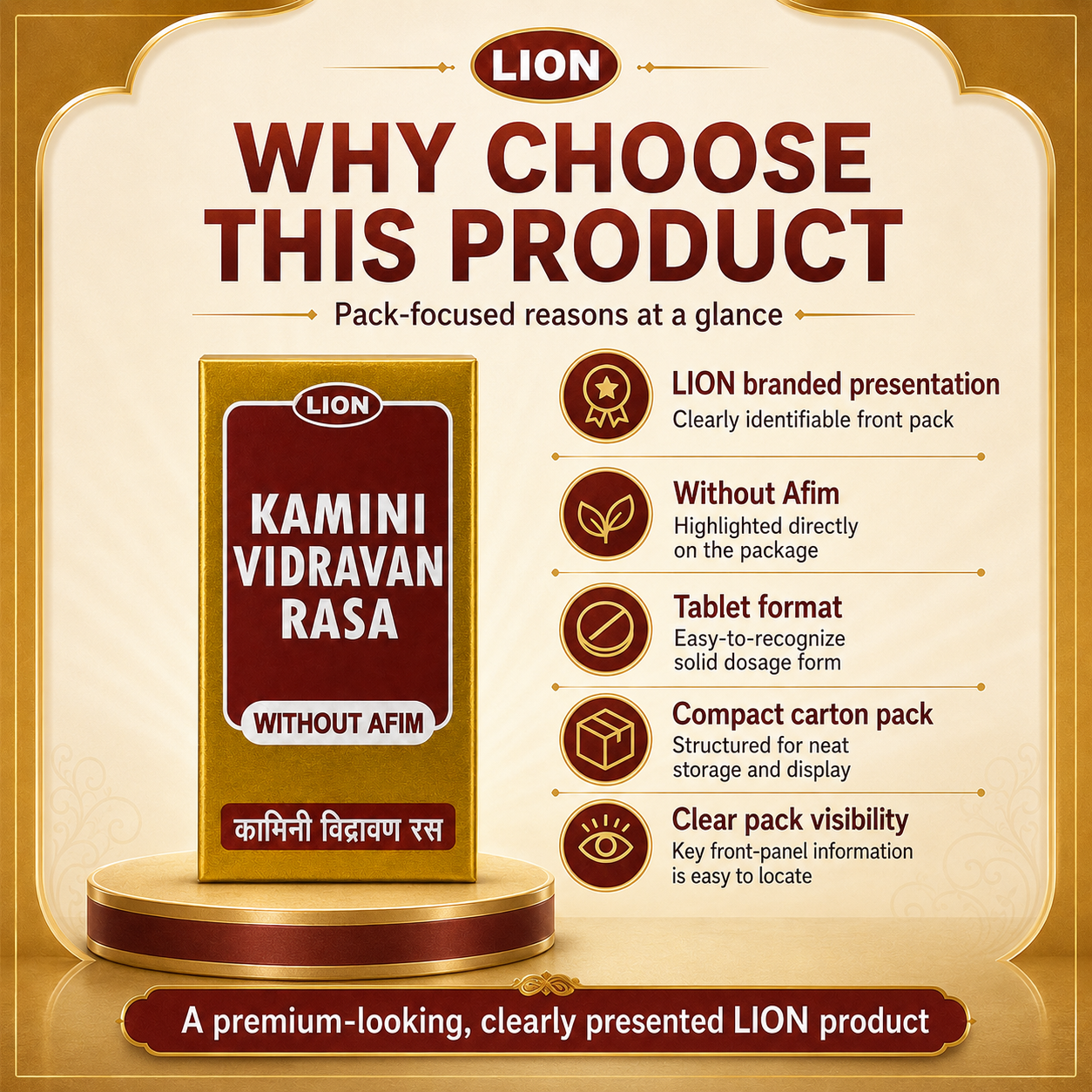
Kamini Vidravan Rasa (Without Afim) – Classical Rasaushadhi – Lion – 5g
Kamini Vidravan Rasa (Without Afim) – Classical Rasaushadhi – Lion – 5g
Couldn't load pickup availability
Kamini Vidravan Rasa by Lion (Shree Narnarayan Ayurvedic Pharmacy) is a classical Vajikara and Stambhaka Rasaushadhi recorded in the Bhaishajya Ratnavali (भे.र.), formulated here without Afim (opium) — as stated on both faces of the pack. Each pill contains eleven ingredients prepared to the Arya Bhishak (A.B.) standard: eight herbs at 5.88% each — Akalgaro (Anacyclus pyrethrum), Sunth (Zingiber officinale), Laving (Syzygium aromaticum), Kesar (Crocus sativus), Pipar (Piper longum), Jayphal, Javantri (both Myristica fragrans), and Safed Chandan (Santalum album) — with Shuddha Hingul and Shuddha Gandhak at 2.94% each, and Ajamo (Hyoscyamus niger seed) at 47.06% as the principal constituent. Net content: 5 g. Mfg. Lic. GA/1646. Manufactured in a GMP- and ISO 9001:2015-certified facility. To be used under strict medical supervision only.
Kamini Vidravan Rasa — The Classical Formula, Without Afim
Kamini Vidravan Rasa is recorded in the Bhaishajya Ratnavali — the textual authority printed as भे.र. on the Lion carton — within the classical Vajikara and Stambhaka preparation categories. The Rajnighantu and other classical compilations describe preparations of this class as Balya (strengthening) and Rasayana in character. This Lion formulation is prepared without Afim (opium/Ahiphena) — printed explicitly on both the Hindi face (अफीम रहित) and the English face (WITHOUT AFIM) of the pack. Classical KVR formulations can include Afim. This version does not, and the manufacturer states this openly. We state it here for the same reason the pack does.
The formulation carries eleven ingredients, all prepared to the Arya Bhishak (A.B.) standard. Eight are classical herbs in equal proportion (5.88% each). Shuddha Hingul and Shuddha Gandhak appear at 2.94% each. Ajamo (Hyoscyamus niger seed, A.B.) at 47.06% is the dominant constituent and the principal classical Stambhaka ingredient in this yoga. Manufactured by Shree Narnarayan Ayurvedic Pharmacy, Changodar, Ahmedabad (Mfg. Lic. No. GA/1646), in a GMP- and ISO 9001:2015-certified facility.
Shuddha Hingul — The Rasashastra Preparation
Shuddha Hingul is natural cinnabar (Parada-Gandhaka compound, α-HgS) taken through Shodhana — the classical Rasashastra purification procedure. Hingul is the classical Ayurvedic name for naturally occurring cinnabar. The Shuddha (purified) prefix records that Shodhana has been performed, removing the raw ore’s surface impurities and preparing it for pharmaceutical use. The result is a processed mineral — not the raw stone — prepared to the Arya Bhishak standard at 2.94% of each pill.
X-ray diffraction work by the Central Council for Research in Ayurvedic Sciences on Vasant Kusumakar Rasa — a different classical preparation, which we also stock — identified its mercurial phase as α-mercuric sulphide, cinnabar: a distinct nanocrystalline compound whose chemical identity differs from the raw material that preceded the Samskara (PMID 29269973, Ancient Science of Life, CCRAS, 2017). Cinnabar is the finding that bears on this formulation, through its own Shuddha Hingul. Shuddha Gandhak at 2.94% — purified sulfur, also Shodhana-processed — accompanies it, following the classical pairing of Parada and Gandhaka in Rasashastra preparations.
The Botanical Group
Eight herbs at equal proportion (5.88% each) complete the formula. Akalgaro (Anacyclus pyrethrum, root, A.B.) — Pellitory root, classically described as Katu and Vatahara. Sunth (Zingiber officinale, rhizome, A.B.) — dry ginger, one of Ayurveda’s foundational Deepana herbs. Laving (Syzygium aromaticum, flower bud, A.B.) — cloves, Katu and Ushna in classical pharmacology. Kesar (Crocus sativus, style and stigma, A.B.) — saffron, classically described as Hridya and Balya.
Pipar (Piper longum, fruit, A.B.) — Pippali, a classical Rasayana herb and potent Deepana agent. Jayphal (Myristica fragrans, fruit, A.B.) and Javantri (Myristica fragrans, fruit aril, A.B.) — nutmeg and mace, the seed and outer covering of the same plant, classically included together for their complementary Stambhaka qualities. Safed Chandan (Santalum album, wood, A.B.) — white sandalwood, traditionally described as Sheeta, Pittashamaka, and Hridya in classical texts.
Research on the Constituents
◆ A Central Council for Research in Ayurvedic Sciences study that ran X-ray diffraction on Vasant Kusumakar Rasa — a different classical preparation, which we also stock — identified its mercurial component as cinnabar, α-mercuric sulphide (HgS) arising from the Rasashastra Samskara, confirming that Shodhana and Marana produce a distinct compound from the raw mineral. Cinnabar is the finding that bears on this formulation, through its own Shuddha Hingul 2.94% — Ota S, Singh A, Srikanth N, Sreedhar B, Ruknuddin G, Dhiman KS (2017), Ancient Science of Life 36(4):207–214, CCRAS — PMID 29269973.
Results were observed under study conditions. Individual results may vary. This is shared for general educational interest and is not a medical claim. Consult your Ayurvedic physician before use.
Composition — each pill (label-verified, Arya Bhishak standard)
| Ingredient | Botanical / Plant Part | Reference | Proportion |
|---|---|---|---|
| Akalgaro (Rt.) | Anacyclus pyrethrum — Root | A.B. | 5.88% |
| Sunth (Rh.) | Zingiber officinale — Rhizome | A.B. | 5.88% |
| Laving (Fl.b.) | Syzygium aromaticum — Flower bud | A.B. | 5.88% |
| Kesar (Styl./Stigm.) | Crocus sativus — Style & Stigma | A.B. | 5.88% |
| Pipar (Ft.) | Piper longum — Fruit | A.B. | 5.88% |
| Jayphal (Ft.) | Myristica fragrans — Fruit | A.B. | 5.88% |
| Javantri (Ft.Pu.) | Myristica fragrans — Fruit Aril | A.B. | 5.88% |
| Safed Chandan (Wd.) | Santalum album — Wood | A.B. | 5.88% |
| Shuddha Hingul | Processed cinnabar (α-HgS) — Shodhana | A.B. | 2.94% |
| Shuddha Gandhak | Purified sulfur — Shodhana | A.B. | 2.94% |
| Ajamo (Sd.) | Hyoscyamus niger — Seed | A.B. | 47.06% |
Label-verified against the Lion (Shree Narnarayan Ayurvedic Pharmacy) pack. Proportions are w/w as printed on the label. No absolute mg-per-pill quantity is stated on this label; only the above percentages. Net content: 5 g. Reference key — A.B. = Arya Bhishak. Classical text reference: Bhaishajya Ratnavali (भे.र.), as printed on the carton. Formulated without Afim (opium/Ahiphena) — stated explicitly on both the Hindi and English faces of the pack. Manufacturer: Shree Narnarayan Ayurvedic Pharmacy, 1 Radhe Estate, Tajpur Road, Changodar, Ahmedabad-382 213 (Gujarat). Mfg. Lic. No. GA/1646.
How to Use
As directed by your Ayurvedic physician. The carton states: चिकित्सक के निर्देशानुसार लें — take as directed by the physician. No standard numeric dose is printed on the outer pack; dose, anupan and duration are to be set by a qualified Vaidya who has examined you and knows your Prakriti, your Agni, and your current state.
Who Can Use It
Adults, on the explicit prescription of a qualified Ayurvedic practitioner. Not for use during pregnancy or lactation. Not suitable for children — no paediatric dose should be inferred from this page. If you take any other medicine, or are under care for any condition, inform your physician before starting this preparation.
Safety Information
Bhasma and Bhasma-based Ayurvedic medicines are to be used under strict medical supervision only. That is the standard practice for this class of medicine, and the instruction the manufacturer prints on the pack: To be taken under medical supervision only / सावधान: चिकित्सक के देखरेख में लें। Your Vaidya matches the preparation, the dose and the duration to your individual Prakriti, Agni and condition — which no pack and no web page can do.
Use strictly under the guidance of a qualified Ayurvedic physician. Consult your physician before use, especially if you are pregnant, lactating, taking any medication, or managing any medical condition. Keep out of reach of children. Results may vary from person to person.
Storage
Store in a cool, dry place away from direct sunlight and moisture. Keep the container tightly closed after every use. Do not refrigerate. Keep out of reach of children.
Frequently Asked Questions
What is Kamini Vidravan Rasa?
Kamini Vidravan Rasa is a classical Vajikara and Stambhaka Rasaushadhi recorded in the Bhaishajya Ratnavali (भे.र.). This Lion formulation is prepared without Afim (opium) — stated explicitly on the pack. Each pill contains eleven ingredients, with Ajamo (Hyoscyamus niger seed, 47.06%) as the principal constituent, prepared to the Arya Bhishak standard. Net content 5 g. Manufactured by Shree Narnarayan Ayurvedic Pharmacy, Changodar, Ahmedabad. Mfg. Lic. GA/1646.
What does ‘Without Afim’ mean on the label?
Afim is the classical Sanskrit/Hindi term for opium (Ahiphena). Classical KVR formulations can include Afim for its Stambhaka (delaying) properties. This Lion formulation specifically excludes Afim — printed on the Hindi face (अफीम रहित) and the English face (WITHOUT AFIM) of the pack. The Stambhaka function in this version rests primarily on the Ajamo (Hyoscyamus niger seed) constituent.
What is the classical category of this preparation?
The Lion carton states वाजीकर एवं स्तम्भक — Vajikara and Stambhaka. These are classical Ayurvedic preparation categories recorded in the Bhaishajya Ratnavali. What that means for your particular situation is a clinical judgement that belongs to your qualified Ayurvedic physician, who has examined you.
What is Shuddha Hingul in this formulation?
Shuddha Hingul is natural cinnabar (α-mercuric sulphide, HgS) that has been through Shodhana — the classical Rasashastra purification procedure. Hingul is the classical name for naturally occurring cinnabar. The Shuddha prefix records that Shodhana has been completed. In this formula it appears at 2.94%, paired with Shuddha Gandhak (purified sulfur), both prepared to the Arya Bhishak standard.
What is Ajamo in this preparation?
On this label, Ajamo (Sd.) refers specifically to the seed of Hyoscyamus niger, prepared to the Arya Bhishak (A.B.) standard — not the common kitchen Ajwain (Trachyspermum ammi). The botanical name on the label is definitive. It is the dominant ingredient at 47.06% and is the principal Stambhaka constituent of this classical yoga. This is why the preparation requires strict medical supervision.
Is this GMP and ISO certified?
Yes. Shree Narnarayan Ayurvedic Pharmacy, the manufacturer, carries both GMP Certified and ISO 9001:2015 certification seals, verified on the physical carton. These are facility quality certifications, not product health claims.
What is the classical text reference for this medicine?
The Bhaishajya Ratnavali (भे.र.), printed on the carton. The Bhaishajya Ratnavali is one of the authoritative post-classical compilations of Ayurvedic formulations. The Lion carton’s abbreviation भे.र. is the standard short form of this text.
What is the dose and anupan?
The outer pack states: चिकित्सक के निर्देशानुसार लें — as directed by the physician. No numeric dose is printed on the outer carton. Dose, anupan (vehicle) and duration are set by your Vaidya based on your examination. Do not self-determine the dose.
Can I take this without seeing a doctor?
No. This is a physician-prescribed classical Rasaushadhi. The manufacturer’s caution printed on the pack — ‘To be taken under medical supervision only’ — states the category standard plainly. Consult a qualified Ayurvedic practitioner before use.
How should I store Kamini Vidravan Rasa?
In a cool, dry place away from direct sunlight and moisture, tightly closed after every use. Do not refrigerate. Keep out of reach of children.
Related at Riddhish Herbals
Ten On Powder – Classical Vajikara Rasayana Blend · Safed Musli (Dholi Musali) Powder · Gokshur Powder – Tribulus terrestris