

Riddhish Herbals
Ten On Powder | Shilajit Ashwagandha 12-Herb Blend | Riddhish Herbals | 100gm
Ten On Powder | Shilajit Ashwagandha 12-Herb Blend | Riddhish Herbals | 100gm
Couldn't load pickup availability
Ten On Powder is a proprietary twelve-herb Ayurvedic formulation by Riddhish Herbals, combining classical Rasayana (rejuvenative) and Vajikarana (vitality) botanicals in defined traditional ratios — led by Ashwagandha (18%) and Gokhru (15%), and built around the classical Yoga-Vahi, purified Shilajit. This is a precisely rationed formulation for guided use, not a generic equal-parts blend.
The formulation draws together botanicals from multiple classical traditions — the Himalayan orchid Salampanja, the Alpine root Akkalkaro, and Shilajit — each included at a specific percentage by weight. Because it contains a herbo-mineral Rasayana, it must be used under the guidance of a qualified Ayurvedic physician.
About Ten On Powder
Ten On Powder is a twelve-herb formulation developed by Riddhish Herbals, Khambhalia, Gujarat. The combination draws from classical Ayurvedic categories — primarily Rasayana (tissue nourishment) and Vajikarana (vitality support) — bringing together adaptogenic roots, nourishing tubers, warming aromatics and Shilajit. Classical Ayurveda specifies that Shilajit must undergo Shodhana (purification) before internal use; this is a critical quality standard for any Shilajit-containing formulation. Each ingredient is included at a specific percentage by weight, making this a precisely rationed proprietary formulation.
Traditional Ayurvedic Importance
The Bhaishajya Ratnavali describes Vajikarana and Rasayana preparations that combine adaptogenic roots with Shilajit and warming spices such as Javantri and Dalchini to support the absorption of heavier Rasayana ingredients. Akkalkaro (Akarkara), described in the Bhaishajya Ratnavali and Rasaratna Samuchchaya as a Deepana (digestive-fire support), is traditionally used to prime the digestive system for the absorption of nourishing herbs — a sophisticated classical formulation principle.
Salampanja (Salabmisri), a Himalayan orchid tuber found at 2,500–5,000 m altitude, is described in classical Unani–Ayurvedic literature as a glucomannan-rich, nourishing and restorative tuber. Shilajit is described in the Charaka Samhita (Chikitsa Sthana 1.1) as Yoga-Vahi — a substance that carries and amplifies the potency of every herb it accompanies. Kesar (saffron), included at 0.25%, functions classically as Deepana, Varnya and an anupan-enhancer. Javantri (the aril of Myristica fragrans, distinct from Jaiphal, the seed) is referenced in the Bhaishajya Ratnavali alongside Dalchini as a warming, Vata-pacifying aromatic.
Key Features
- Twelve-herb precision formulation: all twelve ingredients at specific classical ratios — Ashwagandha leads at 18%, Gokhru at 15%, Akkalkaro at 12%. Not a generic equal-parts blend.
- Shilajit — the classical Yoga-Vahi: Shilajit (Asphaltum panjabinum) is described in the Charaka Samhita as Yoga-Vahi, the potency carrier; classical Ayurveda requires Shodhana (purification) before internal use.
- Genuine Kesar at 0.25%: saffron stigma included as a premium classical anupan-enhancer and Deepana ingredient.
- Akkalkaro — classical Agni support: Anacyclus pyrethrum at 12%, traditionally used to prime digestive fire for absorption of Snigdha Rasayana herbs.
- Salampanja — Himalayan orchid tuber: Orchis latifolia, a nutritive, glucomannan-rich tuber traditionally described for Brimhana (tissue-nourishing) properties.
- Javantri & Dalchini — warming harmonisers: mace and cinnamon provide Ushna-veerya balance to the Snigdha herbs, a classical formulation principle.
- Doctor-guided selection: a formulation of this complexity deserves expert personalisation — Riddhish Herbals, serving customers since 2015.
Composition (label-verified — total 100%)
| Ingredient | Botanical (part) | % |
|---|---|---|
| Ashwagandha | Withania somnifera (root) | 18% |
| Gokhru | Tribulus terrestris (fruit) | 15% |
| Akkalkaro | Anacyclus pyrethrum (root) | 12% |
| Shatavari | Asparagus racemosus (root) | 10% |
| Vidarikand | Pueraria tuberosa (tuber) | 10% |
| Safed Musli | Asparagus adscendens (tuber) | 9.75% |
| Yashtimadhu | Glycyrrhiza glabra (root) | 8% |
| Salampanja | Orchis latifolia (tuber) | 5% |
| Shilajit (Shuddha) | Asphaltum panjabinum (exudate) | 5% |
| Javantri | Myristica fragrans (aril) | 4% |
| Dalchini | Cinnamomum zeylanicum (bark) | 3% |
| Kesar | Crocus sativus (stigma) | 0.25% |
Proprietary Ayurvedic formulation by Riddhish Herbals. Net weight 100 g. Label-verified composition. Consult your Ayurvedic physician for personalised dosage guidance.
Research & Scientific References
Several of the formulation's herbs have been studied individually. A peer-reviewed review of Ashwagandha (Withania somnifera) documented its withanolides and reviewed its traditionally recognised adaptogenic constituents. (Singh et al., 2011 — African Journal of Traditional, Complementary and Alternative Medicines; PMID 22754076) A review of Shilajit described fulvic acid as its key constituent within a traditionally recognised Rasayana context. (Carrasco-Gallardo et al., 2012 — International Journal of Alzheimer's Disease; PMID 22482077)
Findings are observed under research conditions and do not constitute medical claims. Individual results may vary. Use under the guidance of a qualified Ayurvedic physician.
How to Use & Anupan
As directed by your qualified Ayurvedic physician. Standard traditional guidance is 1 teaspoon (about 5 g) once or twice daily with lukewarm cow's milk as the classical anupan; those avoiding dairy may use lukewarm water. Avoid cold liquids and sour substances (citrus, tamarind) with Shilajit-containing formulations — a classical contraindication. Do not self-prescribe dose or duration.
Who Can Use It
Suited to adults seeking a traditional Rasayana–Vajikarana wellness blend, used under guidance. As it contains a herbo-mineral Rasayana (Shilajit) and a strongly heating herb (Akkalkaro), it is not recommended during pregnancy or lactation, or for children, without physician advice. Those of markedly Pitta constitution should use it cautiously.
Safety Information
Storage
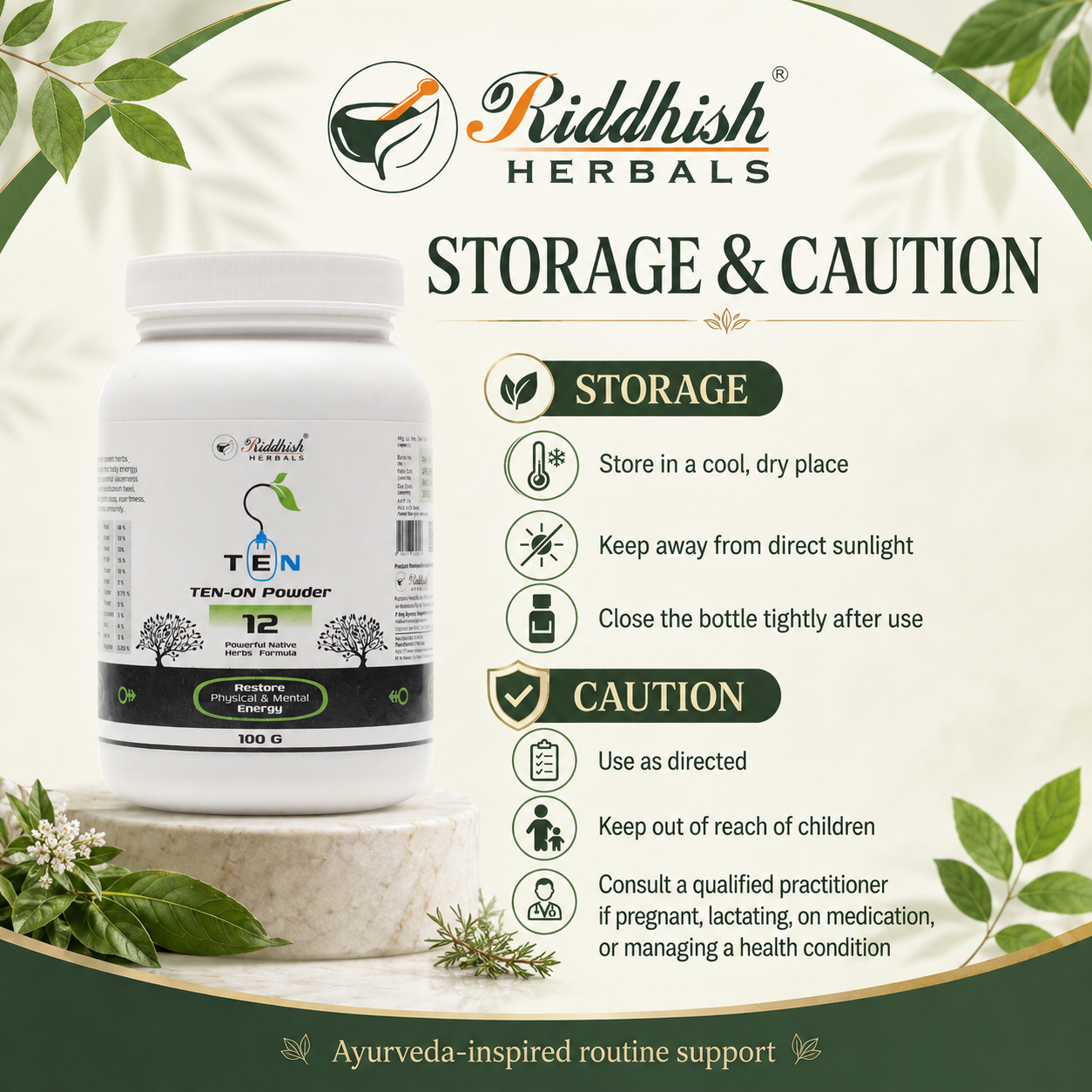
Store in a cool, dry place away from direct sunlight and moisture. Keep tightly closed after use. Do not refrigerate — Kesar and Shilajit are sensitive to heat, humidity and light. Use before the date printed on the packaging.
Frequently Asked Questions
Is Ten On Powder AYUSH or GMP certified?
Ten On Powder is a proprietary formulation by Riddhish Herbals. GMP or AYUSH certification, where applicable, is as declared on the product label.
Can I take Ten On Powder without a doctor's guidance?
We advise against it. It contains Shilajit, Akkalkaro and Salampanja — potent classical ingredients that call for personalised dosage based on your Prakriti and current health status. Riddhish Herbals offers doctor-guided selection to help determine whether it suits you.
What makes it different from a standard vitality powder?
Most vitality powders use four or five herbs in equal proportions. Ten On Powder is a twelve-herb formulation at specific classical ratios, including three ingredients rarely found in commercial blends — Shilajit (the Yoga-Vahi potency carrier), Salampanja (a Himalayan orchid tuber) and Akkalkaro — alongside genuine Kesar at 0.25%.
What is Shilajit, and why is Shodhana important?
Shilajit is a mineral-organic exudate from Himalayan rock, described in the Charaka Samhita as Yoga-Vahi. Classical Ayurveda specifies it must undergo Shodhana (purification) before internal use, as raw Shilajit contains impurities — a key quality marker to ask about for any Shilajit-containing product.
What are the alternate names for the herbs?
Ashwagandha (Asgandh); Gokhru (Gokshura, Tribulus); Akkalkaro (Akarkara, Pellitory root); Shatavari (Shatamuli); Vidarikand (Vidari, Indian Kudzu); Yashtimadhu (Mulethi, liquorice); Salampanja (Salabmisri, Salep); Javantri (mace, the aril of nutmeg, distinct from Jaiphal); Dalchini (Tvak, cinnamon); Kesar (saffron, Zafran).
Is this suitable for women as well as men?
Yes. Herbs such as Shatavari, Yashtimadhu and Vidarikand have documented traditional use for both men and women. It is a general Rasayana wellness blend — consult your physician to confirm suitability for your needs.
What is the recommended anupan?
The classical anupan is lukewarm cow's milk (Go-dugdha), as described for Vajikarana–Rasayana preparations; those avoiding dairy may use lukewarm water. Avoid cold and sour substances with Shilajit.
How long does one 100 g pack last?
At 1 teaspoon (about 5 g) once daily, roughly 20 days; at twice daily as prescribed, roughly 10 days.
Has the formulation's herbs been studied scientifically?
Individual herbs have peer-reviewed literature — for example Ashwagandha (Singh et al., 2011) and Shilajit (Carrasco-Gallardo et al., 2012). Findings are observed under study conditions and individual results may vary.
Is it available at Riddhish Herbals?
Yes — on this website with pan-India delivery and at our Khambhalia, Gujarat retail counter, with a bill provided.
Related Rasayana & Balya Herbs
- Safed Musli Powder — Asparagus adscendens root, a key ingredient in this blend
- Ashwagandha Churna — Withania somnifera root, classical Rasayana & Balya herb
- Shatavari Powder — Asparagus racemosus root
- Gokharu Akhu (whole fruit) · Gokshur Powder (churna) — Tribulus terrestris
- Rasayan Churna (Amrutadi) · Kaucha Churna (Kapikacchu)
- Browse all Wellness Products · Ayurvedic Medicines
About Riddhish Herbals
Since 2015 · Genuine Products · Bill Provided · Doctor-Guided Selection · 4000+ Ayurvedic Products · 130+ Trusted Brands · Pan-India Delivery