

Riddhish Herbals
Rose Petal Powder (Gulab Phool Churna) | Rosa centifolia 100% | Skin & Gulkand | Riddhish Herbals 100g
Rose Petal Powder (Gulab Phool Churna) | Rosa centifolia 100% | Skin & Gulkand | Riddhish Herbals 100g
Couldn't load pickup availability
Rose Petal Powder — pure Rosa centifolia, 100%. Finely milled dried rose petals (Gulab Phool / Gulab Patti), known in classical Ayurveda as Shatapatri. A single, fragrant, dual-purpose herb: a cooling face-pack and ubtan ingredient on the skin, and the base of gulkand, rose milk and rose drinks in the kitchen. Made for Riddhish Herbals in a GMP-, ISO 9001:2015- and HACCP-certified facility — nothing added, no colour, no fragrance.
About Rose Petal Powder (Gulab Phool Churna)
Rose Petal Powder is simply dried Rosa centifolia petals, ground fine. In Sanskrit the hundred-petalled rose is Shatapatri (also called Gulab or Taruni); on this pack it appears as Gulab Patti Powder. It is one of the most versatile single herbs in an Indian home — equally at ease in a face pack and in a glass of rose milk.
◆ Why is it light brown, not pink? Pure dried rose petal powder is naturally a soft brown — petals lose their pink colour as they dry. A bright-pink powder usually means added colour. Ours is 100% Rosa centifolia with no dye, no fragrance and no preservative, so the natural colour and the true rose aroma are exactly what you would expect from the flower itself.
Traditional Ayurvedic Importance
Rose holds a gentle, respected place in classical Ayurveda. In the Nighantu (materia medica) tradition, Shatapatri is described as Sheeta (cooling in potency) and Pitta-pacifying — valued for the season of heat. It is classically noted as Varnya (complexion-supporting) and Hridya — a term meaning cordial and pleasing to the heart and mind, reflecting the calming quality of its aroma rather than any medical action.
As traditionally described in Ayurvedic Lepa (topical) literature, rose petal powder is mixed into face and body pastes with a liquid Drava such as rose water or milk. In daily life it is best known through Gulkand — the classic rose-petal preserve enjoyed across India as a cooling, fragrant treat.
Key Features
- 100% Rosa centifolia: single-herb dried rose petal powder — no fillers, no colour, no fragrance, no preservative.
- Dual-use: a face-pack and ubtan ingredient for the skin, and an edible powder for gulkand, drinks and desserts.
- Naturally cooling (Sheeta): traditionally valued to pacify Pitta in the heat of summer.
- Varnya — complexion-supporting: classically used in Lepa preparations for a fresh, even-toned, radiant look.
- True rose aroma: a soft, natural fragrance that lifts any face pack or drink — straight from the petal.
- Honest colour: a natural light brown, the mark of genuine dried petals with nothing added.
- Made in a certified facility: produced for Riddhish Herbals in a GMP-, ISO 9001:2015- and HACCP-certified facility (Ayurvedic Lic. GA/1762).
Ways to Use It — On the Skin
- Rose & milk glow pack: mix 1 tsp powder with raw milk or curd into a smooth paste, apply 15 minutes, rinse with cool water.
- Rose, besan & multani ubtan: blend with our Multani Mitti and a little besan, loosen with Rose Water — a classical cooling face pack.
- Rose & chandan calm pack: combine with Chandan Powder and rose water for a soothing, fragrant Pitta-cooling Lepa.
- Soothing after sun & heat: a rose-water paste applied to heat-stressed skin feels cool and comforting.
- Hair pack add-in: stir into a hair mask with amla or hibiscus powder for fragrance and scalp freshness.
Ways to Use It — In the Kitchen
- Gulkand: the classic — layer rose petal powder with sugar or mix into a rose preserve.
- Rose milk & lassi: stir a pinch into chilled milk, lassi or thandai for a natural rose flavour.
- Rose tea & sherbet: add to herbal teas, sherbets and summer coolers.
- Desserts & mithai: dust over kheer, barfi, falooda or ice cream.
- Mukhwas: a fragrant addition to after-meal mouth fresheners.
Composition
- Rose Petal — Rosa centifolia — 100%
No added colour · fragrance · preservative · filler.
Quality & Certification
Made exclusively for Riddhish Herbals in a GMP-, ISO 9001:2015- and HACCP-certified facility, under Ayurvedic Manufacturing Licence GA/1762 — produced to our specification and sold under the Riddhish Herbals name, with a bill on every purchase.
Pack declaration (as required by law): Marketed by Riddhish Herbals, Opp. Axis Bank, Post Office Road, Jam-Khambhalia – 361305, Gujarat. Manufactured by our contract-manufacturing partner, Panchamrut Herbals, Masma, Olpad, Dist. Surat, Gujarat. Net wt. 100 g · Product of India.
Rose, in Research
The rose is among the most-studied aromatic plants in botanical literature. Published reviews document the antioxidant and aromatic character of rose, most extensively for Rosa damascena, the genus's most-researched species and a close relative of Rosa centifolia.
A comprehensive peer-reviewed review documented the rose's antioxidant and aromatic properties across traditional and modern use. — (Boskabady et al., 2011, Iranian Journal of Basic Medical Sciences, 14(4):295–307; PMC3586833)
A later review revisited the rose as a classical aromatic herb with broad cosmetic and culinary applications. — (Mahboubi, 2016, Journal of Traditional and Complementary Medicine, 6(1):10–16)
Shared for educational context. This is a herbal powder for cosmetic and culinary use — it is not intended to diagnose, treat or cure any condition. Results may vary from person to person.
How to Use & Anupan
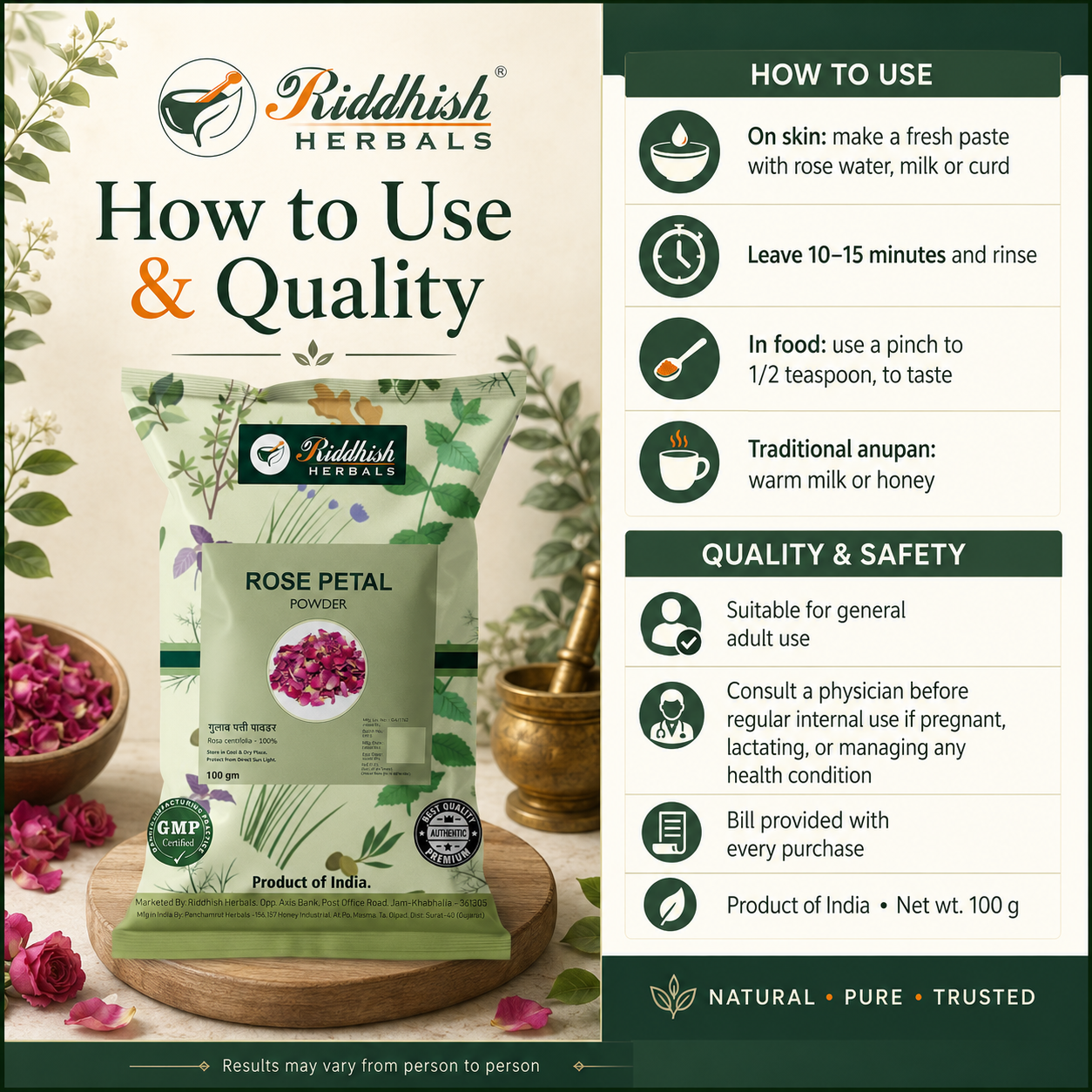
On the skin: make a fresh paste with rose water, milk or curd; apply, leave 10–15 minutes, rinse with cool water. Patch test first.
In food: a pinch to ½ teaspoon stirred into milk, gulkand, sherbet or desserts, to taste. For regular internal use as part of an Ayurvedic routine, take under the guidance of a qualified Ayurvedic physician. Traditional anupan: warm milk or honey.
Who Can Use It
Suitable for general adult use, as a face-pack ingredient and as a culinary rose flavouring. A patch test is recommended before first facial use. If you are pregnant, lactating, or managing any health condition, consult a physician before regular internal use.
Safety Information
For external face-pack use: generally well tolerated; perform a patch test on the inner wrist before first use and discontinue if any irritation appears. For culinary use: use clean, dry spoons and keep the pack sealed. Keep out of reach of children. Results may vary from person to person. Consult a qualified Ayurvedic physician before regular internal use if pregnant, lactating, taking any medication, or managing any medical condition.
This is a herbal powder for cosmetic and culinary use. It is not a drug, medicine or treatment for any medical condition.
Storage
Store in a cool, dry place, away from direct sunlight, in an airtight container. Keep moisture out to preserve the natural aroma and shelf life.
Regional Names & Spelling Variants
Rose — botanically Rosa centifolia, the hundred-petalled or cabbage rose — is called Shatapatri in classical Sanskrit and Gulab across most of India. Indian shoppers look for it under many scripts and spellings:
| Language | Script | Romanised |
|---|---|---|
| Sanskrit | शतपत्री · तरुणी | Shatapatri · Taruni |
| Hindi | गुलाब | Gulab |
| Gujarati | ગુલાબ | Gulab |
| Marathi | गुलाब | Gulab |
| Bengali | গোলাপ | Golap |
| Tamil | ரோஜா · பன்னீர் | Roja · Panneer |
| Telugu | గులాబీ | Gulabi |
| Kannada | ಗುಲಾಬಿ | Gulabi |
| Malayalam | റോസാപ്പൂവ് | Rosappoovu |
| Punjabi (Gurmukhi) | ਗੁਲਾਬ | Gulab |
| Odia | ଗୋଲାପ | Golapa |
| Urdu | گلاب | Gulab |
| English | — | Rose · Cabbage Rose · Hundred-Petal Rose |
| Botanical | — | Rosa centifolia (Rosaceae) |
Common spellings & search terms: Gulab Phool Churna · Gulab Patti Powder · Gulab Powder · Gulab Churna · Shatapatri Churna · Rosa centifolia powder · dried rose petal powder · rose powder for face · edible rose powder · gulkand powder.
Frequently Asked Questions
Is this rose petal powder pure? Is it GMP certified?
Yes — it is 100% Rosa centifolia rose petal powder with no colour, fragrance, preservative or filler. It is made exclusively for Riddhish Herbals in a GMP-, ISO 9001:2015- and HACCP-certified facility, under Ayurvedic Manufacturing Licence GA/1762. Riddhish Herbals has been a trusted Ayurvedic store in Gujarat since 2015 and provides a bill with every purchase.
Why is the powder brown and not pink?
Because it is genuine. Rose petals lose their pink colour as they dry, so pure dried rose petal powder is naturally light brown. A bright-pink powder usually contains added colour. Ours has nothing added.
Can I eat this rose petal powder?
Yes — it is pure edible rose petal powder. Use a pinch to half a teaspoon in gulkand, rose milk, lassi, sherbet, tea or desserts. For regular internal use as part of an Ayurvedic routine, take under the guidance of a qualified Ayurvedic physician.
How do I use it as a face pack?
Mix about a teaspoon with rose water, raw milk or curd into a smooth paste. Apply to clean skin, leave 10–15 minutes, and rinse with cool water. It blends beautifully with multani mitti, chandan or besan for a classical cooling ubtan.
What is the difference between Rosa centifolia and Rosa damascena?
Both are true roses used for rose petal powder. Rosa centifolia (the Hundred-Petal rose, classical Shatapatri) — the species in this pack — has a soft, powdery aroma. Rosa damascena (Damask rose) is the species behind most rose otto. Either makes a fragrant, cooling rose powder.
What are the alternate names for this product?
Also known as: Rose Petal Powder · Gulab Phool Churna · Gulab Patti Powder · Gulab Powder · Gulab Churna · Shatapatri Churna · Rosa centifolia Powder · Dried Rose Petal Powder.
Is it good for making gulkand?
Yes. Rose petal powder is a convenient base for homemade gulkand — layer or mix with sugar (and a touch of honey if you like) and let it rest. The result is the classic cooling rose preserve enjoyed across India in summer.
Is it available at the Riddhish Herbals store in Gujarat?
Yes. Riddhish Herbals has served customers from retail stores in Gujarat since 2015 alongside the online store. ✓ Since 2015 · ✓ Genuine Products · ✓ Bill Provided · ✓ Doctor-Guided Selection · ✓ Pan-India Delivery.
How should I store it?
In a cool, dry place away from sunlight, in an airtight container. Keeping moisture out preserves both the aroma and the shelf life.
Complete Your Ayurvedic Face-Care Routine
Rose Petal Powder is your cooling face-pack herb. Build the full Gujarat ubtan ritual — cleanse, pack, tone, soothe:
- Mud Face Wash — daily foam-free herbal clay cleanser
- Multani Mitti — oil-balancing clay face pack
- Chandan (Sandalwood) Powder — complexion-radiance pack
- Gulab Jal Rose Water — toner & pack-mixing liquid
- Aloe Vera Gel — soothe & moisturise after
Reviewed by Dr. Riddhish Padiya — B.Pharm (Ayurveda), M.Pharm (Pharmacognosy), Ph.D. (Dravyaguna), ITRA Jamnagar. Publications under “Padiya RH”.
Since 2015Genuine ProductsBill ProvidedDoctor-Guided Selection4000+ Ayurvedic Products130+ Trusted BrandsPan-India Delivery